The Adafruit Mini GPS PA1010D Module is a miniature GPS/GNSS breakout board, measuring only 1" x 1" (approximately 25mm x 25mm). Despite its small size, it integrates a complete GPS/GNSS solution with both I2C and UART interfaces, making it highly versatile for various projects. A key feature is the built-in antenna, which allows for plug-and-play functionality without the need for an external antenna, though this also means it requires a more unobstructed view of the sky compared to modules with external antennae.
Function Description:
This module is designed to provide precise location, time, and date information by receiving signals from multiple global navigation satellite systems (GNSS). It supports GPS, GLONASS, GALILEO, and QZSS, ensuring broad compatibility and accuracy. The module can perform up to 10 location updates per second, making it suitable for high-speed logging or tracking applications. It outputs NMEA sentences, which contain various data points such as time, date, latitude, longitude, altitude, estimated land speed, and fix type. The fix type indicates whether the GPS has locked onto satellite data and determined a 2D or 3D location.
Important Technical Specifications:
- Dimensions: 1" x 1" (~25mm x 25mm)
- GNSS Support: GPS, GLONASS, GALILEO, QZSS
- Sensitivity: -165 dBm
- Update Rate: Up to 10 Hz
- Channels: Up to 210 PRN channels with 99 search channels and 33 simultaneous tracking channels
- Voltage Compatibility: 5V friendly design for inputs on UART and I2C
- Current Draw: Only 30mA during navigation
- Interfaces: UART and I2C
- RTC Compatibility: Compatible with an RTC battery (CR1220 coin cell) for warm starts
- PPS Output: ±20ns jitter on fix
- Antenna: Internal patch antenna
- Power Modes: Low-power and standby modes with a WAKE pin
- Default UART Baud Rate: 9600 baud 8N1
- I2C Address: 0x10
The module is built around the MTK3333 chipset, known for its reliability and high-quality GPS performance. It includes an ultra-low dropout 3.3V regulator, allowing it to be powered with 3.3-5VDC. The 5V level-safe inputs on UART and I2C simplify integration with various microcontrollers.
Usage Features:
- Breadboard-able: Designed with 4 mounting holes and standard header pin spacing for easy integration into breadboard projects.
- STEMMA QT Connectors: Features SparkFun Qwiic compatible STEMMA QT JST SH connectors on both sides, enabling solder-free connection to microcontrollers or SBCs (Single Board Computers) using STEMMA QT adapter cables.
- Flexible Interface: Users can choose between I2C and UART interfaces based on their project requirements and microcontroller capabilities.
- Arduino Compatibility: Supported by the Adafruit GPS Library, which can be easily installed via the Arduino IDE's Library Manager. Examples like
GPS_I2C_EchoTest and GPS_SoftwareSerial_EchoTest are provided to verify basic functionality and raw NMEA data output. The GPS_I2C_Parsing and GPS_SoftwareSerial_Parsing examples offer a more user-friendly format for parsed GPS data.
- CircuitPython & Python Compatibility: The module is fully supported by Adafruit CircuitPython GPS library, allowing for Python code development on CircuitPython microcontrollers or Linux-based computers (like Raspberry Pi) using Adafruit_Blinka.
- Configurable Data Output: The module's behavior, including the type and rate of NMEA data sent, can be adjusted using custom PMTK commands. Default settings provide core location information at 1Hz.
- Status LEDs:
- ON LED (Green): Indicates that the board is powered.
- PPS LED (Red): Blinks at approximately 1Hz when a GPS fix is found and remains off when no fix is available.
- Reset Pin (RST): Can be pulled to ground to reset the chip, providing a clean setup.
- WAKE Pin: Used for controlling low-power and standby modes, with more details available in the datasheet.
- 3Vo Output: Provides a clean 3.3V output from the onboard regulator, capable of supplying at least 100mA, useful for powering other low-current components.
Maintenance Features:
- RTC Battery Footprint: Includes a footprint for an optional CR1220 coin cell battery. While the battery is not included, it can be soldered onto the back of the board to keep the Real-Time Clock (RTC) running, enabling warm starts and faster fix acquisition.
- Firmware Version Request: The module supports commands to request its firmware version, which can be useful for debugging or verifying software compatibility.
- Troubleshooting Fixes: If experiencing difficulty obtaining a GPS fix, it is recommended to move the module to a location with a clear, unobstructed view of the sky, with the antenna pointing upwards. The built-in antenna's sensitivity means it may require more ideal conditions compared to modules with external antennae. The module will continuously send data even without a fix, so it's important to check the
has_fix property in code to ensure valid data is being processed.
- Library Updates: Regular updates to the Adafruit GPS Library and CircuitPython libraries ensure ongoing compatibility and performance improvements. Users are advised to use the latest versions of CircuitPython and the necessary libraries.

 Need help?
 General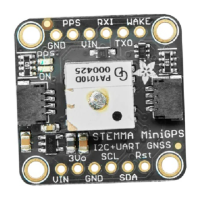

 To Next Page