Need help?
Do you have a question about the ADE CK 2309 and is the answer not in the manual?
Explains the purpose and importance of the operating manual for safe use and future reference.
Details the meaning of warning symbols (DANGER, WARNING, NOTE) and information symbols used in the manual.
Warns about choking hazards from packaging material and keeping it away from children.
Highlights risks associated with improper battery replacement, charging, or disposal.
Provides precautions against shocks, vibrations, and improper battery handling to prevent damage.
States the clock is for displaying time, other data, and has an alarm function for private, dry area use.
Lists model, battery type, power, temperature and humidity ranges, and physical dimensions.
Describes the 2-year warranty from GRENDS GmbH and the process for claims.
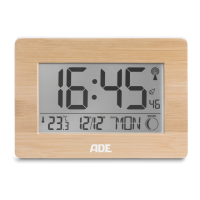
Identifies and describes the main physical components of the clock, such as the display elements, loops, and battery compartment.
Details the functions of each button on the clock for various operations and settings.
Instructions for initial setup, requiring two LR6 batteries.
Explains how the clock automatically receives the time signal, the reception indicator, and automatic synchronization.
Provides troubleshooting steps if the time signal transmitter data is not displayed correctly.
Step-by-step guide for manually adjusting the time and date if automatic reception fails.
Instructions on how to manually initiate the radio signal reception process for time synchronization.
Advice on selecting an optimal location for the radio-controlled clock to ensure good signal reception.
Information about the DCF77 transmitter, its location, and its role in broadcasting the official German time.
Detailed steps for setting the wake-up hour, minute, and the days the alarm should be active.
Instructions on how to activate or deactivate the set alarm functions.
Explains how the alarm signal works, including auto-stop and repeat alarm (snooze) functions.
Covers activating the display backlight and switching between 12/24 hour formats.
Instructions on how to select between Celsius and Fahrenheit for temperature display.
Explains automatic switching for daylight saving time and the DST indicator.
Procedure to restore the clock to its factory settings if issues arise.
Guidance on when and how to replace the batteries, including battery type and disposal.
Instructions on how to clean the clock safely, avoiding water and abrasive materials.
States compliance with EU directives and provides a web link for the full declaration.
Instructions for environmentally friendly disposal of the clock and batteries.


 To Next Page
 General