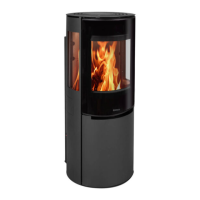
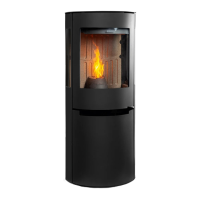
66
wooden pellets has a direct influence on the noise level, the efficiency, and the cleaning interval of the stove.
It is important that the pellets are kept dry, as moist pellets can reduce the nominal heat output by up to 50%.
When the firing season is coming to an end, it is important to completely remove all pellets from the pellet
container and the augers. If you don't do this, material damage can occur when you start using the stove
again.
At our website you can find more information. Go to
www.adurofire.com/aduro-hybrid.
4. The chimney
The optimum combustion is achieved at a constant chimney draft of 10-14 Pascal (Pa) measured in the flue
pipe above the stove (when having a smoke exhauster). However, with natural draft (chimney without smoke
exhauster) the draft in the chimney will be between 18-25 Pa when conditions are optimum. There are many
factors that affect the chimney draft, including the outside temperature, wind strength, and surrounding
buildings. There are no requirements with respect to specific chimney heights, but a chimney must be tall
enough to provide a good draft. If the recommended chimney draft is not achieved, there may be problems
with smoke out of the door by firing.
Data for chimney calculation
Flue temperature at [20°C]
Chimney draft at testing power [mbar]/[Pa]
4.1 Inadequate draft in the chimney
If you experience poor draft in the stove after the installation, please make sure that there is nothing in the
chimney to restrict the smoke and that no nearby buildings or trees affect the winds around the chimney.
If the chimney is too short, leaks, or is inadequately insulated, there may be problems with the chimney draft
(let the chimney sweep assess this). The draft should be sufficient during the ignition phase when the
stove/chimney is cold to provide a clean combustion and prevent smoke leakage. Therefore, we recommend
a chimney draft around 5 Pa in the ignition phase.
Once the ignition is a success and the smoke temperature is rising, it is important that the chimney draft
reaches a stable area around 18-25 Pa in operation (1 hour after ignition) when the chimney/stove is hot.
The draft in the area of 18-25 Pa when the stove is hot is essential in order to achieve an optimum and clean
combustion and avoid problems such as pellet accumulation and smoke leakage. Therefore, we recommend
that you measure your chimney draft when the chimney is cold and when it is hot after 1 hour in operation.
In practice, the chimney draft will differ – especially in cold condition. Therefore, the best indication of the
chimney draft is to measure the draft when it is hot. If the chimney sweep judges the draft to be sufficient, but
you still have problems lighting a fire in “wood mode”, try extending the fire lighting phase by using more thin
pieces of kindling and 1-2 firelighters, so that the chimney gets thoroughly warm. The chimney will not draw
at optimum effect until it is warm. When a layer of embers has been formed, add 2-3 dry logs.


 To Next Page