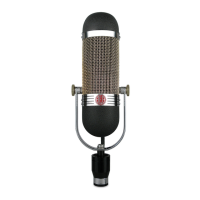
The AEA R84 Series microphone is a classic ribbon microphone inspired by the R44, designed to offer exceptional headroom, an intimate performance quality with smooth highs and extended lows, and a milder proximity effect. It is 100% handcrafted in Pasadena, CA, by AEA, a family-owned company.
Function Description:
The R84 and R84A are pill-shaped, side-address ribbon microphones with a bidirectional pickup pattern. They are assembled with the same Big Ribbon™ tuning (16.5 Hz) as the AEA/RCA R44, sharing many of its unique sound characteristics. These microphones are designed for distant and medium miking duties, exhibiting a flat frequency response when placed 3 feet (1 meter) away from the source. This makes them well-suited for a variety of recording applications, including vocals, brass, strings, woodwinds, guitars, and drums. The R84 series microphones are known for their natural sound, articulate midrange, and forgiving nature, delivering intimate, warm, and detailed performance without harshness.
As a figure-of-8 microphone, the R84 series is constructed with positive polarity on the front and negative polarity on the back. Positive pressure on the front side of the ribbon produces a positive voltage on Pin-2 with respect to Pin-3 on the output connector. The sound of the R84 series microphone is subtly different between the front and the back, offering two "flavors." This difference is due to using two wraps of grille cloth on the back and only one on the front. When using the rear lobe, it is recommended to invert the polarity on the preamp or DAW to ensure recordings are in-phase with other microphones.
The bidirectional pattern of the R84 creates deep nulls at right angles to the principal axis, forming a “plane of rejection” around the sides, top, and bottom of the mic. This feature is beneficial for minimizing leakage from nearby instruments in studio recording by arranging musicians so that instruments are placed in the null of their neighbor's microphone. This can significantly reduce the need for gobos. The R84 captures a natural off-axis sound, meaning bleed from other instruments can contribute positively to the overall sound.
Important Technical Specifications:
- Operating Principle: Pressure gradient transducer
- Directional Pattern: Bidirectional
- Frequency Range: <20 Hz to >20 kHz
- Polarity: Pin 2 high for positive pressure on front of mic
- Off-Axis Response (Horizontal): Up to 90 dB rejection at right angles to the front and back axis.
- Off-Axis Response (Vertical): Level changes with angle of incidence, but frequency response is consistent.
- Transducer Element Material: Pure aluminum corrugated ribbon
- Transducer Element Thickness: 1.8 µm
- Transducer Element Width: 0.185 in (4.7 mm)
- Transducer Element Length: 2.35 in (59.7 mm)
- Microphone Dimensions (Height): 11.6 in (29.5 cm)
- Microphone Dimensions (Width): 3.9 in (9.9 cm)
- Microphone Dimensions (Depth): 2.5 in (6.4 cm)
- Weight with cable: 3 lb (1.36 kg)
- Shipping Weight: 4 lb (1.8 kg)
- Connector: XLR-3M wired to a 10' (3 m) captive cable
R84 Passive Microphone Specifics:
- Maximum SPL: 165+ dB SPL (1% third harmonic > 1 kHz)
- Sensitivity: 2.5 mV/Pa (-52 dBV) into loaded circuit
- Output Impedance: 270 Ω nominal
- Rec Load Impedance: 1.2K Ω or greater
- Phantom Power: Not required or recommended
R84A Phantom-Powered Microphone Specifics:
- Maximum SPL: Sensitivity: 141+ dB SPL (1% third harmonic > 1 kHz)
- Output Impedance: 6.3 mV/Pa (-44 dBV) into loaded circuit
- Recommended Load Impedance: 92 Ω nominal
- Phantom Power: P48 phantom power, 7 mA (IEC specifies P48 power should deliver 10 milliamps per input; some USB and battery-powered audio interfaces may not deliver this).
Usage Features:
- Phantom Power (R84 Passive): Not required or recommended. While generally safe with correctly wired cables and proper phantom power supplies, passive ribbons can be damaged if ground (Pin 1) is accidentally shorted, miswired, or hot patched in a patch bay to Pin 2 or Pin 3. Using phantom power with faulty or miswired cables or defective supplies can severely stretch or break a ribbon. It is recommended to disengage phantom power before plugging and unplugging the microphone.
- Phantom Power (R84A Active): Requires a standard 48V phantom-power source. Ensure phantom power is disengaged before plugging and unplugging to avoid loud 'pops' that can damage speakers, headphones, and ears.
- Proximity Effect: A characteristic of all directional microphones, resulting in a rise in low-frequency response at closer working distances. This can be used to enhance richness and depth, particularly with deeper vocals. However, excessive bass boost can reduce articulation by masking treble.
- Stray Magnetic Fields: Ribbon microphones are prone to picking up strong external magnetic fields from light dimmers or power transformers. If hum is encountered, rotate or move the microphone to find a spot where the hum disappears, and try to eliminate potential sources of stray magnetic fields. The microphone can be used to locate the source of hum.
- Microphone Positioning: Always use a sturdy microphone stand, preferably a high-quality boom stand with a heavy base or tripod, ensuring it is properly balanced to prevent tipping.
Maintenance Features:
- Storage: Keep the microphone covered when not in use to prevent damage from gusts of air. Use the supplied protective bag for short-term storage and the protective case for long-term storage. An unprotected ribbon microphone can attract minute iron particles ("tramp iron") which can penetrate the screen, build up in the magnetic gap, rub against the ribbon, causing distortion, electrical shorts, or tearing.
- Air Turbulence: Avoid exposing the microphone to strong air turbulence. While ribbon microphones can withstand high SPL, they can be damaged by strong gusts of air or high levels of very low-frequency sound waves (e.g., from a kick drum or bass cabinet), which can stretch the ribbon and reduce output, especially at high frequencies.
- "The Hand Test": When recording sources that move air, place the back of your hand where the mic will be positioned. If moving air is felt, use a pop-filter or move the mic farther back. When recording kick drums or bass guitar cabinets, angle the microphone to prevent air blasts directly on-axis.
- Testing: Never blow directly into any microphone to test it. This can force moisture and dirt into the microphone and strong air movement can stretch the ribbon, degrading performance. Although the R84's ribbon is protected by multilayer screens and acoustic cloths, avoid high-wind outdoor environments.
- Magnetic Field Precaution: The high-performance magnets in AEA microphones are very strong. Avoid placing the microphone in close proximity to hard drives, credit cards, analog tape, or other magnetically sensitive items to prevent data loss.
- Warranty: Your R84 comes with a one-year limited warranty on parts and labor (shipping not included). Registering your product with AEA extends the warranty to a full three years.
- Support: For problems or questions, contact AEA customer support at orders@ribbonmics.com or by phone at +1-800-798-9127 (9:00 a.m. - 5:00 p.m. PST Monday-Friday). AEA's repair center is located at 1029 N. Allen Ave, Pasadena, CA 91104, U.S.A.
- Online Resources: Users are encouraged to visit AEAribbonmics.com for in-depth articles, tutorials, and audio/video demonstrations of the R84 series.

 Need help?
 General

 To Next Page