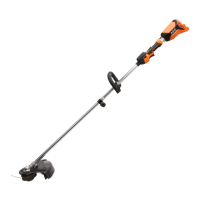
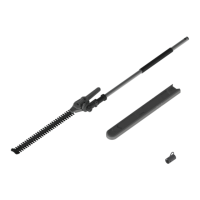
BATTERY AND CHARGER
Model ALT18BS6 A18LTR14 ALT18B
Battery pack L1860R A18FB4 –
Charger BL1218 BL1218 –
Compatible
battery packs
A18FB2, A18B4, A18FB4, A18FB5, L1815R, L1820R,
L1825R, L1830R, L1840R, L1850R, L1860R, L1850R-X5,
L1860B, L1890R, L1860R-X5
SPARE PARTS
Model ALT18BS6/ALT18B/ A18LTR14
Trimmer head 312699001
INTENDED USE
The cordless line trimmer is intended to be used only by adults who have
read and understood the instructions and warnings in this manual and can be
considered responsible for their actions.
The product is intended only for outdoor use in a well-ventilated area. For
safety reasons, the product must be adequately controlled by a two-handed
operation.
When fitted with the line trimmer head (and appropriate guard), the product
is intended for cutting long grass, pulpy weeds, and similar vegetation at or
about ground level.
The cutting plane should be approximately parallel to the ground surface. The
product should not be used to cut or trim hedges, bushes, or other vegetation
where the cutting plane is not parallel to the ground surface.
Do not use the product for any other purpose.
TECHNICAL DATA CORDLESS LINE TRIMMER
ALT18B/ALT18BS6/A18LTR14
Rated voltage 18 V d.c.
High speed 6200/min
Low speed
5200/min
Cutting line diameter
2.4 mm
Cutting swath 280/330 mm
Weight without battery pack and charger 3.7 kg
Vibration level (in accordance with AS/NZS 60335.2.91Annex BB)
Rear handle
4.4 m/s
2
Front handle 6.6 m/s
2
Uncertainty of measurement 1.5 m/s
2
Noise emission level (in accordance with AS/NZS 60335.2.91 Annex CC)
A-weighted sound pressure level at operator’s position
85.9 dB(A)
Uncertainty of measurement 2.5 dB
A-weighted sound power level 97.0 dB(A)
Uncertainty of measurement 2.5 dB
Guaranteed sound power level 100 dB(A)
Required torque to secure the trimming head 50-80 kgf-cm
WARNING!
The vibration emission level given in this information sheet has been measured in accordance with a standardised test method and may be used to compare one
tool with another. It may be used for a preliminary assessment of exposure.
The declared vibration emission level represents the main applications of the tool. However if the tool is used for dierent applications, with dierent accessories
or poorly maintained, the vibration emission may dier. This may significantly increase the exposure level over the total working period.
An estimation of the level of exposure to vibration should also take into account the times when the tool is switched o or when it is running but not actually doing
the job. This may significantly reduce the exposure level over the total working period.
Identify additional safety measures to protect the operator from the eects of vibration such as: maintain the tool and the accessories, keep the hands warm,
organisation of work patterns.


 To Next Page
 Loading...