
 Need help?
Do you have a question about the AEG ARCTIS 75210 GA and is the answer not in the manual?
Appliance is for domestic use, freezing, storing food, making ice.
Check for transport damage before plugging in.
Contains flammable R600a, avoid ignition, ventilate room if circuit is damaged.
Keep packaging away from children; make old appliances unusable before disposal.
Check power, fuse, socket if pilot light is off.
Interpret green and yellow lights for status and fast freeze.
Adjust temperature, check door seal, heat sources, and recent food additions.
Remove adhesive tape and packing pieces before use.
Place in a well-ventilated, dry room away from heat sources.
Maintain minimum clearances around the appliance for ventilation.
Ensure supply voltage matches rating plate; use a correctly installed, earthed socket.
Maintain -18°C, observe freezing capacity, cool food before freezing.
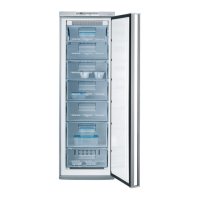
This document serves as a comprehensive operating instruction manual for the ARCTIS 75210 GA freezer, providing essential information for its safe use, installation, and maintenance. It is designed to guide users through various aspects of the appliance, from initial setup to troubleshooting and disposal.
The ARCTIS 75210 GA is a household appliance primarily intended for freezing and storing frozen food, as well as for making ice. Its design adheres to accepted technical standards and appliance safety regulations, ensuring a safe and reliable user experience. The appliance utilizes isobutane (R600a) as a refrigerant, a natural gas known for its high environmental compatibility. Users are advised to handle the appliance carefully during transportation and installation to prevent damage to the refrigerant circuit. In the event of damage to the circuit, it is crucial to avoid open flames, ignition sources, and to thoroughly ventilate the room.
Before the initial start-up, users are instructed to check the appliance for any transport damage. A damaged appliance should never be plugged in, and any issues should be reported to the vendor. The interior and all accessories must be cleaned thoroughly before the first use.
The freezer should be installed in a well-ventilated, dry room, away from direct sunlight, radiators, cookers, or other heat sources. Proper air circulation at the appliance base and back wall is essential, and air vent openings should never be covered. The appliance's climate classification, found on the serial plate inside, indicates the suitable ambient temperature range for optimal operation. Minimum clearances must be maintained if installed near heat sources or other refrigeration appliances to prevent condensation. The door's opening side can be reversed if required by the installation site, a process detailed with step-by-step instructions. Electrical connection requires a correctly installed, earthed socket with a fuse rating of at least 10 Amps, and the supply voltage and current values must match those on the appliance rating plate.
The appliance features an intuitive operating and indicator panel. Key components include:
To start the appliance, plug it into the mains socket and press the ON/OFF button. The green mains pilot indicator will illuminate, and the alarm light will flash with a buzzer sound. Pressing the ALARM OFF button will stop the buzzer. The temperature can be set by pressing the temperature setting buttons. The display will switch between actual and desired temperatures, with the desired temperature flashing during adjustment. The FROSTMATIC function can be activated to accelerate the freezing of fresh food and protect already stored items. This function can be manually ended or will automatically switch off after 52 hours. In case of an abnormal temperature rise, a warning light will flash, and a buzzer will sound. The alarm can be reset by pressing the ALARM OFF button.
Before freezing fresh food, the freezer compartment temperature should be -18 °C or colder. Users should observe the freezing capacity specified on the rating plate, which indicates the maximum quantity of fresh food that can be frozen within 24 hours. For continuous freezing over several days, it's recommended to freeze only 2/3 to 3/4 of the rating plate capacity. Warm food should be allowed to cool down before freezing to prevent increased ice formation and power consumption. Thawed foods should not be refrozen unless processed into meals. Flammable gases, liquids, and high carbonate content drinks should not be stored in the freezer due to explosion risks. All foods must be packed airtight to prevent drying out, flavor loss, and contamination. Frozen food should be placed in the drawers, ensuring that unfrozen food does not touch already frozen items to prevent defrosting.
Ice cubes can be made by filling the ice cube tray 3/4 full with cold water and placing it in the freezer compartment. To loosen frozen cubes, the tray can be bent or held under running water. The manual warns against using pointed or sharp objects to free ice trays. The appliance includes two ice packs, which should be placed in the uppermost drawer, at the front, above frozen food, to extend the time frozen food remains cold during power failures or malfunctions. These ice packs can also be used for cooling cold bags.
The inner walls of the freezer are automatically defrosted, simplifying maintenance for the user.
Regular cleaning of the appliance interior and accessories is crucial for hygiene. Before cleaning, the appliance must be switched off and unplugged, or the circuit breaker/fuse should be turned off. Steam cleaners are not to be used, as moisture can damage electrical components and hot vapors can harm plastic parts. The appliance must be dry before being put back into service. Ethereal oils, organic solvents, butyric acid, and cleansers containing acetic acid should not come into contact with plastic parts. Abrasive cleansers are also prohibited. Frozen food should be removed and stored in a cool place, wrapped in newspaper. The appliance and accessories should be cleaned with a cloth and lukewarm water, using commercially available dishwashing detergents if desired, then wiped dry with fresh water. The condenser at the back of the appliance should be cleaned annually with a soft brush or vacuum cleaner to prevent dust accumulation, which can increase energy consumption. Users are warned not to pull, move, or damage any pipes or cables inside the cabinet.
For extended periods of non-use, all deep-frozen packages and ice trays should be removed. The appliance is switched off by holding down the ON/OFF button until the temperature display goes off. The mains plug should then be removed, or the circuit breaker/fuse turned off. After thorough cleaning, the door should be left open to prevent odor buildup.
To optimize energy consumption, users are advised to:
The manual provides a section for correcting common malfunctions. Users are encouraged to consult this section first if a problem arises. If the provided information is insufficient, users should not attempt further repairs themselves. Repairs should only be performed by qualified service engineers to avoid significant hazards. The customer service department should be contacted for assistance if repairs are needed.
For environmental reasons, refrigeration appliances must be disposed of properly. Old appliances should be rendered inoperable before disposal by removing the plug, severing the power cable, and breaking/removing any snap or latch closures to prevent children from becoming trapped. The appliance should not be disposed of with domestic waste but handed over to an applicable collection point for the recycling of electrical and electronic equipment. The refrigerant circuit, especially the heat exchanger, should not be damaged during disposal. The packaging materials are environmentally sound and can be recycled or burned. Plastics are identified for recycling, and carton parts are made from recycled paper.
 General
| Category | Freezer |
|---|---|
| Energy Efficiency Class | A+ |
| Noise Level | 42 dB |
| Defrost System | Manual |
| Climate Class | SN-T |



 To Next Page
