Need help?
Do you have a question about the AEG ATB68E7NU and is the answer not in the manual?
This document is a user manual for the AEG ATB68E7NU and ATB68E7NW freezer models. It provides comprehensive information on safety, installation, operation, daily use, hints and tips, care and cleaning, troubleshooting, technical data, and environmental concerns.
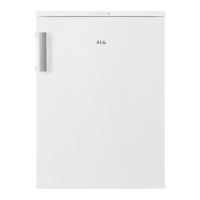
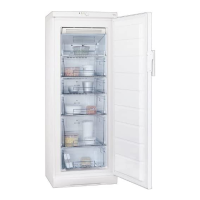
The AEG ATB68E7NU and ATB68E7NW are freestanding freezer appliances designed for household and similar applications. Their primary function is to freeze fresh food and store frozen and deep-frozen food for extended periods. The appliance utilizes isobutane (R600a) as a refrigerant, which is a natural gas with high environmental compatibility.
The manual provides detailed dimensions for installation and space requirements:
The appliance is designed to operate within an ambient temperature range of 10°C to 38°C. It requires a 13 amp fuse (BS 1362 ASTA approved) for electrical connection and must be earthed. The rating plate, located inside the appliance, provides information on electrical parameters and the maximum amount of food that can be frozen within 24 hours. The freezer compartment is marked with a four-star rating (****), indicating its suitability for freezing fresh food and long-term storage of frozen food at temperatures of -18°C or lower.
The freezer features a control panel with a temperature indicator, a Super Freeze indicator, and a control button.
Temperature Regulation: Users can set the desired temperature by repeatedly pressing the control button. The internal temperature is influenced by room temperature, door opening frequency, quantity of food stored, and appliance location. A medium setting is generally recommended.
Super Freeze Function: This function is designed for pre-freezing and fast freezing of fresh food, while also protecting already stored foodstuffs from warming. It should be activated at least 24 hours before placing fresh food in the freezer. To activate, press and hold the control button for 3 seconds; the Super Freeze indicator will flash. The function automatically stops after 52 hours but can be manually deactivated by pressing and holding the control button for 3 seconds.
Door Open Alarm: An audible alarm sounds if the freezer door is left open for approximately 1 minute. The alarm stops once the door is closed and automatically switches off after about 10 minutes to prevent disturbance.
Freezing Fresh Food: The freezer compartment is suitable for freezing fresh food. To optimize freezing, activate the Super Freeze function 24 hours prior to placing food. Food should be fresh, wrapped, and sealed in appropriate food-contact materials (aluminium foil, plastic film, bags, or airtight containers). For efficient freezing and thawing, food should be divided into small portions. Hot food should be cooled to room temperature before freezing. Users are advised to label and date frozen food to track its shelf life. Bottles or cans with liquids, especially carbon dioxide, should not be frozen.
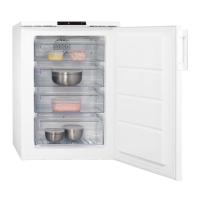
Storage of Frozen Food: For initial use or after a period of inactivity, the appliance should run for at least 3 hours with the Super Freeze function activated before storing products. The freezer drawers facilitate easy access to food packages. For large quantities, all drawers except the bottom one can be removed to ensure good air circulation. Food should be kept at least 15 mm from the door. In case of accidental defrosting due to power failure, defrosted food must be consumed quickly or cooked and re-frozen.
Thawing: Frozen food can be thawed in the refrigerator or at room temperature. Small portions can be cooked directly from frozen, though cooking time will be longer.
Ice-cube Tray: The appliance includes trays for ice-cube production. Metallic instruments should not be used to remove trays from the freezer.
Hints for Energy Saving: To ensure efficient energy use, the internal configuration of the appliance should be maintained. Frequent or prolonged door opening should be avoided. Colder temperature settings increase energy consumption. Good ventilation around the appliance is crucial, and ventilation grilles or holes should not be covered.
Shopping Tips: When grocery shopping, ensure frozen food packaging is undamaged. To minimize defrosting, purchase frozen goods last and transport them in an insulated cool bag. Place frozen foods in the freezer immediately upon returning home. Partially defrosted food should not be re-frozen but consumed as soon as possible. Always respect expiry dates and storage information on packaging.
Care and Cleaning:
Service: For repairs, users should contact an Authorised Service Centre and use original spare parts. Self-repair or non-professional repair can void the guarantee and have safety consequences. Specific spare parts (thermostats, temperature sensors, printed circuit boards, light sources, door handles, door hinges, trays, and baskets) will be available for 7 years after the model is discontinued. Door gaskets will be available for 10 years.
Troubleshooting: The manual includes a comprehensive troubleshooting guide for common issues such as the appliance not operating, being noisy, compressor operating continually, door not opening easily, excessive frost/ice, water flow issues, and temperature regulation problems. Solutions range from checking power connections and temperature settings to cleaning components and adjusting the door. If issues persist, users are advised to contact the Authorized Service Centre.
Door Reversibility: The door can be reversed to open from the opposite side. This process involves unscrewing the top cover, removing hinges, lifting the door, and re-installing hinges and the door on the desired side. After reversing the door, the appliance should stand for at least 4 hours before connecting to power.
Installation of a Door Handle: If a separate door handle is provided, it can be installed by removing screws from the door side, matching handle holes, and screwing the handle into place.
Disposal: The appliance and its packaging materials should be recycled appropriately. The refrigerant circuit and insulation materials are ozone-friendly. The insulation foam contains flammable gas, so municipal authorities should be consulted for correct disposal. The cooling unit near the heat exchanger should not be damaged during disposal. Appliances marked with the symbol (crossed-out wheeled bin) should not be disposed of with household waste but returned to a local recycling facility.


 To Next Page
 General