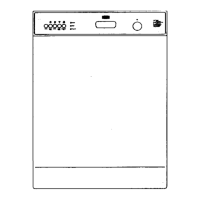
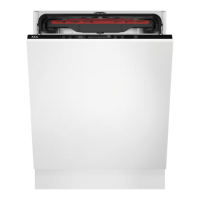
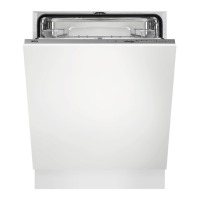
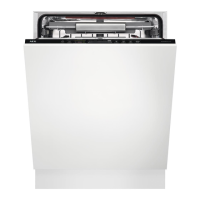
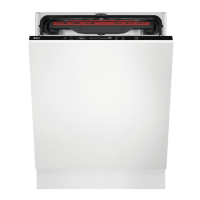
This document is a user manual for the AEG Favorit 77000 Dishwasher, providing comprehensive information on its operation, maintenance, and technical specifications.
Function Description
The AEG Favorit 77000 is a dishwasher designed to clean crockery, cutlery, pots, and pans. It features multiple wash programmes tailored to different soil levels and load types, including:
- AUTO (45°-70°C): Senses soil type and quantity, automatically adjusting temperature, water volume, energy consumption, and programme duration. Suitable for all crockery, cutlery, pots, and pans with varying soil levels. Includes prewash, wash, rinses, and dry phases.
- PRO (70°C): For heavy soil, suitable for crockery, cutlery, pots, and pans. Includes prewash, wash, rinses, and dry phases, and incorporates the ExtraHygiene option.
- SILENT (50°C): A quiet washing programme for normal soil on crockery and cutlery. The pump operates at a low speed to reduce noise, resulting in a longer programme duration. Includes prewash, wash, rinses, and dry phases.
- 30MIN (60°C): For fresh soil on crockery and cutlery, providing good washing results in a short time. Includes wash and rinse phases, and the ExtraHygiene option.
- ECO (50°C): The standard programme for test institutes, offering efficient use of water and energy for normal soil on crockery and cutlery. Includes prewash, wash, rinses, and dry phases, and the ExtraHygiene option.
- 50MIN (55°C): For light soil on crockery and cutlery. Includes wash and rinse phases, and the ExtraHygiene option.
- Prewash: A quick rinse programme for all load types, preventing food from bonding and bad odours. No detergent is used in this programme.
The dishwasher also includes several options to enhance cleaning and drying:
- Multitab Function: Activates when using combi detergent tablets, deactivating the flow of rinse aid and salt. The related indicators turn off, and programme duration may increase.
- ExtraHygiene: Improves hygiene by maintaining a temperature of 70°C for 10 to 14 minutes during the rinsing phase.
The appliance is equipped with a water softener to neutralize minerals in hard water, preventing damage and ensuring optimal washing results. It requires regular refilling of dishwasher salt and rinse aid.
Important Technical Specifications
- Dimensions (Width / Height / Depth): 596 / 850 / 610 mm
- Electrical Connection: 220-240 V, 50 Hz (refer to rating plate for specific details)
- Water Supply Pressure (Min. / Max.): 0.5 / 0.05 bar / MPa to 8 / 0.8 bar / MPa
- Water Supply Temperature: Cold water or hot water (max. 60°C). Using hot water from alternative energy sources (e.g., solar panels) can decrease energy consumption.
- Capacity: 12 place settings
- Energy Consumption (kWh) and Water Consumption (l) for selected programmes:
- AUTO: 0.9-1.7 kWh, 8-15 l
- PRO: 1.5-1.6 kWh, 13-14 l
- SILENT: 1.1-1.2 kWh, 9-11 l
- 30MIN: 0.9 kWh, 9 l
- ECO: 0.9-1.0 kWh, 9-11 l
- 50MIN: 1.0-1.2 kWh, 10-11 l
- Prewash: 0.1 kWh, 4 l
Usage Features
The dishwasher's control panel includes an on/off button, programme guide, program button, programme indicators, display, delay button, start button, and option button. Indicators provide status updates for multitab, ExtraHygiene, washing, rinsing, drying, end of programme, rinse aid, salt, delay, and door status.
- Setting a Programme: The appliance must be in setting mode (all programme indicators on, display shows two horizontal status bars). Users select a programme by pressing the Program button repeatedly.
- Delay Start: Programmes can be delayed from 1 to 24 hours. The delay time flashes on the display, and the delay indicator is on.
- Loading Baskets: Items should be dishwasher-safe. Wood, horn, aluminium, pewter, and copper items should not be washed. Remaining food should be removed, and burned food softened. Hollow items should be placed opening down. Cutlery and dishes should not bond, and glasses should not touch. Small items go in the cutlery basket, light items in the upper basket, ensuring they do not move. Spray arms must move freely.
- Detergent Use: Only dishwasher detergents should be used. Detergent is placed in compartment (A). For programmes with a prewash phase, a small quantity of detergent can be placed on the inner part of the appliance door. Detergent tablets are placed in compartment (A).
- Water Softener Adjustment: The water softener can be adjusted manually (dial positions 1 or 2) or electronically (via the control panel) to match local water hardness.
- Rinse Aid Dispenser: Filled with rinse aid to improve drying and prevent streaks. The released quantity can be adjusted from position 1 (lowest) to 4 (highest).
- Auto Off: The appliance automatically deactivates after a few minutes if the on/off button is not pressed at the end of a programme, saving energy.
- Opening Door During Operation: The appliance pauses when the door is opened and resumes from the point of interruption when closed.
Maintenance Features
Regular maintenance is crucial for optimal performance:
- Cleaning Filters: The filters (A, B, A1, A2) should be checked and cleaned regularly. They are disassembled by turning filter (A) counter-clockwise, pulling apart (A1) and (A2), and removing filter (B). After washing, they must be correctly reassembled and locked into position. Incorrect filter positioning can lead to bad washing results and appliance damage.
- Cleaning Spray Arms: If holes in the spray arms are clogged, remaining soil should be removed with a thin pointed object. The spray arms should not be removed.
- External Cleaning: The appliance exterior should be cleaned with a moist soft cloth. Only neutral detergents should be used; abrasive products, cleaning pads, or solvents are not recommended.
- Salt Container: Requires regular refilling with dishwasher salt. For first-time use, 1 litre of water should be added before filling with salt. Any spilled salt around the opening should be removed, and the cap tightened clockwise.
- Rinse Aid Dispenser: Requires regular refilling. Spilled rinse aid should be removed with an absorbent cloth to prevent excessive foam.
Troubleshooting: The manual provides a comprehensive troubleshooting guide for common issues such as the appliance not starting, not filling with water, not draining water, and unsatisfactory washing/drying results. Alarm codes (e.g., "10" for no water, "20" for no drain, "30" for anti-flood device activation) are explained. Users are advised to contact service if problems persist after performing checks.

 Need help?
 General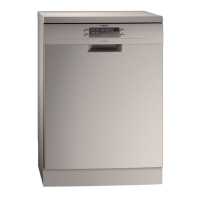

 To Next Page