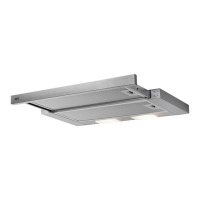
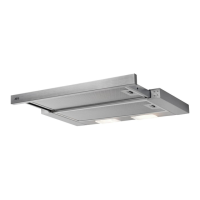
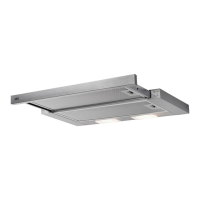
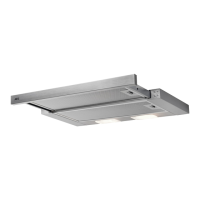
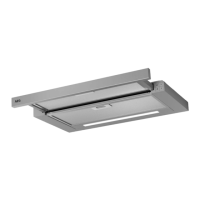
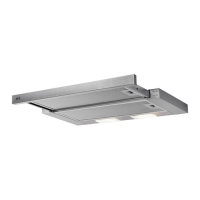
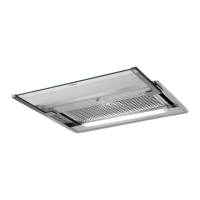
This document is a user manual for AEG cooker hoods, specifically models DPB3932S and DPB3632S. It provides comprehensive instructions on the product's description, daily use, care, cleaning, and environmental considerations.
Function Description
The AEG cooker hood is designed to extract cooking fumes and odors from the kitchen, ensuring a cleaner and more pleasant cooking environment. It features a control panel with distinct functions for fan speed and lighting.
The control panel includes:
- First Speed (1): Activates the fan at its lowest speed level, suitable for light cooking activities.
- Second Speed (2): Engages the fan at a medium speed level, ideal for moderate cooking.
- Third Speed (3): Sets the fan to its highest speed level, recommended for intensive cooking or when significant fumes are present.
- Lamp (4): Controls the cooker hood's lighting, turning it on or off to illuminate the cooking surface.
The hood operates by pulling out its drawer by more than 5 cm to expose the control panel. Once exposed, the desired functions can be activated by pressing the corresponding buttons. The fan speed can be adjusted as needed during operation.
Usage Features
The cooker hood offers several features to enhance its usability during daily cooking:
- Recommended Speed Settings: The manual provides guidance on selecting the appropriate fan speed based on cooking intensity:
- First Speed (0|1): Recommended for heating up food or cooking with covered pots.
- Second Speed (2): Suitable for cooking with covered pots on multiple cooking zones or burners, and for gentle frying.
- Third Speed (3): Best for boiling and frying large quantities of food without a lid, or when using multiple cooking zones or burners simultaneously.
- Post-Cooking Operation: It is advised to leave the hood operating for approximately 15 minutes after cooking to ensure all residual fumes and odors are cleared from the kitchen.
- Independent Lighting: The hood's light functions independently of the fan. The light can be turned on or off using the dedicated button, and closing the drawer does not affect the light's operation.
- Memory Function: The hood remembers the last fan speed setting used when the drawer is closed. When the drawer is pulled out again, the hood will operate at this previously set fan speed level, providing convenience for recurring cooking habits.
- Drawer-Activated Control: The fan can be turned off by pressing the "First Speed" button or by simply closing the hood drawer.
Maintenance Features
Regular care and cleaning are essential to maintain the cooker hood's performance and longevity. The manual outlines specific procedures for cleaning various components:
- General Cleaning:
- Surfaces: Use a soft cloth with warm water and a mild detergent. Abrasive detergents and brushes should be avoided to prevent damage.
- Stains: Clean stains with a mild detergent.
- Hot Surfaces: After cooking, some parts of the appliance may be hot. Allow the appliance to cool down before cleaning to avoid stains, then dry with a clean cloth or paper towel.
- Frequency: The appliance and grease filters should be cleaned monthly. Accumulation of fat or other residues can pose a fire risk.
- Grease Filter Cleaning:
- Removal: Grease filters are mounted with clips and pins. To remove, press the handle of the mounting clip on the filter panel underneath the hood, then slightly tilt the front of the filter downwards and pull it out. Repeat for all filters.
- Washing: Grease filters can be washed in a dishwasher. Set the dishwasher to a low temperature and a short cycle. Discoloration of the grease filter may occur but does not affect its performance. Alternatively, clean them using a sponge with non-abrasive detergents.
- Reinstallation: To mount the filters back, follow the removal steps in reverse order.
- Charcoal Filter Replacement:
- Purpose: Charcoal filters are used to absorb odors in recirculation mode. Their saturation time varies depending on cooking type and grease filter cleaning regularity.
- Non-Washable: Activated charcoal filters are not washable and cannot be regenerated.
- Replacement Frequency: They must be replaced approximately every 4 to 6 months of operation, or more frequently for heavy usage.
- Replacement Procedure: First, remove the grease filters. Then, turn the charcoal filter counterclockwise and pull it out.
- Lamp Replacement:
- The appliance is equipped with an LED lamp and a separate control gear (LED driver).
- These parts can only be replaced by a qualified technician. In case of a malfunction, refer to the "Service" section in the "Safety Instructions" chapter for assistance.
Environmental Concerns
The manual emphasizes responsible disposal and recycling:
- Packaging: Recycle packaging materials using appropriate containers.
- Appliance Disposal: Do not dispose of appliances marked with the symbol (crossed-out wheeled bin) with household waste. Return the product to a local recycling facility or contact the municipal office for proper disposal. This helps protect the environment and human health by recycling waste electrical and electronic appliances.

 Need help?
 General
 Weight and Dimensions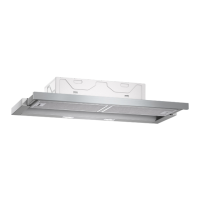

 To Next Page