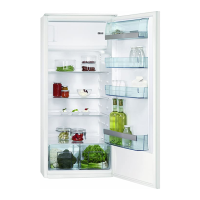
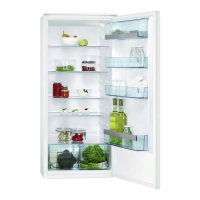
This document is a user manual for the AEG SKS58840S0 refrigerator. It provides comprehensive information on safety, operation, maintenance, and troubleshooting for the appliance.
Function Description:
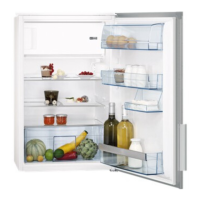
The AEG SKS58840S0 is a refrigerator designed for keeping foodstuffs and beverages in a normal household setting. It features a refrigerator compartment for fresh food storage and a freezer compartment for freezing fresh food and storing frozen and deep-frozen food for extended periods. The appliance utilizes a refrigerant circuit containing isobutane (R600a), a natural gas known for its environmental compatibility.
Important Technical Specifications:
- Dimensions of the recess:
- Height: 880 mm
- Width: 560 mm
- Depth: 550 mm
- Rising Time: 12 h (This refers to the time it takes for the temperature inside the freezer to rise to a certain level in the event of a power failure, indicating how long frozen food can remain safe.)
- Voltage: 230 V
- Frequency: 50 Hz
- Climate Class: The appliance is suitable for various ambient temperatures depending on its climate class:
- SN: +10°C to +32°C
- N: +16°C to +32°C
- ST: +16°C to +38°C
- T: +16°C to +43°C
The specific climate class for a particular appliance is indicated on its rating plate.
- Refrigerant: Isobutane (R600a), which is flammable.
- Insulation materials: The insulation foam contains flammable gases.
- Lamp: Special purpose bulb lamps are used for interior lighting, not suitable for household room illumination. The maximum power of the lamp is shown on the lamp cover.
Usage Features:
- Temperature Regulation: The temperature is automatically regulated. Users can adjust the temperature regulator to lower settings for minimum coldness or higher settings for maximum coldness. A medium setting is generally recommended. The optimal setting depends on room temperature, door opening frequency, food quantity, and appliance location. Continuous operation at the lowest settings in high ambient temperatures or with a full load may lead to frost formation, requiring adjustment to a warmer setting for automatic defrosting and energy saving.
- First Use: Before initial use, the interior and accessories should be washed with lukewarm water and neutral soap to remove the new product smell, then thoroughly dried. Abrasive powders or detergents should not be used as they can damage the finish. After cleaning, it is advisable to wait at least four hours before connecting the appliance to allow the oil to flow back into the compressor.
- Freezing Fresh Food: The freezer compartment is suitable for freezing fresh food. For faster freezing, the temperature regulator can be set to higher settings to achieve maximum coldness. In this condition, the refrigerator compartment temperature might drop below 0°C, requiring a reset to a warmer setting. The maximum quantity of food that can be frozen in 24 hours is specified on the rating plate. The freezing process takes 24 hours, during which no additional food should be added.
- Storage of Frozen Food: When starting up or after a period of disuse, the appliance should run for at least two hours on higher settings before loading products. In case of accidental defrosting due to a power failure exceeding the "rising time" indicated in the technical characteristics chart, defrosted food must be consumed quickly or cooked immediately and then re-frozen (after cooling).
- Thawing: Deep-frozen or frozen food can be thawed in the refrigerator compartment or at room temperature. Small pieces can be cooked directly from frozen, though cooking time will be longer.
- Movable Shelves: The refrigerator walls have runners allowing shelves to be positioned as desired. The glass shelf above the vegetable drawer and the bottle shelf should not be moved to ensure proper air circulation.
- Positioning Door Shelves: Door shelves can be adjusted to different heights to accommodate various food packages. They can be pulled out in the direction of the arrows and repositioned. Some models include a variable storage box under a door shelf compartment that can slide sideways.
- Energy Saving Hints: To save energy, avoid frequent or prolonged door openings. If the ambient temperature is high, the regulator is set to low, and the appliance is fully loaded, continuous compressor operation may cause frost. Adjusting to a warmer setting allows automatic defrosting and reduces electricity consumption.
- Fresh Food Refrigeration Hints: Do not store warm food or evaporating liquids. Cover or wrap food, especially items with strong flavors. Ensure food is positioned to allow free air circulation.
- Refrigeration Hints:
- Meat: Wrap in polythene bags and place on the glass shelf above the vegetable drawer. Store for only one or two days.
- Cooked foods/cold dishes: Cover and place on any shelf.
- Fruit and vegetables: Clean thoroughly and place in provided drawers.
- Butter and cheese: Place in airtight containers or wrap in aluminum foil/polythene bags to exclude air.
- Milk bottles: Cap and store in the bottle rack on the door.
- Bananas, potatoes, onions, garlic: Do not keep in the refrigerator unless packed.
- Freezing Hints: Freeze only top-quality, fresh, and thoroughly cleaned foodstuffs. Prepare food in small portions for rapid and complete freezing and to thaw only the required quantity. Wrap food in aluminum foil or polythene, ensuring airtight packages. Avoid contact between fresh and already frozen food to prevent temperature rise. Lean foods store better and longer; salt reduces storage life. Water ices can cause frost burns if consumed directly from the freezer. Mark packs with freezing dates to track storage time.
- Storage of Frozen Food Hints: Ensure commercially frozen foodstuffs were adequately stored by the retailer and transferred quickly to the freezer. Avoid frequent or prolonged door openings. Once defrosted, food deteriorates rapidly and should not be re-frozen. Adhere to the food manufacturer's recommended storage period.
Maintenance Features:
- General Care and Cleaning:
- Always unplug the appliance before maintenance.
- Clean the inside and accessories with lukewarm water and neutral soap.
- Regularly check and wipe door seals to keep them clean and free from debris.
- Rinse and dry thoroughly.
- Do not use metal objects, sharp objects, detergents, abrasive powders, highly perfumed cleaning products, or wax polishes, as these can damage surfaces or leave strong odors.
- Do not pull, move, or damage any pipes or cables inside the cabinet.
- Take care not to damage the cooling system.
- The outer casing should be cleaned with warm water and a little washing-up liquid.
- Maintenance and recharging of the cooling unit (containing hydrocarbons) must only be carried out by authorized technicians.
- Defrosting the Refrigerator: Frost is automatically eliminated from the evaporator during normal use when the compressor stops. Defrost water drains into a special container at the back of the appliance, where it evaporates. Periodically clean the defrost water drain hole in the middle of the refrigerator compartment channel using the provided cleaner to prevent water overflow onto food.
- Defrosting the Freezer: Frost will form on freezer shelves and around the top compartment. Defrost when the frost layer reaches 3-5 mm thickness.
- Steps for defrosting:
- Switch off the appliance.
- Remove stored food, wrap it in newspaper, and place in a cool location.
- Leave the door open.
- Once defrosting is complete, dry the interior thoroughly and refit the plug.
- Switch on the appliance.
- Set the temperature regulator to maximum coldness and run for two or three hours.
- Reload the food.
- Warning: Never use sharp metal tools or mechanical devices to speed up thawing, as this can damage the evaporator or shorten the safe storage life of frozen food.
- Periods of Non-Operation: If the appliance is not in use for long periods:
- Disconnect from electricity supply.
- Remove all food.
- Defrost and clean the appliance and accessories.
- Leave the door(s) ajar to prevent unpleasant smells.
- If the cabinet remains on, arrange for periodic checks to prevent food spoilage during power failures.
- Replacing the Lamp:
- Disconnect the mains plug.
- Remove the screw from the lamp cover.
- Remove the lamp cover.
- Replace the used lamp with a new lamp of the same power, specifically designed for household appliances (maximum power indicated on the lamp cover).
- Install the lamp cover.
- Tighten the screw.
- Connect the mains plug.
- Open the door to ensure the lamp comes on.
- Closing the Door:
- Clean the door gaskets.
- Adjust the door if necessary (refer to "Installation").
- Replace defective door gaskets if necessary (contact Service Center).
Troubleshooting (What to do if...):
The manual provides a table of common problems, possible causes, and solutions:
- Noisy appliance: Not supported properly (check stability).
- Appliance not operating, lamp not working: Switched off (switch on), mains plug not connected (connect), no power/voltage (connect different appliance, contact electrician).
- Lamp not working: In stand-by (close/open door), defective (refer to "Replacing the lamp").
- Compressor operates continually: Temperature not set correctly (set higher), door not closed correctly (refer to "Closing the door"), door opened too frequently (do not keep open longer than necessary).
- Product temperature too high, room temperature too high: Let product cool before storage, decrease room temperature.
- Water flows on rear plate: Normal during automatic defrosting.
- Water flows into refrigerator: Water outlet clogged (clean outlet), products touching rear plate (ensure space).
- Water flows on ground: Melting water outlet not flowing into evaporative tray (attach outlet to tray).
- Temperature too low/high: Temperature regulator not set correctly (set higher/lower).
- Refrigerator temperature too high: Door not closed correctly (refer to "Closing the door"), product temperature too high (let product cool), many products stored at once (store less), no cold air circulation (ensure circulation), products too near each other (store with space).
- Too much frost: Food not wrapped correctly (wrap food), door not closed correctly (refer to "Closing the door"), temperature regulator not set correctly (set higher).
Environmental Concerns:
The symbol on the product or packaging indicates that it should not be treated as household waste. It should be taken to an appropriate collection point for recycling electrical and electronic equipment to prevent negative environmental and health consequences. For detailed recycling information, contact local authorities, waste disposal services, or the retailer.

 Need help?
 General

 To Next Page