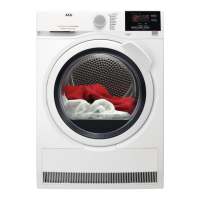
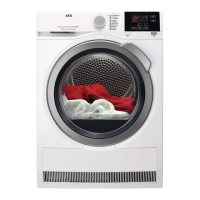
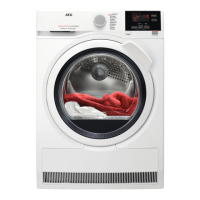
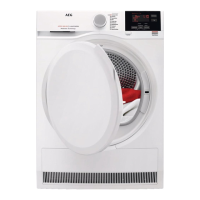
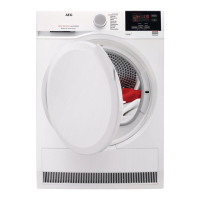
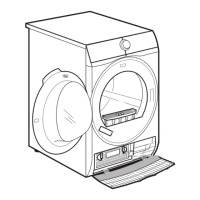
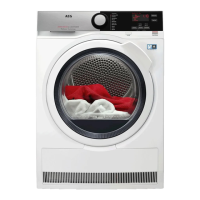
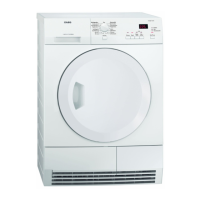
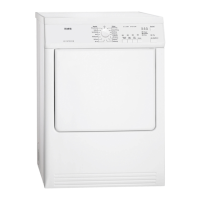
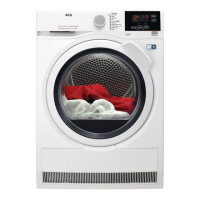
This document is a user manual for AEG T6DBG821N and T6DBG822N tumble dryers, providing comprehensive information for safe and effective operation, maintenance, and troubleshooting.
Function Description
The AEG tumble dryer is designed for drying domestic-type, machine-dryable laundry. It operates as a condenser tumble dryer, meaning it collects moisture from the clothes into a water container, which needs to be emptied after each drying cycle. The appliance offers various drying programs tailored to different fabric types and desired dryness levels, including Cottons Eco, Cottons, Synthetics, Mixed, Delicates, Easy Iron, Bedlinen, Duvet, Jeans, and Sports. The "Cottons Eco" program is the standard cotton program for energy-related products regulations. The dryer features an automatic tumble drier function and is equipped with a humidity sensor to optimize drying results.
Usage Features
The tumble dryer offers a user-friendly control panel with a program dial, display, Start/Pause button, Options, and On/Off button.
Key usage features include:
- Program Selection: Users can select from a range of programs based on fabric type and load size. The approximate program duration is shown on the display.
- Dryness Level Option: This option allows users to achieve a specific laundry dryness, with selections like "ready to iron - iron dry level," "ready to store - cupboard dry level," and "ready to store - drier than cupboard dry level."
- Delicate and Delicate Plus Options: These options provide extra delicate drying for frequently-worn clothes with reduced heat. They cannot be selected simultaneously.
- Anti-crease Option: This extends the anti-crease phase at the end of the drying cycle for up to 120 minutes, rotating the drum periodically to prevent creases.
- Time Drying Option: For cottons, synthetics, and mixed fabrics, users can set a specific drying time from a minimum of 10 minutes to a maximum of 2 hours, in 10-minute steps. The load indicator disappears when this option is at its maximum.
- Delay Start Option: This feature allows delaying the start of a drying program from 30 minutes up to 20 hours.
- Buzzer Option: The appliance provides acoustic signals at the cycle end and at the start and end of the crease guard phase. This option can be activated or deactivated.
- Child Lock Option: This safety feature locks all touch buttons and the program dial (excluding the On/Off button) to prevent children from operating the appliance. It can be activated either before or after touching the Start/Pause button.
- Auto Off Function: To conserve energy, the appliance automatically turns off if the Start/Pause button is not touched within 5 minutes or 5 minutes after a cycle ends.
- Preparing Laundry: For optimal drying, it is recommended to shake and load clothes one by one, close zips and fasteners, tie loose items like ties or ribbons, and remove all objects from pockets. Items with an internal cotton layer should be turned inside out.
- Loading Laundry: Ensure laundry is not trapped between the appliance door and the rubber seal.
- Fabric Labels: The manual provides symbols indicating whether laundry is suitable for tumble drying, and at what temperature levels (higher or low), or if it's not suitable at all.
Maintenance Features
Regular maintenance is crucial for the appliance's performance and longevity.
Key maintenance features include:
- Cleaning the Filter: The filter collects lint during the drying cycle and must be cleaned before or after each use. A clogged filter can lead to inefficient drying, emergency heater shutdown, and longer cycle times. The filter should be cleaned manually, and a vacuum cleaner can be used if necessary. Lint should be disposed of in a dustbin, not in water.
- Emptying the Water Container: The condensed water container must be emptied after each drying cycle. If full, the program stops automatically, and an indicator appears on the display. The water can be drained into a basin.
- Cleaning the Condenser: If the condenser indicator flashes, the condenser and its compartment should be inspected and cleaned. This involves unlocking and removing the condenser, then rinsing it vertically over a basin with a hand shower.
- Cleaning the Humidity Sensor: The metal humidity sensor, located on the inner side of the door area, can accumulate dirt over time, affecting drying performance. It is recommended to clean it 3-4 times a year or when a drop in drying performance is observed, using a dish-washing sponge with vinegar or dish soap. Abrasive materials or steel wool should not be used.
- Cleaning the Drum: The inner surface of the drum and drum lifters should be cleaned with a standard neutral soap detergent and a soft cloth. Abrasive products, cleaning pads, solvents, or metal objects should not be used.
- Cleaning the Control Panel and Housing: These surfaces can be cleaned with a moist soft cloth and a standard neutral soap detergent. Furniture cleaning agents or corrosive cleaning agents should be avoided.
- Cleaning the Airflow Slots: A vacuum cleaner can be used to remove fluff from the airflow slots.

 Need help?
 General

 To Next Page