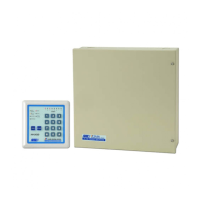
The HA-266 is a compact 6-zone alarm control panel with an integrated auto-dialer and communicator, designed for both home and office security. It incorporates advanced security concepts and is built to provide reliable service for years.
Function Description
The HA-266 serves as a central security hub, offering comprehensive protection through its hardware and software zones. It provides local alarm warnings, similar to traditional alarm systems, and can also transmit alarm reports and voice messages to pre-set telephone numbers, auto-pagers, and a proprietary monitor station equipped with AEI's Alarm-Monitor software (MS-980, sold separately). The system is compatible with all public telephone systems, allowing for remote control, status checking, and report requests from any tone-dialing telephone.
Important Technical Specifications
- Zones: 6 hardware protection zones and 2 software zones for panic and duress alarms.
- Power Input: 12-16VDC/1.5A. The recommended power adaptor is AP-960 (220-240V AC input, 12VDC/1.5A output).
- Backup Battery: Supports a 12V/1.2Ah lead-acid rechargeable battery (not supplied). The battery is trickle-charged when AC power is supplied.
- Output Power (Normal Condition): +12V output power at normal condition (no alarm), switched OFF during alarm. Equipped with a 1.5A resettable fuse.
- Output Power (Alarm Condition): +12V output power at alarm condition, with duration set by the alarm timer. Suitable for electronic sirens or alarm bells. Equipped with a 1.5A resettable fuse.
- Unswitched Output Power: +12V output power, continuously supplied, suitable for devices requiring uninterrupted power (e.g., smoke detectors, motion sensors, control keypads). Equipped with a 750mA resettable fuse.
- Remote Key Switch Input: Accepts Normally Open (N.O.) momentary switches, +12V triggered. Maximum 3 remote switches can be connected in parallel.
- Zone Monitoring: E.O.L. (End of Line) monitored by a 2.2K Ohm resistor for zones 1-6. N.C. contacts are wired in series with the E.O.L. resistor, N.O. contacts in parallel.
- Tamper Zone (Zone 8): Pre-wired internally as a 24-hour protection zone, Normal Closed (N.C.). Triggers an alarm if the cover is removed.
- Dial Tone Selection: Jumper selectable for continuous or cadenced dial tone.
- Telephone Numbers: Stores up to 4 telephone numbers for auto-dialer (locations 60-63) and 2 for communicator (locations 50-51). Each number can be up to 32 digits.
- User Codes: Up to 8 user codes (2-5 digits) at locations 11-18. User Code 1 is used for remote arm-disarm.
- Master Code: 2-5 digits, for programming access (location 01).
- Client Code: 4 digits, for monitor station identification (location 10).
- Exit Delay: Programmable from 2 to 999 seconds (default 60 seconds).
- Entry Delays: Two independent entry delays, programmable from 2 to 999 seconds (default 30 seconds for delay 1, 60 seconds for delay 2).
- Siren Duration: Programmable from 2 to 999 seconds (default 300 seconds).
- Loop Response Time: Programmable (0=25mS, 1=250mS, 2=500mS, 3=750mS). Default 500mS for all zones.
- Listen-in Period: Programmable (default 60 seconds).
Usage Features
- Master Control Console: The primary interface for system operation and programming.
- Optional Control Console: Can be connected remotely, offering similar functions to the master console, excluding voice message recording.
- LED Light Indicators: Provide visual feedback on system status, including armed/disarmed, AC power, battery status, program mode, arm prohibited, dialing, and recording. Zone LEDs indicate unsealed, alarmed, or isolated zones.
- Sound Indicators: Various beeps and tones indicate successful/unsuccessful key entries, exit/entry delays, low battery, AC power failure, DAP jumper status, telephone line faults, and arm prohibited conditions.
- Remote Arm/Disarm: The system can be armed or disarmed remotely using a key switch or a tone-dialing telephone. Only User Code 1 can be used for remote arm-disarm via telephone.
- Remote Status Check: Users can call the system to check its current arm-disarm status, receiving specific beep patterns indicating the system's state (disarmed, armed, alarm occurred, alarm memory, etc.).
- Remote Report Request: Authorized users can request a current status report to be sent to the monitor station or auto-pager by entering the Client Code via telephone.
- Panic Alarm: Holding down any two key buttons on the control console for three seconds triggers a local alarm, sends a panic alarm report via communicator, and dials programmed telephone numbers with a message. No visual indication on the console.
- Duress Alarm: A silent alarm triggered by adding 2 to the first digit of a User Code (e.g., User Code 1357 becomes Duress Code 3357). This sends a silent alarm signal to the monitor station and programmed telephones without local alarm outputs. The system will disarm if armed or in alarm memory, or remain off if already off.
- Handover Function: When enabled, any delay zone is triggered first, while instant zones are disabled during the entry delay period (except 24-hour zones). This allows for setting motion sensors as instant zones and main door as a delay zone.
- Programming: The panel can be programmed via the control console using the Master Code. Programming locations allow customization of zone configurations, delays, siren duration, telephone numbers, and other system features.
- Voice Message Recording: Users can record a custom alarm reporting message for the auto-dialer.
- Telephone Number Testing: Allows testing of communicator and auto-dialer telephone numbers by sending a status report or recorded message.
Maintenance Features
- Backup Battery Testing: The system supports both manual and periodic (daily or weekly) dynamic testing of the standby battery. During the test, AC power is turned off to monitor the battery under load. Test results (low battery, normal battery) can be reported to the monitor station.
- Local Alarm Output Testing: Allows manual testing of siren/bell and strobe light outputs to ensure they are functioning correctly.
- Alarm Memory Clearing: The alarm memory can be cleared manually or automatically when re-arming the system.
- DAP Jumper (Direct Access to Programming): A physical jumper on the circuit board allows direct access to programming mode in case the Master Code is forgotten, ensuring system recoverability.
- Tamper Switch: Internally pre-wired to Zone 8, it triggers an alarm if the control panel's cover is removed, indicating unauthorized access.
- Earth Connection: Requires connection to a solid electrical earth point (e.g., cold water pipe) for lightning protection and safety.
- Power Transformer Placement: The power transformer should be fixed on a wall close to the control panel, and wiring should not exceed 100 feet using 16 gauge wire to maintain proper voltage.
- Battery Replacement: The standby battery should be replaced every two to three years.

 Need help?
 General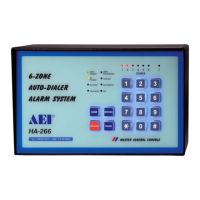

 To Next Page