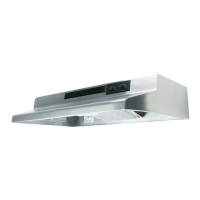
INSTALLATION INSTRUCTIONS
CONVERTIBLE RANGE HOODS SERIES 150,160,170,180,200
STEP BY STEP INSTALLATION INSTRUCTIONS
PREPARATION PROCEDURE
I. GENERAL PREPARATION FOR ALL RANGE HOODS
1. Lay the hood upside down on a table covered with a cardboard or paper to prevent scratching
of the table or hood.
2. If your hood has a lamp cover remove the lamp cover by unscrewing the two screws holding
it in place.
3. Install a 40 or 60 Watt light bulb.
4. Replace the lamp cover.
5. Remove the wiring compartment cover inside the hood.
II.PREPARATION OF CABINET FOR HOOD SUPPORT
1. If the bottom of cupboard is recessed above the bottom of the cupboard door, then it is
necessary to install wood strips at the location above the hood mounting holes. The thickness of
the wood strips should be slightly more than the recessed dimension.
2. Using a template or by measurement, transfer the location of the wood strips to the bottom of
the cupboard. Select the length of the wood strips to prevent interference with the conduit knock-
out location.
IMPORTANT!
IT IS RECOMMENDED THAT AFTER INSTALLATION OF THE HOOD, THE BOTTOM OF THE HOOD
SHOULD BE NO LESS THAN 20" NOR MORE THAN 30" ABOVE THE STOVE RANGE HEATING
ELEMENTS OR BURNERS.
III. SELECTION OF VENTING DIRECTION
Your new Air-King Range Hood assembly may be positioned for either horizontal, vertical or
ductless discharge. Full rated air delivery may be obtained in either the horizontal or vertical
discharge position, however, the longer the ducting the less air will be exhausted. 150 series hood
is designed for ductless operation only.
a. Vertical discharge
Vertical discharge is the most common method of hood
installation. If your kitchen has an attic space above, the ducting may be
run up through the cupboard and the attic to a roof cap. If your kitchen
has a soffit above the cupboards, you may run the duct up into the soffit
and then discharge horizontally through the outside wall to a wall cap.
b. Horizontal discharge
Assuming that the range hood is located against an outside wall,
horizontal discharge is preferred provided that there are no obstructions
such as, wall joists, or where openings are difficult to make.
c. Ductless
In ductless installations the air discharge is vented into the kitchen
through the opening in the hood grill. While the air delivery is
somewhat less than that of a vented installation, this method is energy
efficient because warm inside air is not discharged outside the house.
If you do not anticipate heavy cooking which produces a lot of grease or odour, this method may
be selected.Ductless installation requires the use of an extra charcoal filter (not provided) which
should be replaced at frequent intervals. Check with your dealer to order the charcoal filter(Air-
King part#RF34).
FOR DUCTLESS INSTALLATION, THE FOLLOWING PREPARATION MUST
BE DONE PRIOR TO THE INSTALLATION OF YOUR HOOD!
• Model 150 & 160:
Remove vent cover from slots on the front of range
hood by sliding vent cover to the left or the right until it
stops. Lift trailing edge of vent cover and slide in
direction of lifted end. Discard vent cover (FIG.1).
• Model 170, 180 & 200:
Remove plastic insert from behind plastic grill. Using
scissors, cut along short grooves. Bend along long
groove to break away center piece and discard. Place
‘U’ shape portion back into plastic grill. (FIG.2)
IV. PREPARATION OF ELECTRICAL
CONNECTION
1. Determine the location of the electrical cable to
connect to the range hood in either the vertical or
horizontal position. Refer to FIG.3.
2. On the range hood, remove the appropriate electrical knock-out and install a standard
electrical cable clamp.
3. Transfer the location of the range hood electrical knock-out to the bottom of the cupboard or
in the wall. Drill or cut a hole on the cardboard to clear the electrical cable clamp.
NOTE:
If replacing an existing hood the electrical cable may have
to be re-routed to the desired position.
V. DAMPER ASSEMBLY
1. Remove the appropriate ducting knock-out by
inserting a screwdriver under the end and pry up and snip
or break the attachment points.(FIG.4)
2. Install the damper assembly to the range hood with
the two screws supplied (FIG.3).
3. If discharge is vertical through a rectangular duct, remove knock-out sections D, B and E only
(FIG.5)
4. If discharge is through 7" round duct,remove knock-out sections "A" and "B" and "C" only
(FIG.5). Section "D" and "E" remain with the hood. Mount round collar (E22A-not supplied) over
opening on hood with (3) shorter screws. Allow bottom edge of 7" round duct to be inserted on
the collar.
VI. DUCT WORK
Your Air-king range hood will operate at its best efficiency if the number of elbows and the length
of the duct is kept to a minimum. The back-draft damper flap attached to the damper frame
assembly supplied with the hood does not impede air flow significantly so you may leave this in
place even though you may install a wall or roof cap with another back-draft damper.
VII. HOOD INSTALLATION
1. Lift the hood into position and guide the electrical cable through the electrical cable clamp on
the hood.
2. Insert the four wood screws from the bottom and securely fasten.
3. Secure the electrical cable in
the cable clamp allowing
sufficient length in the hood to
connect the field wires to the
hood wires.
4. Make the electrical
connections using screw-on wire
connectors by attaching the
black wires together and then
the white wires together and
then the green or bare wire to
the green grounding screw in the
hood. Replace the wiring
compartment cover.
CAUTION:
All wiring installation must comply with local and national electrical code regulations.
5. Attach duct work and use duct tape to seal all joints.
6. After turning all range hood switches to "OFF" position, turn the power on and test your
installation.
7. If there is any vibration noise, check for the source and try to tighten fasteners or add duct
tape to eliminate.
110572023
FIG.1
FIG.2
FIG.4
FIG.3
A
A
C
BD E
CUT-OUT FOR VERTICAL DISCHARGE
THROUGH ROUND OR RECTANGULAR DUCT
TOP VIEW
OTE: Care should be taken when removing knock-out
so as not to remove unused knock-out.
0010-16B1
FIG.5
Air King at ::rangehoods.com is a division of kitchen::accessories
::
rangehoods
.
com
Call 1-800-667-8721 anywhere in the US and Canada
-
www.rangehoods.com

 Need help?
 General

 To Next Page