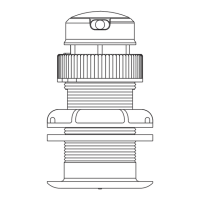
Retractable, Thru-Hull
Depth/Temperature Sensor
Models: D800 and DT800
17-395-01 rev. 01 08/03
CAUTION
:
NEVER USE SOLVENTS
Cleaners, fuel, paint, sealants, and other products may
contain strong solvents, such as acetone, which attack
many plastics greatly reducing their strength.
OWNER’S GUIDE & INSTALLATION INSTRUCTIONS
IMPORTANT
: Please read the instructions completely
before proceeding with the installation. These
instructions supersede any other instructions in your
instrument manual if they differ.
Record the information found on the cable tag for future reference.
Part No._________________Date___________Frequency________kHz
Applications
•
Plastic
housings recommended for fiberglass or metal hulls only.
Never
install a plastic housing in a wood hull since swelling of the
wood may overstress the plastic causing a fracture.
•
Bronze
housings recommended for fiberglass or wood hulls.
Never
mount a bronze housing in an aluminum hull because
electrolytic corrosion will occur.
•
Stainless steel
housing compatible with all hull materials.
Recommended for metal hulls to prevent electrolytic corrosion.
A stainless steel housing must be isolated from a metal hull.
•
Never
install a metal housing in a vessel with a positive ground
system.
Tools and Materials
Water-based antifouling paint (
mandatory in salt water
)
Safety goggles
Dust mask
Electric drill with 10mm (3/8") or larger chuck capacity
Drill bit 3mm
or
1/8"
Hole saw: 51mm
or
2" (plastic or bronze housing)
57mm
or
2-1/4"
(stainless steel housing in a metal hull)
Countersink tool (installing a flush housing)
Sandpaper
Mild household detergent
or
weak solvent (such as alcohol)
File (installation in a metal hull)
Marine sealant
Additional washer [for aluminum hull less than 6mm (1/4") thick]
Slip-joint pliers (installing a bronze housing)
Zip-ties
Installation in a cored fiberglass hull (see page 3):
Hole saw for hull interior 60mm
or
2-3/8"
Fiberglass cloth and resin
or
Cylinder, wax, tape, and casting epoxy
Antifouling Paint
Marine growth can accumulate rapidly on the sensor’s surface
reducing its performance within weeks. Surfaces exposed to salt
water
must
be coated with antifouling paint. Use
water
-
based
antifouling paint only.
Never
use ketone-based paint, since
ketones can attack many plastics possibly damaging the sensor.
It is easier to apply antifouling paint before installation, but allow
sufficient drying time. Reapply paint every 6 months or at the
beginning of each boating season. Paint the following surfaces
(see Figure 1):
• Outside wall of the
insert below the lower
O-ring
• Exposed end of the
insert
• Bore of the housing up
30mm (1-1/4")
• Exterior lip of the
housing
• Blanking plug below the
lower O-ring including
the exposed end
P17
Figure 1. Antifouling paint
outside wall
bore of housing
exterior lip
O-ring
below lower
up 30mm (1-1/4")
of housing
insert
housing
Plastic
exposed end
Low profile housing


 To Next Page
 Need help?
 General