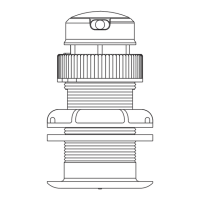
Mounting Location
Acoustic Noise
Acoustic noise is always present and these sound waves can
interfere with the operation of the depth transducer. Background
noise from sources such as: waves, fish, and other vessels cannot
be controlled. However, carefully selecting the depth transducer’s
mounting location can minimize the effect of vessel generated
noise from the propeller(s) and shaft(s), other machinery, and
other echosounders. The lower the noise level, the higher the
echosounder gain setting that can be used.
Placement
Choose a location where:
• The water flowing across the hull is smoothest with a minimum
of bubbles and turbulence (especially at high speeds).
• The depth transducer will be continuously immersed in water.
• The deadrise angle is 20
•
or less, so the transducer beam will
be aimed at the bottom.
• The transducer beam will be unobstructed by the keel or
propeller shaft(s).
• There is adequate headroom inside the vessel for the height of
the housing, tightening the nuts, and removing the insert.
Allow a minimum of 280mm (11").
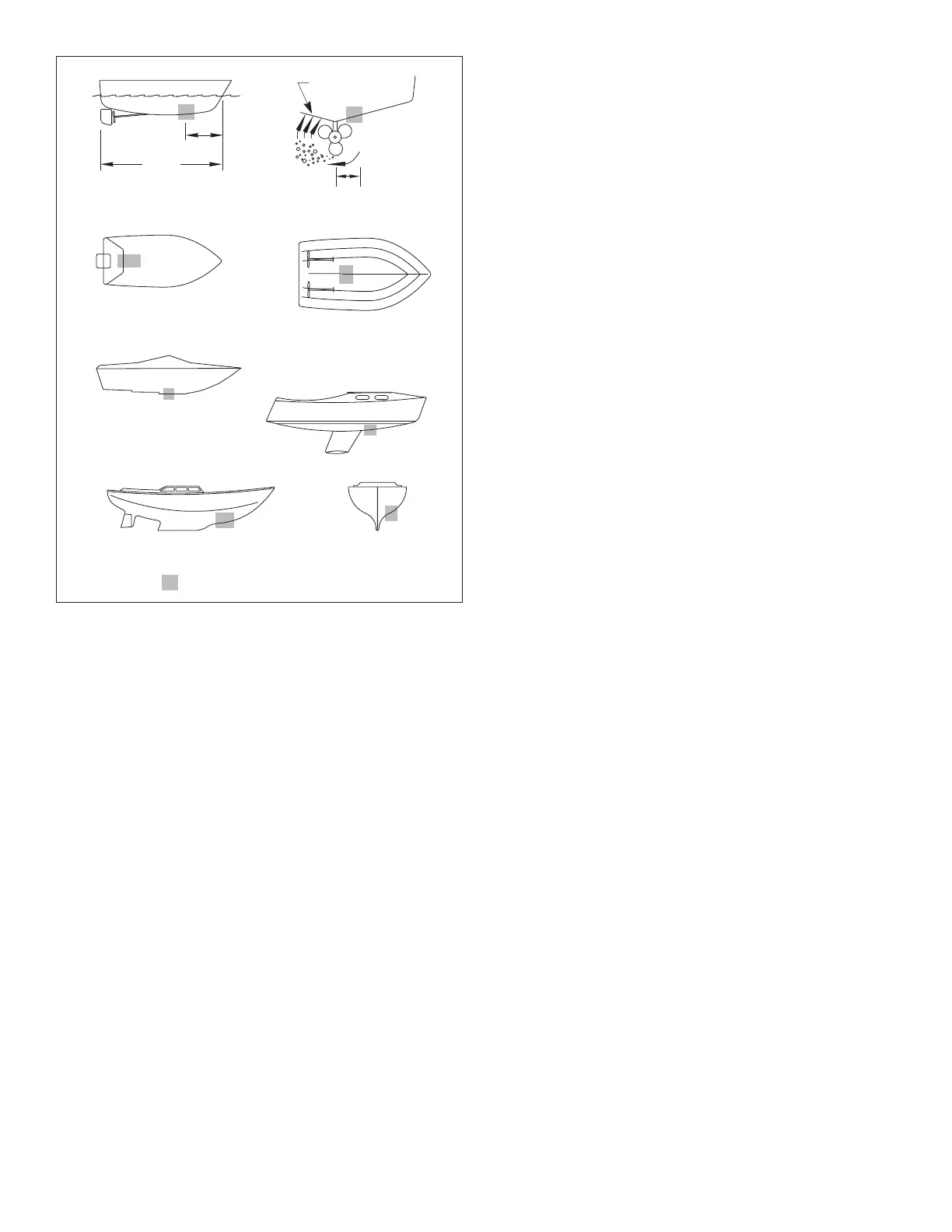
Hull Types
(see Figure 2)
•
Displacement hull powerboats
—Locate amidships near the
centerline.
•
Planing hull powerboats
—Mount well aft, on or near the
centerline, and
well inboard of the first set of lifting strakes
to insure
that the transducer is in contact with the water at high speeds.
Outboard and I/O
—Mount just forward of the engine(s).
Inboard
—Mount well ahead of the propeller(s) and shaft(s).
Step-hull
—Mount just ahead of the first step.
Boat capable of speeds above 25kn
(29MPH)—Review the
installation location and operating results of similar boats before
proceeding.
•
Fin keel sailboats
—Mount on or as close as possible to the
centerline and forward of the fin keel 300–600mm (1–2').
•
Full keel sailboats
—Locate amidships and away from the keel
at the point of minimum deadrise.
Caution
: Do not mount the depth transducer in an area of
turbulence or bubbles: near water intake or discharge openings;
behind strakes, fittings or hull irregularities; or behind eroding
paint (an indication of turbulence).
Installation
Cored fiberglass hull
—Follow separate instructions on page 3.
Hole Drilling
Warning
: Always wear safety goggles and a dust mask.
1. Drill a 3mm or 1/8" pilot hole from inside the hull. If there is a rib,
strut or other hull irregularity near the selected mounting
location, drill from the outside.
2. Using the appropriate size hole saw, cut a hole from outside the hull.
Note
: Flush models require a countersink tool to create a “seat”
in the hull.
3. Sand and clean the area around the hole, inside and outside, to
ensure that the sealant will adhere properly to the hull. If there is any
petroleum residue inside the hull, remove it with either mild
household detergent or a weak solvent (alcohol) before sanding.
Metal hull
—Remove all burrs with a file and sandpaper.
Bedding
Apply a 2mm (1/16") thick layer of marine sealant around the lip of
the housing that contacts the hull and up the sidewall of the
housing. The sealant
must
extend 6mm (1/4") higher than the
combined thickness of the hull, washer(s), and hull nut (see
Figure 3). This will ensure there is sealant in the threads to seal
the hull and to hold the hull nut securely in place.
Stainless steel housing in a metal hull
—To prevent electrolytic
corrosion, the stainless steel housing
must
be isolated from the metal
hull. Slide the isolation bushing onto the housing. Apply additional
sealant to the surfaces of the bushing that will contact the hull.
Installing
Caution
: Never pull, carry, or hold the sensor by the cable as this
may sever internal connections.
1. From outside the hull, push the housing into the mounting hole
using a twisting motion to squeeze out excess sealant (see
Figure 3). Align the arrow on the lip of the housing to point
forward toward the bow.
2. From inside the hull, slide the washer onto the housing.
Aluminum hull less than 6mm
(
1/4"
)
thick
—Use an
additional rubbery, fiberglass, or plastic washer.
Never
use
bronze since electrolytic corrosion will occur.
Never
use wood
since it will swell, possibly fracturing the plastic housing.
2
inboard
Figure 2.
pressure waves
1/3 aft
full keel sailboat
displacement hull
(6-12")
fin keel sailboat
150-300mm
LWL
Best location for the depth transducer
(Load Waterline Length)
step-hull
outboard and I/O
planing hulls


 To Next Page
 Loading...