The provided document is an operating and maintenance manual for the AIRTECH 3AL Vacuum Systems - Standard Design. This manual outlines the installation, operation, maintenance, and troubleshooting procedures for these liquid ring vacuum systems.
Function Description
The AIRTECH 3AL vacuum system is designed to produce a vacuum. It utilizes a Speck liquid ring vacuum pump and is intended for use with non-aggressive and non-explosive vapor or gas mixtures. The system is air-cooled, using ambient air as the coolant, and is not designed to function as a compressor system. Special material versions are available for handling corrosive, explosive, or aggressive gases, but the standard design is not suitable for these applications. The system is also not gas-tight and should not be used with lethal gases.
Important Technical Specifications
The 3AL vacuum systems come in various models, each equipped with a specific Speck liquid ring vacuum pump. The models and their corresponding Speck pump models are:
- 3AL2041: V-30
- 3AL2061: V-55
- 3AL2101: V-95
- 3AL2241: V-130
- 3AL2251: V-155
- 3AL2281: V-255
- 3AL2341: V-330
- 3AL2430: V-430
Vacuum Capability: The 3AL systems can produce vacuums up to 29 inches Hg.
Operating Liquid: The recommended operating liquid is tap water with a pH of 6 to 9, free of solids. De-ionized or distilled water should not be used.
Operating Liquid Sump Capacity:
- 3AL2041: 4.0 US gal / 15.1 liters
- 3AL2061, 3AL2101: 5.5 US gal / 20.8 liters
- 3AL2241, 3AL2251, 3AL2281, 3AL2341, 3AL2430: 16.3 US gal / 61.7 liters
Weights (approximate):
| Model |
Weight (empty) lbs/Kg |
Weight Filled with Water lbs/Kg |
| 3AL2041 |
105/47.7 |
138.4/62.9 |
| 3AL2061 |
150/68.2 |
195.9/89.1 |
| 3AL2101 |
190/86.4 |
235.9/107.2 |
| 3AL2241 |
360/163.6 |
495.9/225.4 |
| 3AL2251 |
380/172.7 |
515.9/234.5 |
| 3AL2281 |
470/213.6 |
605.9/275.4 |
| 3AL2341 |
580/263.6 |
715.9/325.4 |
| 3AL2430 |
620/281 |
785/356.07 |
Anti-liming Agent Quantities:
| Model |
Granulated Citric Acid lbs/Kgs |
10% Ethanoic Acid (US Gal/Liter) |
| 3AL2041 |
4.4/2 |
0.16/0.6 |
| 3AL2061, 3AL2101 |
8.8/4 |
0.26/1.0 |
| 3AL2241, 3AL2251 |
17.6/8 |
1.4/5.5 |
| 3AL2281 |
17.6/8 |
1.7/6.3 |
| 3AL2341, 3AL2430 |
17.6/8 |
1.85/7 |
Corrosion Protection Agent Quantities (Ethylene Glycol without additives):
| Model |
Approximate Amount US Gal/Liters |
| 3AL2041 |
0.16/0.6 |
| 3AL2061, 3AL2101 |
0.26/1.0 |
| 3AL2241 |
1.4/5.5 |
Clearance Requirements for Air Cooling:
| Model |
Front ft/m |
Back ft/m |
Side ft/m |
| 3AL2041 |
1.3/0.4 |
1.3/0.4 |
1/0.3 |
| 3AL2061 |
1.3/0.4 |
1.3/0.4 |
1/0.3 |
| 3AL2101 |
1.3/0.4 |
1.3/0.4 |
1/0.3 |
| 3AL2241 |
1.3/0.4 |
1.3/0.4 |
1/0.3 |
| 3AL2251 |
1.3/0.4 |
1.3/0.4 |
1/0.3 |
| 3AL2281 |
1.3/0.4 |
1.3/0.4 |
1/0.3 |
| 3AL2341 |
1.3/0.4 |
1.3/0.4 |
1/0.3 |
| 3AL2430 |
1.3/0.4 |
1.3/0.4 |
1/0.3 |
Noise Levels (approximate, at 3 feet/1 meter, 60 Hz operation):
| Model |
Sound Pressure Level (dBA) maximum |
| 3AL2041 |
66 |
| 3AL2061 |
70 |
| 3AL2101 |
74 |
| 3AL2241 |
74 |
| 3AL2251 |
71 |
| 3AL2281 |
73 |
| 3AL2341 |
76 |
| 3AL2430 |
76 |
Electrical Rating: Noted on a data plate on the front of the unit. The system operates on 3 Phase, 200-230/380-460 Volt, 50/60Hz AC current, with voltage variations of +/- 5% and frequency variations of +/- 2% not to be exceeded.
Operating Parameters:
- Ambient Temperature: 60 F / 15 C
- Barometric Pressure: 14.7 psia / 1013 mbar
- Air Humidity: 50%
- Maximum Operating Liquid Temperature: 160 F / 71 C
- Minimum Ambient Temperature: 40 F / 5 C (ethylene glycol addition required below this temperature)
- Maximum Discharge Pressure: 5 psig / 0.344 Bar G (consult factory if operating above this range)
Usage Features
Installation:
- Requires installation on a flat, level, stationary surface with adequate load-bearing capacity.
- Specific clearances around the unit must be maintained for proper air cooling.
- Electrical connections must be performed by a qualified electrician, adhering to local and national codes.
- The water supply solenoid valve should be connected to the motor control circuit to open when the motor starter is energized and close when de-energized.
- A properly sized magnetic motor starter with a heater is required for electrical protection.
- Before connecting piping, the system's direction of rotation must be checked by briefly jogging the system. If air blows away from the radiator, the direction is correct. If not, two electrical leads must be exchanged in the motor terminal box after de-energizing.
- The system is filled with water through a plastic plug on the top of the sump until the level reaches the overflow on the back of the unit. High-pressure water should not be used for filling.
- For first-time installation or run, the pump needs to be primed by adding water to the system inlet (0.4 gallons/1.5 liters for smaller systems, 1.3 gallons/7 liters for larger systems).
- Inlet piping should be connected without stress to prevent leaks or malfunction. A pipe plug, inserted for shipment, must be removed. A check valve is included with each system, so additional check valves are not required.
- A 1½ inch water supply line connects to the operating liquid make-up and spray line.
- A drain hose should be connected to the overflow water connection to prevent spills, though it's not strictly required for operation.
- Discharge piping, if installed, must be large enough to keep operating discharge pressure below 5 psig and adequately supported to avoid exerting force on the 3AL system.
- Optional accessories include an inlet filter for particulate gas streams, an electronic level switch for remote liquid level monitoring, a temperature switch for high discharge temperature shutdown, and a temperature gauge for monitoring operating liquid sump temperature. A discharge pressure switch can be added if connecting to a downstream process that might cause excessive back pressure.
Start-up:
- Visually check the operating liquid level in the sump via the liquid level gauge. Adjust water level to just below the overflow connection.
- Ensure the cover plate is mounted and secured.
- Turn on the power. The unit should then produce a vacuum.
Operation:
- Continuous operation at maximum vacuum is possible and results in the lowest power consumption.
- For no-load operation, it's recommended to operate at maximum vacuum (e.g., with the inlet blanked off) rather than open flow to atmosphere.
- The make-up water supply solenoid replaces liquid loss due to dry air operation at a constant rate of 0.06 gallons per minute.
- Excess operating liquid builds up in the separator and flows out of the overflow connection.
Shut-down:
- The system can be shut down at any operating condition by de-energizing the power.
- For long-term shut-down (greater than approximately one week), the system must be drained and protected from corrosion. This involves removing and locking out power, shutting off the make-up water supply, opening the drain valve on the sump to remove all water, removing sheet metal covers, draining the liquid ring vacuum pump by removing bottom drain connections, replacing pump drain plugs, closing the sump drain valve, and replacing covers.
- For very long shut-down periods (greater than 4 weeks), a small amount of ethylene glycol (without additives) should be added to the pump inlet, and the system should be run briefly to ensure glycol exposure. The system should be stored in a clean, dry location, protected from temperature extremes and weather.
Re-commissioning after long storage:
- Measure the motor's insulation resistance (<1kOhm per volt of nominal voltage, dry winding).
- Drain any anti-corrosion agent from the pump casing and dispose of it properly.
- Clean the system by adding water to the sump, priming the pump, briefly running the system, shutting it off, and draining the water. Repeat until free of debris.
Maintenance Features
Regular Maintenance:
- Water Quality: If hard water is used, it should be softened or the unit de-calcified regularly using the recommended anti-liming agent (granulated citric acid or 10% ethanoic acid).
- Leak Checks: Periodically check hoses and fittings for leaks. Tighten or replace leaking fittings after de-energizing the system.
- Cleaning: If dirt or foreign matter enters the system, it must be cleaned regularly as described in the re-commissioning procedure (Section 10.3.3).
Troubleshooting (Maintenance Chart highlights):
- Water consumption increases: Probable cause is a clogged or obstructed cooler. Solution: Clean the cooler by blowing compressed air through it.
- Ambient air highly contaminated: Probable cause is a clogged or obstructed cooler. Solution: Clean the cooling fins with compressed air.
- Dirt builds up in the system: Probable cause is introduction with suction gas or make-up water. Solution: Clean the unit as described in Section 10.3.3 and/or add an inlet filter or water filter.
- Sand or other fine grain particulate enters system: Probable cause is make-up liquid. Solution: Clean the system periodically (at least once a year) as described in Section 10.3.3. Briefly run the system with the operating liquid drain closed to flush out water in the pump, taking care to reinstall housing panels to avoid contact with the cooling fan.
- No vacuum due to jammed impeller: Solution: Turn the shaft by hand to free it up (after turning off and locking out power, removing covers and shroud). If it won't free, contact an authorized service center.
- Extreme hard water used (lime content > 15 degrees of hardness): Solution: Soften water or clean with 10% ethanoic acid periodically. To clean with ethanoic acid: drain and clean the system, lock out power, wear protective gloves, disconnect hose from pump to cooler, fill interior with 10% ethanoic acid (proscribed amount via funnel), let sit for 30 minutes (no more than 45 minutes), occasionally turn impeller by hand, drain acid, reconnect, fill with water, clean, and re-commission. Alternatively, decalcify with granular citric acid: add proscribed amount to sump (dissolved in water), operate for ~10 hours, drain and clean, and re-commission.

 Need help?
 General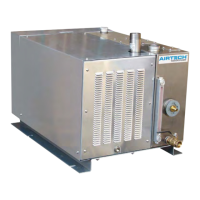

 To Next Page