==K
'SawTri'
This waveform has a shape varying from a triangle wave to a saw wave, depending on the
setting of the 'SHAPE' control, which is located on the VCO page. A Triangle wave has a fuller
sound than a sine wave, but still has very little overtones. A Saw wave a harsh, aggressive
sounding wave, with lots of overtones.
When this wave is selected, an additional knob becomes available called 'SHAPE'. This knob
controls the shape of the waveform. A setting of zero is a true triangle wave. Increasing this
value changes the shape of this waveform, adding overtones, until it reached 100, which is a true
saw wave.
'Pulse'
Ranges from a square wave to varying degrees of pulse widths. Generally a more hollow sound,
approaching nasal a nasal-like quality as the wave gets thinner.
When this wave is selected, an additional knob becomes available called 'SHAPE'. This knob
controls the shape of the waveform. A setting of zero is a very thin and nasal sounding wave,
increasing this value changes the shape of this waveform, adding overtones, until it reached 50,
which is a true square wave. Increasing this further decreases overtones, again yielding a very
nasal sounding wave at 100.
'WNoise', 'PNoise', 'RNoise'
Three different flavors of noise are available - White, Pink and Red. Each has it's own sound,
white being the most content rich and 'coldest' sounding, and red being most 'warm' sounding.
PWM
PWM stands for Pulse Width Modulation. This waveform is special, in that it is a Pulse wave
whose shape is hard-wired to LFO 2. This gives this waveform a range of sounds from a classic
warbling tone, to a buzzing, harsh sound, rich with overtones.
When this wave is selected, an additional knob becomes available called 'DEPTH'. This knob
controls amount of control LFO2 has over the width of the PWM oscillator.
+$/52 5+
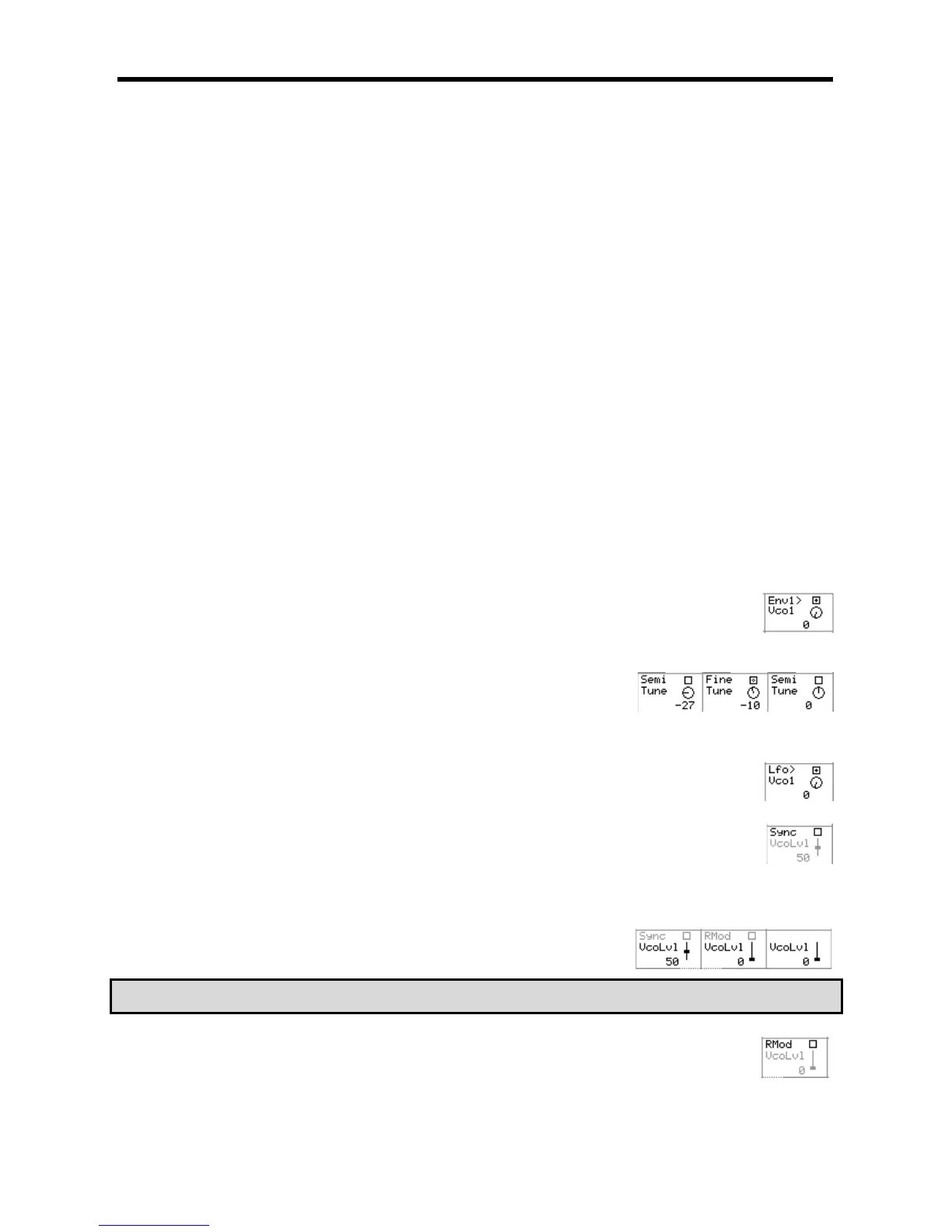
This knob sets how much effect envelope 1 will have on the pitch of VCO1. The corresponding Q-Link
[AFTER] button toggles whether the effect of the envelope will be positive or negative.
This is most commonly used in conjunction with the 'Osc XMod' control.
+!7+
Selecting this control will toggle the 'TUNE' controls range.
When set to 'SEMI', the 'TUNE' control adjusts the tuning of each oscillator
in semitones. Each VCO can be tuned +/- four octaves by semitones.
When set to 'FINE', the 'TUNE' control adjusts the tuning of each oscillator in +/- 100% of one semitone. This is useful for
slightly detuning oscillators to fatten up the sound, or add a chorusing type effect.
+,2 5+
This knob sets how much effect the LFO will have on the pitch of VCO1. This is useful for use in
conjunction with the 'Osc XMod' control.
+!(+
Selecting this checkbox forces the frequency of VCO 1 to match the frequency of VCO 2 by locking their
waves phase when the waves begin their rise and fall during their periodic cycles. When two sound
waves have their phases synchronized, their cycles begin at exactly the same instant and stay locked
throughout the cycle.
As the oscillators are tuned to wider intervals, a new set of harmonics are created resulting from two fundamental waves –
with significantly different frequencies – being locked in phase: the waveforms start their cycles at the same time. This can
result in harsh, distorted, waveforms perfect for aggressive dance-type synth leads, basses and effects.
+ %/-+
This field controls the volume of the selected oscillator in each column.
?D$I'0D$=&#
D$I'"+&
++
This check box turns on the Ring Mod. The Ring Mod is another classic analog tone modifier. It
generates a series of sum-and-difference overtones from two input signals, in this case VCO1 in to
VCO2, resulting often in a metallic, distorted character that is frequency dependent.


 To Next Page
 Loading...