
 Need help?
Do you have a question about the AKKTOL BT-607 and is the answer not in the manual?
Mandatory reading of the manual for proper functioning and performance.
Understand the riveter's use, limits, and potential hazards.
Verify the product's efficiency and integrity prior to each use.
Do not over-tighten with a wrench to prevent thread damage.
Clean and coat mandrel parts with oil for long-term storage.
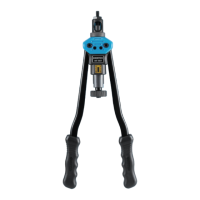
Diagram showing the identification of key components of the rivet nut tool.
Details on model, weight, length, stroke, and mandrel specifications.
List of included items, quantities, and corresponding specifications.
Guide to which nuts and materials are compatible with the tool.
Table detailing rivet nut dimensions, workpiece thickness, and stroke formula.
Loosen and remove the nosepiece using hand or wrench.
Press the sleeve to expose the hex portion and unscrew the mandrel.
Ensure the gauge's white line is at 0mm when handles are closed.
Check the gauge to confirm the working stroke is set correctly.
Screw the rivet nut onto the mandrel until fully seated.
Pre-drill a hole and insert the rivet nut into the workpiece.
Close the tool handles to deform and secure the rivet nut.
Proper stroke adjustment ensures efficient and easy operation.
Adjustment varies based on rivet nut size, type, and hole size.
Method for adjusting stroke by manipulating nuts and sleeves.
Ensure the mandrel engages all rivet nut threads to prevent damage.
Adjust outer sleeve to change handle angle for better leverage if needed.

 To Next Page
 General