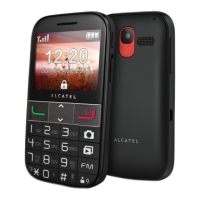
Need help?
Do you have a question about the Alcatel 2003 and is the answer not in the manual?
Safe driving practices with mobile phones, avoiding interference.
Guidelines for phone usage in various environments like aircraft and health facilities.
Advice to prevent hearing damage from loud phone usage.
User responsibility regarding data privacy, photography, and recording laws.
Battery handling, charging, and disposal guidelines.
Operating temperature and compliance of phone chargers.
Compliance with international guidelines for radio wave exposure.
How to protect your phone from theft using IMEI.
Differences between manual and phone operation, software releases.
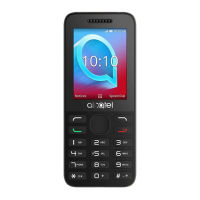
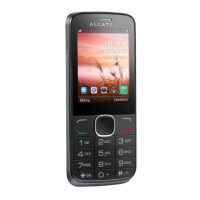
Identifies and explains the function of each key on the phone.
Explains the meaning of various icons displayed on the status bar.
Instructions for removing/installing covers, battery, SIM and SD cards.
Steps to charge the phone's battery and precautions.
Steps for dialling numbers, making emergency calls, and hanging up.
How to access voicemail by holding down a specific key.
How to answer and end incoming calls.
Accessing other features while on a call.
Using the built-in alarm clock with snooze feature.
Using the phone's calculator for arithmetic operations.
Viewing dates, monthly calendar, and adding events.
Exchanging data with other Bluetooth devices.
Performing weight and length conversions.
Creating fake calls to escape social situations.
Creating Blacklist and Whitelist for calls.
Activating and deactivating the phone's torch light.
Displaying and adding time zones for different cities.
Creating a voice file to set as an alarm.
SIM card toolkit service for network-dependent functions.
Composing and sending text/multimedia messages.
Taking pictures and setting them as wallpaper or call images.
Viewing images stored on the phone.
Recording audio files in WAV and AMR formats.
Playing video files and adjusting volume/navigation.
Accessing call memory and viewing all call contacts.
Creating and saving new contacts to Phone or SIM.
Steps to fix issues with the phone not powering on or responding.
Checks for power button contact and battery charge level.
Troubleshooting charging issues including battery contacts and voltage.
Steps to resolve connectivity problems and check IMEI.
Checks for correct insertion and condition of the SIM card.
Resolving problems with making, receiving, and sound quality of calls.
Troubleshooting finding contacts and leaving voicemail messages.
This document outlines the safety, usage, and maintenance guidelines for the Alcatel 2003G/2003D mobile phone. It is recommended to read this chapter carefully before using the phone to ensure proper operation and avoid damage.
Traffic Safety: Using a mobile phone while driving, even with a hands-free kit, poses a significant risk. Drivers are advised to refrain from using their mobile phone when the vehicle is in motion. When driving, avoid using your phone and headphones to listen to music or the radio, as this can be dangerous and is forbidden in some areas. When switched on, the phone emits electromagnetic waves that may interfere with vehicle electronic systems like ABS anti-lock brakes or airbags. To prevent issues, do not place the phone on the dashboard or within an airbag deployment area. Consult your car dealer or manufacturer to ensure the dashboard is adequately shielded from mobile phone RF energy.
Conditions of Use: To optimize performance, it is advisable to switch off the phone periodically. Always switch off the phone before boarding an aircraft. In health care facilities, switch off the phone unless in designated areas, as mobile phones can interfere with other electrical or electronic devices or equipment using radio frequency. Switch off the phone near gas or flammable liquids, and strictly obey all signs and instructions in fuel depots, petrol stations, chemical plants, or potentially explosive atmospheres. When the phone is switched on, maintain a distance of at least 15 cm from medical devices such as pacemakers, hearing aids, or insulin pumps. When using the phone, hold it to the ear on the opposite side of any such device. To prevent hearing impairment, answer calls before holding the phone to your ear. Also, move the handset away from your ear when using "hands-free" mode, as amplified volume can cause hearing damage. Do not allow children to use the phone or play with accessories unsupervised. When replacing the cover, note that the phone may contain substances that could cause allergic reactions. Handle your phone with care, keeping it in a clean and dust-free environment. Avoid exposing your phone to adverse weather or environmental conditions such as moisture, humidity, rain, liquid infiltration, dust, or sea air. The recommended operating temperature range is 0°C (32°F) to +40°C (104°F). Above 40°C (104°F), the display's legibility may be temporarily impaired, but this is not serious. Emergency call numbers may not be reachable on all mobile networks, so never rely solely on your phone for emergency calls.
Do not attempt to open, dismantle, or repair your mobile phone yourself. Avoid dropping, throwing, or bending the phone. If the glass screen is damaged, cracked, or broken, do not use the phone to prevent injury. Do not paint the phone. Only use batteries, chargers, and accessories recommended by TCL Communication Ltd. and its affiliates that are compatible with your phone model. TCL Communication Ltd. and its affiliates disclaim liability for damage caused by using other chargers or batteries. Remember to back up or keep a written record of all important information stored on your phone.
Some individuals may experience epileptic seizures or blackouts when exposed to flashing lights or playing video games, even without a prior history of such incidents. If you have experienced seizures or blackouts, or if there is a family history of such occurrences, consult your doctor before playing video games or enabling a flashing-lights feature. Parents should monitor children's use of video games and features with flashing lights. Discontinue use and consult a doctor if any of the following symptoms occur: convulsion, eye or muscle twitching, loss of awareness, involuntary movements, or disorientation. To reduce the likelihood of such symptoms, take these safety precautions: avoid playing or using flashing-lights features when tired or needing sleep; take a minimum 15-minute break hourly; play in a well-lit room; play at the farthest possible distance from the screen. If your hands, wrists, or arms become tired or sore while playing, stop and rest for several hours. If soreness persists, consult a doctor. When playing games, you may experience discomfort in your hands, arms, shoulders, neck, or other body parts. Follow instructions to prevent problems like tendinitis, carpal tunnel syndrome, or other musculoskeletal disorders.
Protect Your Hearing: To prevent hearing damage, avoid listening at high volume levels for extended periods. Exercise caution when holding the device near your ear while the loudspeaker is active.
Privacy: Users must respect local laws and regulations regarding taking photographs and recording sounds with their mobile phone. It may be strictly forbidden to photograph or record voices of others or their personal attributes without consent, as this could be an invasion of privacy. It is the user's sole responsibility to obtain prior authorization if necessary. The manufacturer, seller, or vendor of your mobile phone (including the operator) disclaim any liability resulting from improper use of the mobile phone.
Battery: Due to air regulations, the product's battery is not charged upon purchase. Please charge it first. Before removing the battery, ensure the phone is switched off.
Battery Use Precautions: Do not attempt to open the battery (risk of toxic fumes and burns). Do not puncture, disassemble, or short-circuit the battery. Do not burn or dispose of a used battery in household rubbish, or store it at temperatures above 60°C (140°F). Batteries must be disposed of according to local environmental regulations. Use batteries only for their intended purpose. Never use damaged batteries or those not recommended by TCL Communication Ltd. and/or its affiliates. The symbol on your telephone, battery, and accessories indicates that these products must be taken to collection points at the end of their life: municipal waste disposal centers with specific bins or collection bins at points of sale. This ensures recycling, preventing environmental disposal and allowing components to be reused. In European Union countries, these collection points are free of charge. All products with this sign must be brought to these points. In non-European Union jurisdictions, items with this symbol should not be thrown into ordinary bins if suitable recycling and collection facilities exist; instead, they should be taken to designated collection points. Caution: Risk of explosion if the battery is replaced by an incorrect type. Dispose of used batteries according to instructions.
Chargers: Mains powered chargers operate within a temperature range of 0°C (32°F) to +40°C (104°F). Chargers designed for your mobile phone comply with safety standards for information technology and office equipment. They also comply with the ecodesign directive 2009/125/EC. Due to varying electrical specifications, a charger purchased in one jurisdiction may not work in another. They should be used only for their intended purpose.
Radio Waves: Proof of compliance with international standards (ICNIRP) or European Directive 2014/53/EU (RED) is required for all phone models before market release. Protecting user health and safety is an essential requirement of these standards. This device meets international guidelines for exposure to radio waves. Your mobile device is a radio transmitter and receiver, designed not to exceed limits for exposure to radio waves (radio frequency electromagnetic fields) recommended by international guidelines. These guidelines, developed by an independent scientific organization (ICNIRP), include a substantial safety margin to ensure the safety of all persons, regardless of age and health. The radio wave exposure guidelines use the Specific Absorption Rate (SAR), with a limit of 2.0 W/kg for mobile devices. SAR tests are conducted using standard operating positions with the device transmitting at its highest certified power level across all tested frequency bands. The highest SAR values under ICNIRP guidelines for this device model are: Head SAR (GSM 900 + Bluetooth) 0.81 W/kg, Body-worn SAR (GSM 1800 + Bluetooth) 1.12 W/kg. During use, actual SAR values are typically below stated values because the device's operating power automatically decreases when full power is not needed, minimizing network interference and increasing system efficiency. Body-worn SAR testing is performed at a 5 mm separation distance. For body-worn operation, the device should be positioned at least 5 mm away from the body. If using an unapproved accessory, ensure it is free of metal and positions the phone at the indicated distance. Organizations like the World Health Organization and the US Food and Drug Administration suggest using a hands-free device or reducing call time to minimize exposure. More information on electromagnetic fields and public health is available on www.who.int/peh-emf. Your telephone has a built-in antenna. For optimal operation, avoid touching or degrading it. Mobile devices offer various functions and can be used in positions other than against the ear. In such cases, the device complies with guidelines when used with a headset or USB data cable. If using another accessory, ensure it is free of metal and positions the phone at least 5 mm away from the body. Note that using the device may share some personal data with the main device. It is your responsibility to protect your personal data and not share it with unauthorized devices or third-party devices. Your product can store personal information in various locations (SIM card, memory card, built-in memory). Remove or clear all personal information before recycling, returning, or giving away your product. Any data shared with TCL Communication Ltd. is stored in accordance with applicable data protection legislation. TCL Communication Ltd. implements and maintains appropriate technical and organizational measures to protect personal data against unauthorized or unlawful processing, accidental loss, or destruction, ensuring a security level appropriate to technical possibilities, implementation costs, risks involved, and data sensitivity.
Keys:
Status Bar Icons (2003G):
Status Bar Icons (2003D):
Set Up:
Charging the Battery: Connect the battery charger to your phone and plug it into a socket. Charging may take about 20 minutes to start if the battery is completely drained. Do not force the plug into the socket. Ensure the battery is correctly inserted before connecting the charger. The mains socket should be near the phone and easily accessible (avoid extension cables). For first-time use, charge the battery to its maximum (approximately 3 hours). To reduce power consumption and energy waste, disconnect the charger when the battery is fully charged and reduce backlight time. The charge is complete when the animation stops.
Power On/Off:
Making a Call: Dial the desired number, then press the Send key. To correct a mistake, press the Delete key. To hang up, press the End Call key.
Making an Emergency Call: If your phone is connected to the network, dial an emergency number and press the Send key. This works even without a SIM card or unlocking the keypad.
Calling Your Voice Mail: To access your voicemail, hold down the 1 key.
Receiving a Call: When an incoming call is received, press the Send key to answer, then the End Call key to hang up.
Available Functions During a Call: During a call, you can access your directory, calendar, and short messages without hanging up.
Your phone has an FM radio. Use the application as a traditional radio with saved channels. In the FM radio interface, press the Play/Pause key to play/pause the current channel, and the Up/Down keys to tune the volume. You can listen while running other applications. To use this feature, you must plug in your headset, which acts as an antenna.
Access your call memory by pressing the Send key from the idle screen, or by pressing the Menu key and selecting the Call Log icon.
Use this function to play audio files. Press the Play/Pause key to play/pause the audio player. Short press the Left/Right keys for last/next audio, and Up/Down keys to tune volume.
Alarm: Your mobile phone has a built-in alarm clock with a snooze feature.
Calculator: Press the up, down, left, right, and center keys to select +, -, ×, ÷, and = respectively. Press the Delete key to delete a figure.
Calendar: Upon entering this menu, a monthly-view calendar allows you to view dates and navigate to any day. You can create a note in text format by accessing "Add a new event" from the Options.
Bluetooth: Exchange data such as video, images, and audio with other Bluetooth-supported devices within a limited range after pairing.
Convert: Supports weight and length conversion.
Fake Call: Create a fake call to politely escape social situations.
Call Filter: Create a Blacklist and Whitelist for calls.
Torch: Turn the torch on/off as needed. In the idle screen, long press the 5 key to activate/deactivate the torch light.
World Clock: The first clock displays the time based on your location. You can add other cities to show their time zones.
Voice Alarm: Create a voice file and set it as an alarm.
STK: STK service is the SIM card's tool kit. This phone supports the service function, with specific items depending on the SIM card and network. The service menu will be automatically added to the phone menu when supported by the network and SIM card. Consult your local network operator for related fees and setup.
Create Message: From the main menu, select "Message" to create text/multimedia messages. Type a message and send it to a recipient in the SIM card directory. You can also insert a pre-defined message from "Templates." While writing, select "Options" for all messaging options. For dual SIM models, you can type a message and send it to a recipient in either the SIM1 or SIM2 directory. An SMS message exceeding a certain character limit (dependent on language) will be charged as multiple SMS. Specific letters (accents) increase SMS size, potentially causing multiple SMS to be sent.
Camera: This function allows you to take pictures. Press the Capture key to take a picture. You can set them as wallpaper or as an incoming call image for a contact in your Contacts.
Gallery: View images through this function.
Sound Recorder: Record audio files in WAV and AMR formats. Stopped recordings are automatically stored.
Video: Play video files. Press the Play/Pause key to play/pause the video player. Short press the Up/Down direction key to tune volume, and Left/Right direction keys for last/next video.
The phone provides space for users to manage files and supports a selectable memory card. Use the file manager to conveniently manage directories and files on the phone and memory card.
Consulting Your Contacts: Access your call memory by pressing the Send key from the idle screen, or press the Menu key and select the Contacts icon. In this menu, you will see all call contacts.
Adding a Contact: Select "New contact" then save it to "Phone" or "SIM" as desired.
From the main menu, select the Settings icon and choose functions to customize your telephone: Profiles, Phone settings, Call settings, Network, Regulatory & safety, Security, Restore factory settings, etc. To restore factory settings, enter the default password 0000 to confirm and reboot. End-user data will be erased.
This mode allows text input by choosing a letter or sequence of characters associated with a key. Press the key multiple times until the desired letter is highlighted. When you release the key, the highlighted character is inserted into the text.
Your phone is warranted against defects or malfunctions under normal use for twelve (12) months from the purchase date shown on your original invoice. Batteries and accessories are warranted for six (6) months from the purchase date. If a defect prevents normal use, inform your vendor and present proof of purchase. If confirmed, your phone or part will be replaced or repaired. Repaired phones and accessories receive a one (1) month warranty for the same defect. Repairs or replacements may use reconditioned components. This warranty covers parts and labor but excludes other costs. This warranty does not apply to defects due to:
Before contacting service, fully charge the battery for optimal operation. Avoid storing large amounts of data, as this may affect performance.
My phone can't switch on:
My phone turns off by itself:
My phone can't charge properly:
My phone can't connect to a network or "No service" is displayed:
My phone can't connect to the Internet:
Invalid SIM card:
Unable to make outgoing calls:
Unable to receive incoming calls:
Caller's name/number does not appear when a call is received:
I can't find my contacts:
Sound quality of calls is poor:
Unable to use features described in the manual:
When I select a number from my contacts, the number can't be dialed:
Unable to add a contact in my contacts:
My callers are unable to leave messages on my voicemail:
 General
| Position location | - |
|---|---|
| Form factor | Bar |
| Personal info management (PIM) | Alarm clock, Calculator, Calendar, Converter |
| FM recording | Yes |
| Type | Feature phone |
| Product color | Gold, Metallic |
| Subscription type | No subscription |
| Talk time (2G) | 7 h |
| Battery capacity | 970 mAh |
| Standby time (2G) | 206 h |
| Battery recharge time | 3 h |
| Video call | No |
| Headphone connectivity | 3.5 mm |
| Multimedia Messaging Service (MMS) | Multimedia Messaging Service (MMS) is a standard way to send messages that include multimedia content to and from a mobile phone over a cellular network |
| Bluetooth version | 2.1+EDR |
| Data network | GSM |
| SIM card type | MicroSIM |
| SIM card capability | Single SIM |
| 2G bands (primary SIM) | 850, 900, 1800, 1900 MHz |
| Mobile network generation | 2G |
| Internal memory | 4 MB |
| Compatible memory cards | MicroSD (TransFlash) |
| Maximum memory card size | 32 GB |
| Display type | TFT |
| Pixel density | 166 ppi |
| Display diagonal | 2.4 \ |
| Display resolution | 320 x 240 pixels |
 Weight and Dimensions
| Depth | 10.3 mm |
|---|---|
| Width | 49 mm |
| Height | 118 mm |
| Weight | 72 g |

 To Next Page