
 Need help?
Do you have a question about the ALDI WORKZONE WBT-TL014 and is the answer not in the manual?
Guidance on reading, understanding, and storing the user manual for safe and effective use of the ladder.
Details the meaning of various safety symbols and signal words used throughout the manual and on the product.
Specifies the intended use, load capacity, inclination angle, and general usage rules for safe operation.
Highlights risks associated with incorrect use or handling, and provides essential safety instructions for preventing injuries.
Instructions for inspecting the ladder and its components for completeness and damage before initial use.
Details on how to assemble and use the protective caps for the ladder's wall mounting.
Step-by-step guide for attaching the support foot, including safety warnings and checks.
Ensures the ladder is properly set up, user is wearing sturdy shoes, and safety information is understood before climbing.
Ensures locking devices are functional and all extended sections are properly locked before climbing.
Alerts users to the crushing hazard when extending or retracting the ladder and advises caution.
Explains how to check and ensure ladder sections are correctly locked using the locking devices before use.
Step-by-step instructions on how to safely extend the ladder to the desired length.
Describes how ladder sections automatically lock when extended to their maximum and the importance of checking this.
Detailed steps for setting up and extending the ladder to its full length, including locking checks.
Provides instructions on how to safely retract the ladder, including the function of unlock keys and hand placement.
Instructions for cleaning the ladder, including what cleaners to avoid and how to dry it properly.
Guidelines for storing the ladder safely, closed, locked, and in a secure, accessible location.
Details common causes of ladder instability, such as incorrect positioning, ground conditions, and weather.
Lists common instances of improper handling, including setting up, assembly/disassembly, and carrying items.
Identifies causes like unsuitable footwear and contaminated rungs that can lead to slips and falls.
Discusses causes of ladder failure like poor condition, wear and tear, and overloading.
Outlines risks related to working with electricity, proximity to live equipment, and using conductive ladders.
Instructions for disposing of the ladder's packaging materials responsibly.
Guidance on disposing of the ladder itself according to local laws and regulations.
Details the 12-month warranty period, what it covers, and consumer rights under Australian law.
This document is a user manual for the Workzone Aluminium Telescopic Ladder 3.27 m, model WBT-TL014. It provides comprehensive instructions for safe use, assembly, operation, maintenance, and disposal of the ladder.
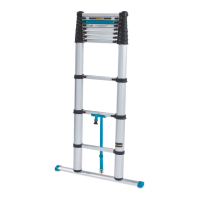
The Workzone Aluminium Telescopic Ladder is designed as a climbing aid for private use, with a maximum load capacity of 100 kg. It functions as a leaning ladder, requiring an inclination angle of approximately 75° (ratio 1:4) against a solid contact point. The telescopic design allows for extension and retraction of individual ladder sections, which are secured by locking devices on the rungs. The ladder is equipped with support feet and non-slip caps for stability, and protective caps for the rungs.
Safety First: The manual emphasizes numerous safety instructions to prevent injury or damage. Users must be in good health, wear sturdy shoes, and ensure the ladder is set up on solid, level ground. The ladder should not be used if damaged, contaminated (e.g., with paint, dirt, oil, snow), or if any non-slip caps are missing or damaged. It is crucial to check the ladder's condition before each use and at the beginning of every workday.
Assembly and Setup: Before first use, the two protective caps (wall) must be assembled with the supplied screws. The support feet, including non-slip caps, must be correctly mounted to the beams using hexagon bolts and nuts, ensuring alignment of mounting holes. The ladder must be positioned with its "back" facing the wall and "front" facing the user, maintaining an inclination angle of approximately 75°. The ladder should overhang the contact point by at least 1 m.
Extending the Ladder: The ladder can be extended rung by rung from the bottom up to the desired length. When extending to full length, all sections automatically lock as each rung reaches its maximum extension. If not extended to full length, the upper blocks of unextended rungs must be at the top end with protective caps. It is critical to ensure all sections are correctly locked before climbing. The locking device is confirmed as locked if the red section next to both unlock keys of a rung is not visible.
Retracting the Ladder: Retraction requires caution to avoid crushing or pinching fingers. Hands and arms must be positioned at the height of the actuated unlock keys. Pushing both unlock keys of a rung towards the center makes the red area visible, unlocking the device and retracting the ladder sections above that rung. If the lowest unlock keys (second rung from below) are activated, all rungs above automatically unlock and retract. Activating an upper rung's unlock keys only retracts sections above it, requiring separate unlocking for lower rungs.
Restrictions and Prohibitions:
Cleaning: The ladder must be kept clean. All contaminants such as dirt, paint residues, oil, or snow must be removed after each use and before retracting the ladder. Rungs should always be wiped clean. Aggressive cleaners, brushes with metal or nylon bristles, or sharp/metallic cleaning utensils should not be used as they can damage surfaces. Protective caps and non-slip caps of the support foot must be kept free from dirt and abrasive grit. Cleaning should be done with a brush or cloth, followed by thorough drying, especially the rungs.
Checks and Inspections: Before using the ladder, a sight check is mandatory. This includes verifying that:
Repairs: Repair and maintenance work must be carried out exclusively by experts. Users are explicitly prohibited from performing maintenance and repairs themselves. Contact the manufacturer or a specialist workshop at the service address provided on the warranty card for any issues. Liability and warranty claims are waived if repairs are performed by the user or due to incorrect handling. The design of the ladder must not be altered.
Storage and Transport: The ladder should always be transported fully retracted and secured with the strap. For storage, it should be kept closed and locked, in as straight a position as possible (e.g., hung up or placed on a flat, clean surface). The storage location must be dry, out of reach of children, away from direct sunlight, and secure from damage by vehicles, heavy objects, or dirt. It should also not present a tripping hazard or be freely accessible for unauthorized use.

 To Next Page
 General