Need help?
Do you have a question about the Alexander Schleicher ASK 21 B and is the answer not in the manual?
Details revisions made to the flight manual, including date and revision number.
Lists all effective pages and their revision status, ensuring current documentation.
Provides an overview of the manual's structure and section contents for easy navigation.
Introduces the flight manual and its purpose for the ASK 21 B sailplane.
Outlines the approval basis and category of airworthiness for the ASK 21 B.
Defines the meaning of warning, caution, and note symbols used throughout the manual.
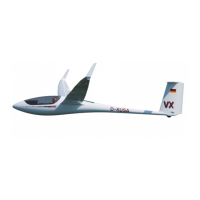
Provides a detailed description and key technical specifications of the ASK 21 B aircraft.
Presents a graphical representation of the aircraft from multiple perspectives.
Introduces the operating limitations and markings for safe aircraft operation.
Details airspeed limitations and their operational significance for various flight conditions.
Explains the color-coded markings on the airspeed indicator and their meaning.
Describes the markings on the G-meter relevant for aerobatic operations.
Specifies the maximum and minimum weight limits for the sailplane.
Defines the permissible center of gravity range for safe flight operations.
Lists approved maneuvers for both utility and aerobatic categories.
Outlines the maximum permissible maneuvering load factors under different conditions.
Specifies requirements and considerations for the flight crew during operation.
Details permissible types of operation, including VFR and cloud flying.
Lists the minimum required equipment for various flight operations.
Describes approved methods for launching the sailplane.
Details important placards related to mass and speed limitations found in the cockpit.
Introduces the section on emergency procedures and checklists.
Provides procedures for safely jettisoning the canopy in an emergency.
Details the steps for bailing out of the aircraft in an emergency situation.
Explains the procedure for recovering from a stall condition.
Outlines the standard procedure for recovering from a spin.
Describes the method for recovering from a spiral dive.
Covers procedures for additional emergency situations like groundloops and airbrake failures.
Introduces normal procedures for daily operations.
Details the steps for assembling and disassembling the sailplane.
Provides a checklist for daily pre-flight inspection of the glider.
Outlines the critical pre-flight checks to be performed before takeoff.
Covers normal flight procedures and recommended airspeeds.
Introduces the section on approved and non-approved performance data.
Presents approved data for airspeed calibration and stall speeds.
Provides additional performance information, including crosswind capabilities.
Explains the importance of payload range and safe operating limits.
Details how to use the mass and balance form for weight calculations.
Introduces the sailplane's systems and equipment.
Describes the function and adjustment of cockpit controls.
Details the instrument panel layout and required safety standards.
Explains the fixed main, nose, and tail wheel landing gear system.
Covers seat adjustment and correct fastening of safety harnesses.
Describes the pitot tube, static ports, and their connection to instruments.
Explains the operation of Schempp-Hirth airbrakes and their effect.
Specifies limitations and proper use of baggage compartments.
Details the 12V battery system, fuses, and wiring for avionics.
Covers optional equipment like trim ballast, oxygen, and ELT.
Introduces recommended procedures for ground handling and servicing.
Outlines requirements for annual airworthiness renewal inspections.
Emphasizes contacting the airworthiness authority for any modifications.
Provides guidelines for parking, securing, and transporting the sailplane.
Details proper cleaning procedures to maintain the sailplane's finish and structure.
Introduces supplements for operating the sailplane with optional systems.
Lists any supplements that have been added to the manual.
Discusses how the aircraft departs from controlled flight and enters spins.
Details the methods for initiating a spin entry.
Explains how CG and inertia affect spin entry and characteristics.
Describes the flight behavior and modes of spinning.
Details pitch attitude, rotation rate, and altitude loss during spins.
Analyzes the impact of control inputs on spin recovery and behavior.
 General
| Manufacturer | Alexander Schleicher |
|---|---|
| Model | ASK 21 B |
| Crew | 2 |
| Length | 8.35 m (27 ft 5 in) |
| Wing area | 17.95 m² (193.2 sq ft) |
| Aspect ratio | 16.1 |
| Empty weight | 360 kg (794 lb) |
| Type | Glider |
| Wingspan | 17.0 m (55 ft 9 in) |
| Height | 1.6 m |
| Max takeoff weight | 600 kg |
| Maximum speed | 280 km/h (174 mph, 151 kn) |
| Stall speed | 65 km/h (40 mph, 35 knots) |


 To Next Page