Need help?
Do you have a question about the Alexander Schleicher AS 33 ES and is the answer not in the manual?
Procedure to drain wing water ballast by opening valves and ensuring all water is emptied, including checking wing root drain holes.
Check for water in the tail cone and inspect hoses, clamps, and valves for leaks if a tail water ballast tank is installed.
Method for dismantling a firmly seated tailplane by pushing it forwards from the tips.
Instructions for removing the battery box and platform before de-rigging if installed in the baggage compartment.
Details on Avionic-Battery 2, its compartment in the baggage area, and its role in supplying electronic instruments.
Information about Avionic-Battery 3, its location in the vertical tail, and its function for electrical instruments.
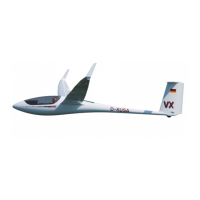
The provided manual excerpts describe aspects of the AS 33 Es glider, focusing on de-rigging procedures and optional avionic batteries.
The de-rigging process for the AS 33 Es is essentially the reverse of rigging, starting with the horizontal tail, followed by winglets, wing tips, and inner wings. Several suggestions are provided to ensure proper de-rigging and maintenance:
Water Ballast Drainage:
Tail Water Ballast Tank (if installed):
Tailplane Dismantling:
Battery Removal (if applicable):
The AS 33 Es offers two optional avionic batteries, Avionic-Battery 2 and Avionic-Battery 3, in addition to a standard Avionic Battery 1 (implied by the note).
These procedures and features are crucial for the safe operation, maintenance, and storage of the AS 33 Es glider.
 General
| Brand | Alexander Schleicher |
|---|---|
| Model | AS 33 ES |
| Category | Aircrafts |
| Language | English |


 To Next Page