Method 1: Standard charging cable
(200W maximum input)
Approximately 1.5 hours
Approximately 3-4 hours
Approximately 3-4 hours
About 1 hour
Method 2: Car cigarette lighter base
(100W maximum input)
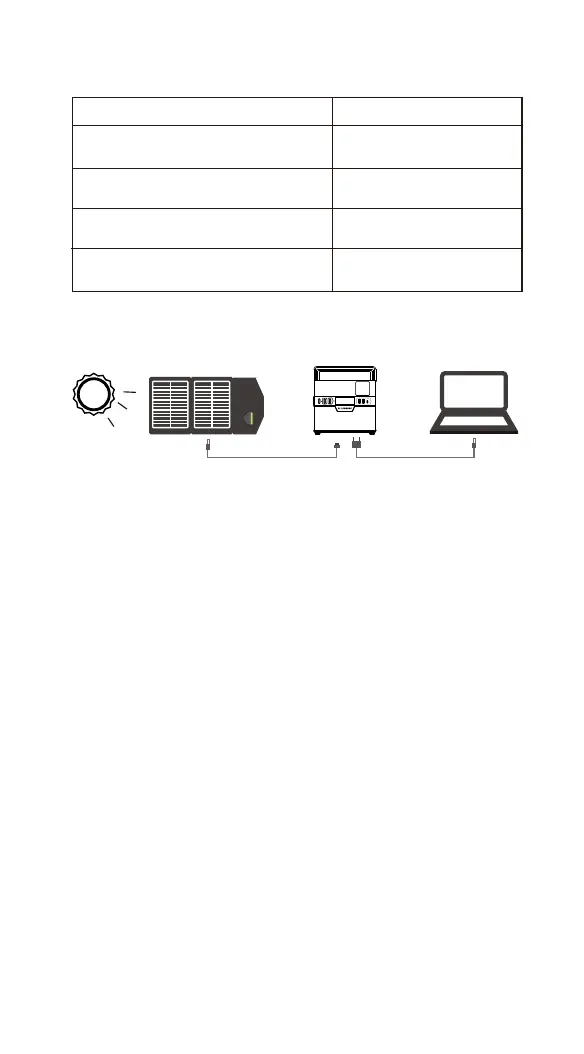
Method 3: Solar charging
(MPPT100W maximum input)
Method 1+2/3: 300W maximum input
Charging method
Estimated charging time
The full charge indication time is for reference only,
please refer to the actual operation.
The charging effect of solar energy is closely related to
factors such as solar module power, light intensity, and
sunlight incidence angle.
Reminder: During the charging process, please turn off the
laptop to reduce screen power consumption. The laptop battery
can store full charge faster.
Choose the optimal lighting time period (2-3 hours before
and after noon each day)
The more abundant the sunlight, the thinner the clouds and mist
above the atmosphere, and the closer the output power of the
solar panel is to the theoretical peak power.
Choose the optimal angle of sunlight incidence
It is generally required that the inclination angle between the
solar panel and the ground should be between 30-60 degrees,
and the solar panel should be installed as far south as possible
to obtain as much solar radiation as possible.
Avoid any possible obstructions
Regularly inspect your photovoltaic modules and eliminate any
potential threats of obstruction, such as trees, accumulated dust,
etc. (PV photovoltaic modules are generally limited by current
technology and working principles, and a small amount of
obstruction on the solar panel may result in a significant
decrease in power.)
The radiation of light varies with the seasons
The light radiation at the same location varies with the seasons
throughout the year, but the photoelectric conversion effect
depends more on the intensity of light rather than temperature.
The impact of unusually cold winter weather on the temporary
charging effect is relatively limited.


 To Next Page
 Loading...