Need help?
Do you have a question about the AllyNav Geodetic R26 and is the answer not in the manual?
Lists key technical advantages of the GNSS receiver, including integration, precision, and connectivity.
Details the satellite systems and frequency bands supported by the receiver.
Specifies the positioning accuracy for various modes like stand-alone, DGPS, and RTK.
Outlines power consumption, endurance, voltage, battery, and storage capacity.
Describes data output formats, refresh rates, baud rates, and interface connectors.
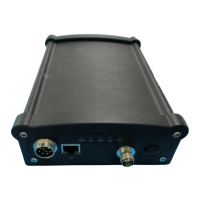
Shows an image of the R26 product and its physical layout.
Explains the interface functions and connector definitions for the R26 receiver.
Details the meaning of indicator lights and button functions on the R26 receiver panel.
Describes the different operating modes available for the R26 receiver.
Explains the available control modes for configuring the R26 receiver.
Details how to configure parameters for the motherboard and bottom plate of the receiver.
 General
| GLONASS | L1, L2 |
|---|---|
| QZSS | L1, L2, L5 |
| SBAS | L1, L5 |
| Static Accuracy Horizontal | 2.5 mm + 0.5 ppm |
| Static Accuracy Vertical | 5 mm + 0.5 ppm |
| RTK Accuracy Horizontal | 8 mm + 1 ppm |
| RTK Accuracy Vertical | 15 mm + 1 ppm |
| Tilt Sensor | Yes |
| Electronic Bubble | Yes |
| IMU | Yes |
| Waterproof/Dustproof | IP67 |
| GPS | L1, L2, L5 |
| BeiDou | B1, B2, B3 |
| Galileo | E1, E5a, E5b |
| Data Format | CMR, CMR+, NMEA-0183 |
| Communication Interfaces | Bluetooth, Wi-Fi |
| Internal Battery | 6800 mAh, 7.2V |

 To Next Page