EasyManua.ls Logo

Alpine 3DE-7886R - Page 8

Alpine 3DE-7886R
92 pages
Print Icon
To Next Page IconTo Next Page
To Previous Page IconTo Previous Page
Loading...
3DE-7886R
lll.
Operating
Specifications
The
automatic
adjustment
operations
of
the
3DE-7886R
are
performed
by
output
of
the
commands
of
the
various
-adjustment
items
from
the
main
microprocessor.
Adjustments
are
performed
in
response
to
these
commands
by
the
digital
servo
LSI.
This
servo
monitor
jig
receives
the
signal
returned
to
the
main
microprocessor
from
the
digital
servo
LSI
and
causes
the
LED
to
light
or
go
off.
The
adjustment
condition
(of
either
completed
or
not
yet
completed)
of
the
various
adjustment
items
can
be
checked
using
the
lighting
condition
of
this
LED.
The
following
test
discs
are
required
for
the
good/fault
judgment:
1.
A-BEX
TCD-721
(6th
track
-
1.2mm)
:
Scratch
test
disc
2.
A-BEX
TCD-782
:
Signal
test
disc
Measures
to
be
Taken
Corresponding
1.
When
a
LED
other
than
FAGC
or
TAGC
lights,
perform
the
fault
causation
analysis
using
the
fault
diagnosis
chart
according
to
the
LED
indication.
2.
When
only
the
FAGC
or
TAGC
LED
turn
on
a
lights
(indicating
that
the
focus
/
tracking
fine
gain
adjustment
is
not
completed)
,
perform
the
focus
/
tracking
servo
gain
adjustment.
If
the
value
is
within
the
specification,
the
adjustment
is
normal.
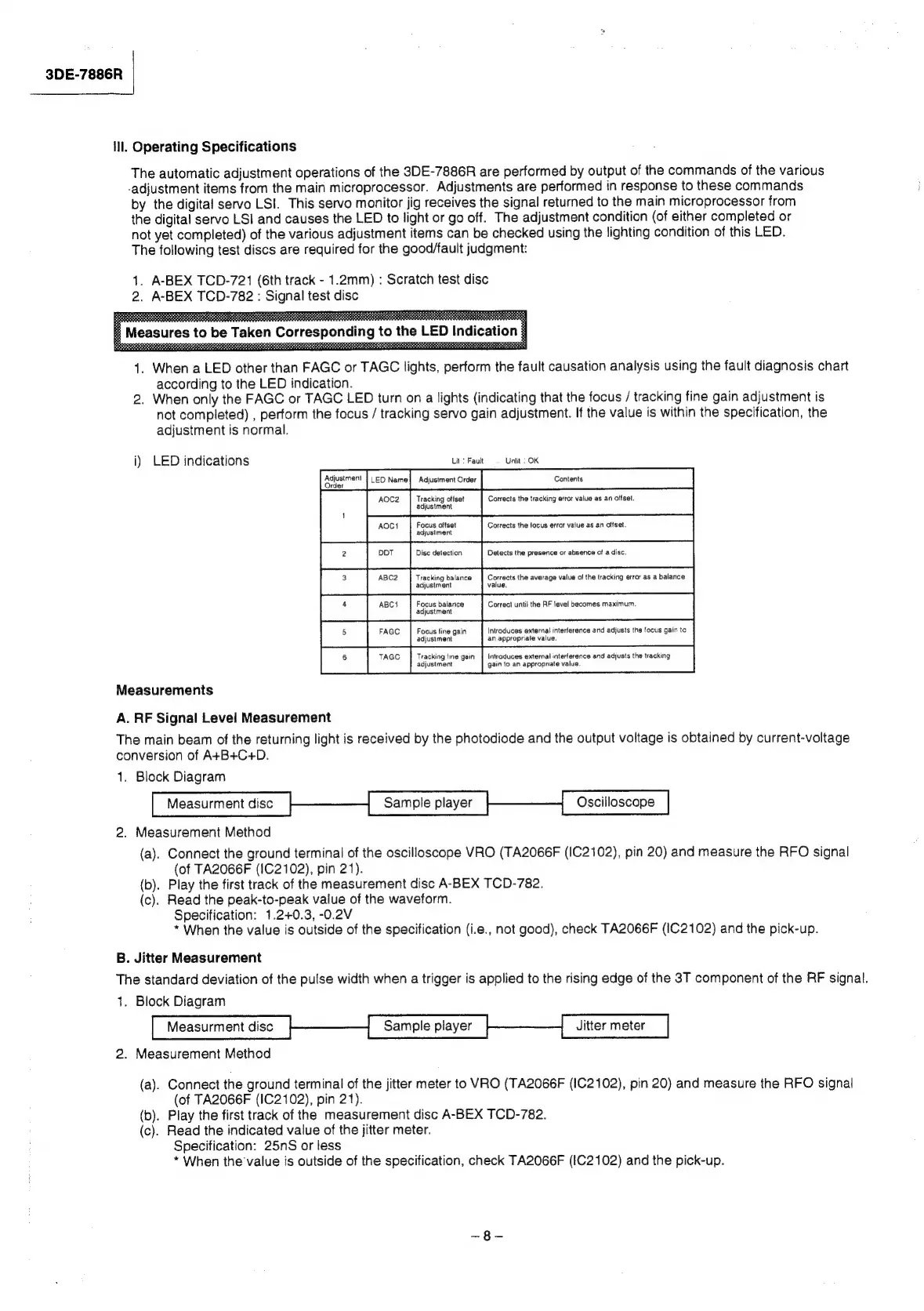
i)
LED
indications
Lit:
Fault
=
Unlit:
OK
Order
AOC2
Tracking
offset
Corrects
the
tracking
error
value
as
an
offset.
adjustment
AOC1
Focus
offset
Corrects
the
locus
error
vaiue
as
an
offset.
adjustment
Bea
ee
Cee
ee
3
ABC2
Tracking
balance
Corrects
the
average
value
of
the
tracking
error
as
a
balance
adjusiment
value.
4
ABC1
Focus
balance
Correct
until
the
AF
level
becomes
maximum
adjustment
§
FAGC
Focus
fine
gain
Invoduces
external
interference
and
adjusts
the
focus
gain
to
adjustment
an
appropriate
value.
TAGC
Tracking
fine
gain
|
Introduces
external
interference
and
adjusts
the
tracking
adjustment
gain
to
an
appropriate
value
Measurements
A.
RF
Signal
Level
Measurement
The
main
beam
of
the
returning
light
is
received
by
the
photodiode
and
the
output
voltage
is
obtained
by
current-voltage
conversion
of
A+B+C+D.
1.
Block
Diagram
Sample
player
Oscilloscope
2.
Measurement
Method
(a).
Connect
the
ground
terminal
of
the
oscilloscope
VRO
(TA2066F
(IC2102),
pin
20)
and
measure
the
RFO
signal
(of
TA2066F
(1C2102),
pin
21).
(b).
Play
the
first
track
of
the
measurement
disc
A-BEX
TCD-782.
(c).
Read
the
peak-to-peak
value
of
the
waveform.
Specification:
1.2+0.3,
-0.2V
*
When
the
value
is
outside
of
the
specification
(i.e.,
not
good),
check
TA2066F
(C2102)
and
the
pick-up.
B.
Jitter
Measurement
The
standard
deviation
of
the
pulse
width
when
a
trigger
is
applied
to
the
rising
edge
of
the
3T
component
of
the
RF
signal.
1.
Block
Diagram
Sample
player
Jitter
meter
2.
Measurement
Method
(a).
Connect
the
ground
terminal
of
the
jitter
meter
to
VRO
(TA2066F
(1C2102),
pin
20)
and
measure
the
RFO
signal
(of
TA2Z066F
(IC2102),
pin
21).
(b).
Play
the
first
track
of
the
measurement
disc
A-BEX
TCD-782.
(c).
Read
the
indicated
value
of
the
jitter
meter.
Specification:
25nS
or
less
*
When
the
value
is
outside
of
the
specification,
check
TA2066F
(IC2102)
and
the
pick-up.

Related product manuals