
 Need help?
Do you have a question about the Alpitronic Hypercharger HYC 075 and is the answer not in the manual?
Purpose and intended application of the hypercharger for electric vehicles.
Target audience for the manual and required knowledge for operation and maintenance.
Critical safety precautions for installation and maintenance operations.
Information and location of the device nameplate for identification.
Details of the hypercharger packaging, dimensions, and weight for transport.
Guidelines for safe transportation, handling, and storage conditions.
Step-by-step instructions for safely unpacking the hypercharger.
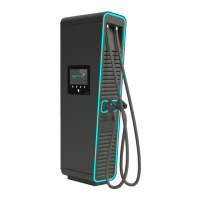
Overview of the external components, ports, and indicators of the device.
Recommended minimum distances for installation site setup and airflow.
Information on the cable length and operating radius for vehicle connection.
Procedure and order for safely opening the hypercharger doors.
Detailed view of internal components and their identifiers.
Overview of available product configurations and options for different models.
Requirements and dimensions for the concrete foundation and base plate.
Use and mounting of the adaptor for universal foundations.
Details, dimensions, and mounting of the hypercharger base.
Step-by-step guide for the complete mechanical installation process.
Electrical schematic for HYC_075 and HYC_150 models.
Electrical schematic for HYC_225 and HYC_300 models.
Guidelines for preparing and connecting mains power supply cables.
Procedures for connecting the hypercharger to the electrical grid.
Mandatory checks before putting the charging station into operation.
Overview of the web interface and initial login process.
Options and procedures for diagnosing the charging station's status and connectivity.
Setting up main running parameters and configuration options.
Common errors, their possible causes, and troubleshooting steps.
Scheduled maintenance tasks, execution, and intervals.
Step-by-step guide for replacing a power stack unit.
Details on the cooling unit for active cooled charging cables.
General specifications like degree of protection, mounting, and temperature ranges.
Physical dimensions (width, depth, height) and weight of hypercharger models.
Electrical parameters such as operating voltage, frequency, and current.
Manufacturer's declaration of compliance with relevant EU directives and standards.
 General
| Model | HYC 075 |
|---|---|
| Category | Automobile Accessories |
| Power Output | 75 kW |
| Connector Types | CCS, CHAdeMO |
| Output Current | Up to 200 A |
| Efficiency | >95% |
| Cooling | Liquid Cooling |
| Protection Class | IP54 |
| Operating Temperature | -30°C to +50°C |
| Input Voltage | 400 V AC |
| Output Voltage | 150 - 500 V DC |
| Dimensions | 800 x 600 mm |
| Communication Interface | OCPP 1.6 |
| Standards Compliance | IEC 61851 |

 To Next Page