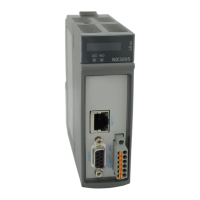
The provided document is a user manual for the Altus Nexto Series CPU NX3008, a programmable logic controller (PLC) designed for industrial automation and system control.
Function Description
The NX3008 is a powerful and complete programmable controller, part of the Nexto Series, offering exclusive and innovative characteristics for industrial automation. It is designed to control small to large industrial machines and processes in a distributed and redundant way, making it suitable for complex industrial systems, high-performance production lines, and advanced Industry 4.0 processes. The CPU is built on a 64-bit, 1 GHz ARM processor and runs on a Linux operating system, allowing for the virtualization of software developed for Unix technology and customization with external programs via the Docker platform. Its modular architecture facilitates easy integration with supervision, control, and field networks, and supports CPU and power supply redundancy. The device also features advanced diagnostics and hot-swapping capabilities to minimize maintenance downtime and ensure continuous production.
Important Technical Specifications
General Features:
- Backplane rack occupation: 2 sequential slots
- Power supply: Integrated (18 to 30 Vdc input voltage, 24 Vdc nominal, 15 W max output power, 3 A max output current, 15 A max in-rush current, 10 ms @ 24 Vdc max input voltage interruption). Includes polarity inversion protection and internal fuse.
- Ethernet TCP/IP local interface: 3 (NET 1, NET 2, NET 3)
- Serial Interface: 1 (COM 1, RS-485 half-duplex, 32 max transceivers, 0.5 mm² cross-section, baud rates from 2400 to 115200 bps, 1000 Vac / 1 minute isolation)
- CAN Interface: 1 (CAN bus, 64 max nodes, 0.5 mm² cross-section, baud rates from 10 to 1000 kbit/s, 1000 Vac / 1 minute isolation)
- USB Port Host: 1 (USB A Female, USB V2.0, 1.5 Mbps (Low-Speed), 12 Mbps (Full-Speed), 480 Mbps (Hi-Speed), 500 mA max current, 1000 Vac / 1 minute isolation to protection earth)
- Memory Card Interface: 1 (MicroSD, 32 Gbytes max capacity, 2 Gbytes min capacity, FAT32 file system)
- Real time clock (RTC): Yes (resolution of 1 ms, max variance of 2 s per day, 15 days retention at 25 °C, 10 days at max product temperature)
- Watchdog: Yes
- Status and diagnostic Indication: Graphic display, LEDs, Web pages, CPU internal memory
- Programming languages: Structured Text (ST), Ladder Diagram (LD), Sequential Function Chart (SFC), Function Block Diagram (FBD), Continuous Function Chart (CFC)
- Tasks: Cyclic (periodic), Event (software interruption), External (hardware interruption), Freewheeling (continuous), Status (software interruption)
- Online changes: Yes
- Maximum number of tasks: 24
- Maximum number of expansion bus: 24
- Bus expansion redundancy support: Yes
- Maximum number of I/O modules on the bus: 128
- Maximum number of additional Ethernet TCP/IP interface modules: 2
- Ethernet TCP/IP interface redundancy support: Yes
- Maximum number of PROFIBUS-DP network (using master modules PROFIBUS-DP): 4
- PROFIBUS-DP network redundancy support: Yes
- Redundancy support (half-clusters): No
- Hot Swap support: Yes
- Event oriented data reporting (SOE): No
- User web pages (Webvisu): Yes
- Firewall: Yes
- Docker: In Progress
Memory:
- Addressable input variables memory (%I): 64 Kbytes
- Addressable output variables memory (%Q): 64 Kbytes
- Direct representation variable memory (%M): 32 Kbytes
- Symbolic variable memory: 12 Mbytes
- Maximum amount of memory configurable as retentive or persistent: 1 Mbytes
- Total memory: 256 Mbytes (Program memory + Source code memory + Webvisu files memory)
- User files memory: 2 Gbytes
Performance:
- Instruction execution times (µs):
- 1000 Contacts (LD, BOOL): 2.1
- 1000 Divisions (LD, ST, INT): 9.2
- 1000 Divisions (LD, ST, REAL): 17.0
- 1000 Multiplications (LD, ST, INT): 6.4
- 1000 Multiplications (LD, ST, REAL): 8.2
- 1000 Sums (LD, ST, INT): 4.4
- 1000 Sums (LD, ST, REAL): 8.2
- Initialization times: 30 s (initial screen after 2 s)
- Main task interval time: Configurable from 5 to 750 ms
Environmental Characteristics:
- Dissipation: 9 W
- Operating temperature: -20 to 60 °C
- Storage temperature: -40 to 75 °C
- Relative humidity: 5% to 96%, non-condensing
- Conformal coating: Yes
- IP Level: IP 20
- Module dimensions (W x H x D): 36.00 x 114.63 x 115.30 mm
- Weight: 330 g (380 g with package)
Standards and Certifications:
- IEC 61131-2, IEC 61131-3
- CE – 2014/35/EU (LVD) and 2014/30/EU (EMC)
- RoHS – 2011/65/EU
- UL/cUL Listed - UL 61010-1 (file E473496)
- DNV Type Approval – DNV-CG-0339 (TAA000013D) (In Progress)
- EAC – CU TR 004/2011 (LVD) and CU TR 020/2011 (EMC) (In Progress)
Usage Features
- Programming: Uses standard IEC 61131-3 languages (IL, ST, LD, SFC, FBD, CFC) through the MasterTool IEC XE development interface. Supports various project profiles (Single, Basic, Normal, Expert, Custom, Machine Profile) to guide application development.
- Memory Organization: Utilizes a little-endian memory organization (common in x86 processors), where the least significant byte is stored first. Supports volatile and non-volatile memory types, including retain and persistent variables.
- CPU Configuration: Configurable via MasterTool IEC XE, allowing settings for diagnostics, retentive/persistent memory, hot swap mode, and Ethernet interfaces.
- Protocol Instances: Supports various communication protocols like MODBUS RTU (Master/Slave), MODBUS Ethernet (Client/Server), OPC DA Server, OPC UA Server, EtherCAT Master, EtherNet/IP (Scanner/Adapter), and CANopen Manager. Protocols can be configured via symbolic mapping or direct representation.
- External Event Configuration: Allows a digital input to trigger the execution of a specific user-defined task with higher priority.
- Time Synchronization: Supports SNTP (Simple Network Time Protocol) for clock synchronization, with configurable time zones and server addresses.
- Internal Points: Enables relating internal variables (value and quality) in the PLC program to communication drivers for reporting to a control center.
- USB Interface Configuration: Supports USB mass storage devices for data storage, USB to RS-232 converters for serial communication, and USB 3G/4G modems/WiFi adapters for internet connectivity.
- Ethernet Interfaces Configuration: Configurable in Single, Redundant, or Switch Mode, including RSTP for network loop protection.
- OpenVPN: Provides secure communication over unsecured networks using TLS, with configurable client/server modes, security files (certificates, keys), and private network routing.
- User Files Memory: Allows storing various project files (doc, PDF, data) in the CPU's internal memory or on a MicroSD card.
- RTC Clock: Provides function blocks for reading and writing date and time, including time zone settings.
Maintenance Features
- Module Diagnostics: Offers multiple ways to visualize system diagnostics:
- One Touch Diag (OTD): Exclusive feature allowing direct viewing of module diagnostics on the CPU's graphic display with a single touch of the diagnostic switch.
- Diagnostics via LED: Uses DG (Diagnostic) and WD (Watchdog) LEDs, along with RJ45 connector LEDs, to indicate alarm diagnostics, watchdog events, network link speed, and traffic.
- Diagnostics via WEB: Provides a web page interface for accessing system diagnostics and operation states using a standard browser.
- Diagnostic Explorer: Integrates web-based diagnostics into MasterTool IEC XE for faster and direct access.
- Diagnostics via Variables: Stores diagnostics in CPU variables (direct representation %Q or symbolic AT variables) for use in supervisory systems.
- Diagnostics via Function Blocks: Provides function blocks (e.g., GetTaskInfo) for visualizing parameters not accessible otherwise.
- System Log: Available in MasterTool IEC XE, providing chronological log entries of system events (task cycles, user access, online changes, application download/upload, firmware updates) with filtering options.
- Not Loading Application at Startup: Allows preventing the CPU from loading an existing application at startup by pressing the diagnostic button during power-on.
- Troubleshooting: Provides a table of common symptoms, possible causes, and solutions for issues like power-on failure, wrong CPU slot, and communication problems.
- Preventive Maintenance: Recommends annual verification of cable connections, dust accumulation, and periodic inspection/replacement of TVS diodes for transient protection. Also suggests bus tightness and cleanness every six months.

 Need help?
 General

 To Next Page