Need help?
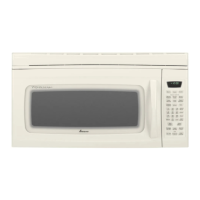
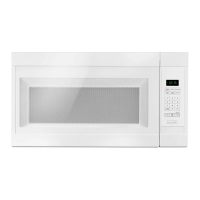
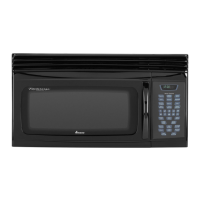
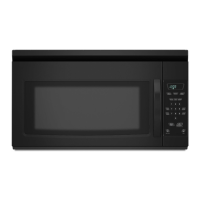
Do you have a question about the Amana AMV1150VAS and is the answer not in the manual?
Provides critical safety alerts and definitions for hazard symbols like DANGER and WARNING.
Lists required tools, parts, and criteria for choosing an installation location and dimensions.
Details electrical supply requirements, grounding, and specific venting needs.
Instructions for preparing the blower motor and mounting plate for venting installation.
Steps for preparing the wall or roof for venting and the microwave's role.
Guidance on finding wall studs and marking the rear wall for secure mounting.
Procedures for drilling holes and securely fastening the mounting plate to the wall.
Steps for preparing the upper cabinet and lifting the microwave into place.
Completing electrical connections, testing operation, and securing the installation.
Details on vent transitions, clearance requirements, and recommended fittings.
Guidance on calculating total vent length and system limitations for optimal performance.
Information on ordering replacement parts and available accessories like filler panels.
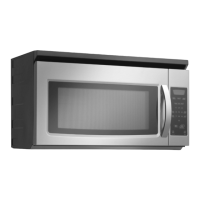
This manual describes the installation, safety, and maintenance of a Microwave Hood Combination appliance. This device serves a dual purpose: it functions as a microwave oven for cooking and reheating food, and it integrates a ventilation system, or hood, designed to remove smoke, steam, and cooking odors from the kitchen environment. The combination design makes it a space-saving solution, typically installed above a range or cooktop, providing both cooking convenience and air purification in one unit.
As a microwave oven, the appliance uses microwave radiation to heat food quickly and efficiently. Users can typically set cooking times and power levels, and many models include pre-programmed settings for common food items. The interior usually features a turntable to ensure even heating. The hood component operates by drawing air from the cooking surface, filtering it, and then either recirculating it back into the kitchen (recirculation installation) or expelling it outside the home (wall or roof venting installation). This helps maintain air quality, reduces grease buildup on kitchen surfaces, and enhances comfort during cooking.
The installation process is detailed to ensure proper and safe setup. Key features related to usage include:
While the manual primarily focuses on installation, it touches upon maintenance aspects related to the ventilation system:
In summary, this Microwave Hood Combination appliance offers a versatile cooking and ventilation solution with detailed installation guidance, robust safety features, and provisions for ongoing maintenance to ensure its longevity and optimal performance in the kitchen.
 General
| Style | over-the-range |
|---|---|
| Color | stainless steel |
| Total Capacity | 1.5 cubic feet |
| Sensor Cooking | no |
| Child Lock | yes |
| Timer | yes |
| Microwave Power | 1000 watts |
 Weight and Dimensions
| Depth | 15.5 inches |
|---|---|
| Height | 17.25 inches |
| Width | 29.94 inches |
| Net Weight | 74 pounds |

 To Next Page