Need help?
Do you have a question about the Amana AU150KW and is the answer not in the manual?
Steps for removing packaging and protective materials from the freezer.
General guidelines for handling and moving the freezer safely.
Recommendations for placing the freezer for optimal performance and safety.
Instructions for connecting the freezer to a power source.
Steps for installing and securing the freezer door handle.
Procedures for leveling the freezer using adjustable legs.
Checks to perform after the freezer has been installed.
Specifies voltage, amperage, and grounding requirements for safe operation.
Information about purchasing an extended service plan.
Guidelines for safely disposing of an old freezer unit.
Guidance on setting the temperature control for efficient operation.
Detailed explanation of the temperature control dial and its settings.
Information on the function and settings of the audible alarm system.
Instructions for operating the freezer's door lock mechanism.
How to remove and replace a reversible storage rack.
Recommendations for proper food wrapping for freezer storage.
Recommended storage times for various food items at 0°F.
Basic instructions for cleaning interior and exterior surfaces.
Method for removing adhesive residue using toothpaste.
How to clean and maintain door gaskets for a proper seal.
Steps to eliminate odors from the freezer interior.
Procedure for manually defrosting the freezer when frost accumulates.
Instructions for replacing the interior light bulb.
Advice on operating the freezer efficiently to save energy.
Recommendations for freezer maintenance during long absences.
Explanation of common sounds the freezer may make during operation.
Troubleshooting steps for common operational issues before contacting service.
Detailed explanation of normal operating sounds with diagrams.
Steps for testing the refrigeration system using temperature testers.
Procedure for testing the main condenser for leaks using nitrogen.
Safety warnings and procedures for testing refrigeration systems for leaks.
Grounding and wiring considerations for electrical components.
Steps for testing compressor electrical connections and voltage.
Method for directly testing the compressor's operation.
Explanation of the overload protector and its function.
How to test the overload protector for continuity.
Information about the PTC relay and its role in compressor starting.
Procedure for testing the PTC relay using an ohmmeter.
Troubleshooting and replacement of the interior light and switch.
How to check the temperature control for proper operation.
Testing cut-in and cut-out temperatures for the control.
Explanation of the defrost timer's operation and circuits.
Procedure for testing the defrost timer for continuity and function.
Testing the defrost heater and thermostat for proper operation.
Description of the freezer fan's function in no-defrost models.
Steps to test the freezer fan motor for operation.
Information on the audible alarm system and its settings.
Table showing performance data for manual and auto defrost models.
Possible causes and corrections for frost build-up on the freezer coil.
Troubleshooting steps when the compressor fails to start.
Diagnosing and correcting excessive noise during operation.
Reasons for high freezer temperature despite compressor running.
Troubleshooting combined issues of compressor failure and no light.
Identifying causes of exterior sweating on the freezer.
Diagnosing short cycling of the compressor.
Troubleshooting when the freezer fails to reach freezing temperatures.
Addressing issues where the freezer becomes excessively cold.
Solutions for issues related to defrost water drainage.
Step-by-step guide for replacing the refrigerant drier.
Procedures for removing and installing a replacement compressor.
Steps to replace the heat exchanger in refrigerated shelf models.
Steps to replace the heat exchanger in no-defrosting models.
How to replace freezer shelving units in refrigerated shelf models.
Procedure for removing and replacing the freezer coil in no-defrost models.
Instructions for replacing the interior light switch.
Steps for removing and installing the temperature control assembly.
Procedure for replacing the defrost heater element.
Steps to replace the freezer fan motor assembly.
Breakdown of the cabinet door components and assembly.
Steps to remove the entire cabinet door assembly.
Procedure for reinstalling the cabinet door assembly.
How to install the inner door liner and gasket.
Steps for removing the freezer door handle.
Explanation of the door lock mechanism and its operation.
Detailed steps for removing the door lock assembly.
How to align the cabinet door for proper sealing.
Methods to test the effectiveness of the door gasket seal.
Techniques to improve or correct door gasket sealing.
Adjustments to hinges for proper door alignment and sealing.
Overview of the main cabinet shell and its components.
Description of the cabinet liner and its components.
General overview of the freezer's defrost water drain system.
Specifics of the drain system for refrigerated shelf models.
Specifics of the drain system for no-defrost models.
How the refrigeration system operates and common issues.
Symptoms and diagnosis of a failed compressor.
Identifying and diagnosing restrictions in the capillary tube.
Problems caused by moisture in the refrigerant system.
Issues related to over or undercharging the refrigerant system.
Diagnosing partial restrictions in the low side tubing.
Understanding compressor pressure unloading.
Causes of compressor overload during initial pull-down.
Procedures for checking refrigeration system operating pressures.
Performing operational checks on the freezer.
General tips and advice for servicing the freezer.
Guidance for acquainting customers with the owner's manual.
Common abnormal usage patterns leading to service calls.
Understanding normal compressor cycle times and variations.
Explanation of normal operating noises, including "gurgling".
Identifying and addressing voids in the freezer's foam insulation.
Common customer complaints and diagnostic steps.
Safety warnings and procedures for detecting refrigerant leaks.
Signs indicating a refrigerant leak within the system.
Differentiating and locating external versus internal refrigerant leaks.
Method for confirming internal leaks via pressure testing.
Diagnosis and handling of internal leaks in the condenser.
Diagnosis and repair of internal leaks in the evaporator.
Steps for evacuating and charging the refrigerant system.
Information on HFC134a refrigerant properties and handling.
Safety considerations for handling HFC134a refrigerant.
Table comparing CFC12 and HFC134a properties and safety.
List of tools and equipment required for HFC134a servicing.
Procedures for replacing the drier filter in sealed systems.
Steps for installing a replacement HFC134a compressor.
Importance of correct refrigerant charge for performance.
Methods for testing sealed systems for leaks.
Safety warnings for evacuation and charging procedures.
Diagram and steps for typical evacuation and charging setup.
Process for dehydrating sealed refrigerant systems to prevent acid formation.
Precautions and materials for brazing refrigeration components.
Safety warnings regarding handling refrigerants.
Risks associated with leaving refrigeration lines open to the atmosphere.
Use and limitations of line piercing valves for diagnosis.
How to adjust temperature control for altitude variations.
Description of the freezer's outer cabinet construction.
Description of the cabinet liner and its components.
General overview of the freezer's defrost water drain system.
Specifics of the drain system for refrigerated shelf models.
Specifics of the drain system for no-defrost models.
Diagram showing grounding connections for various components.
Grounding schematic for specific model configurations.
Grounding schematic illustrating connections for defrost and control systems.
 General
| Brand | Amana |
|---|---|
| Model | AU150KW |
| Category | Freezer |
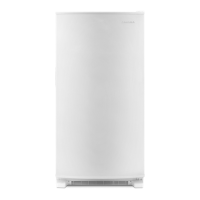
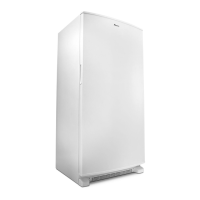
| Type | Upright Freezer |
| Color | White |
| Energy Star Certified | No |
| Defrost Type | Manual |
| Shelves | 4 |


 To Next Page