Need help?
Do you have a question about the Amano PIX-200 and is the answer not in the manual?
Detailed technical specifications of the PIX-200, including power, dimensions, and environment.
Lists the items provided with the PIX-200 unit upon unpacking.
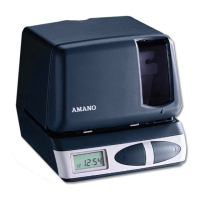
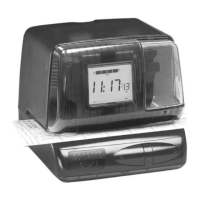
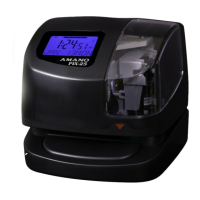
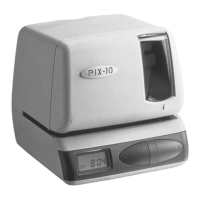
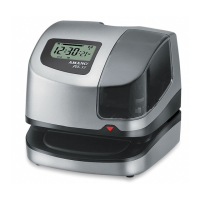
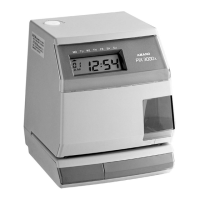
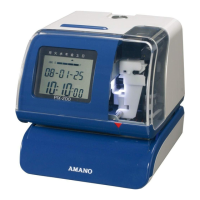
Identifies and describes the various external and internal components of the PIX-200.
Explains the contents and indicators of the PIX-200's LCD screen, including ink capacity.
Details the functions of the five control buttons used for setting and navigation.
Explains how to adjust the print position using the slide lever for optimal alignment.
Step-by-step guide to safely remove packaging and access the PIX-200 unit.
Guidelines for selecting an appropriate location and mounting the PIX-200.
Lists environmental factors and conditions to avoid for proper operation.
Detailed instructions for securely mounting the PIX-200 unit on a wall.
Recommendations for placing the PIX-200 on a level surface for desktop use.
Steps to conduct a test print to verify the PIX-200 is functioning correctly.
Procedures for setting the correct time and date, including a quick setting method.
How to configure the desired format for displaying and printing dates.
Setting, editing, layout, and testing of custom text comments for imprints.
Configuring print direction, year, hyphen, hour, minute, language, and comment settings.
Setting imprint length in millimeters and configuring printing activation methods.
Setting sequential numbering, starting numbers, and auto-reset functions.
Configuring number repeat times and Daylight Saving Time adjustments.
Managing display options, time format, password, and recovery procedures.
Lists countries and their supported atomic clock frequencies and transmitting stations.
Explains the symbols indicating the status of atomic clock signal reception.
Details how the PIX-200 automatically searches for and receives time code signals.
How to manually initiate a search for atomic clock signals if time is off.
Lists locations and conditions that hinder or prevent radio wave signal reception.
How to set specific atomic clock frequencies (DCF, MSF) or disable the function in Europe.
How to set the correct US time zone and disable the atomic clock if needed.
Information on the duration required for the PIX-200 to receive time code signals.
Step-by-step instructions for replacing the ink ribbon cartridge.
Guidelines for safely cleaning the exterior and interior of the PIX-200.
Lists common error codes, their causes, and recommended solutions for troubleshooting.
A table showing preprogrammed comments and language options for various regions.
A chart mapping character codes to specific print characters and functions.
Further details and charts related to character codes used for imprinting.
Explains different font types (one-byte, two-byte, emphatic) and their dot configurations.
Illustrates different ways minutes are printed based on various settings (60th, 100A, 100B).
 General
| Print Method | Dot Matrix |
|---|---|
| Mounting | Wall or Table |
| Type | Time Recorder |
| Power Supply | 120V AC ±10%, 60Hz |
| Display | Digital |
| Time Format | 12 or 24 hour |
| Battery Backup | Yes |
| Timekeeping | Quartz |
| Operating Temperature | 14°F to 113°F (-10°C to 45°C) |
| Humidity Range | 10% to 90% RH (non-condensing) |

 To Next Page