EasyManua.ls Logo

American Water Heater Compact 6 - User Manual

American Water Heater Compact 6
24 pages
Print Icon
To Next Page IconTo Next Page
Loading...
PLACE THESE INSTRUCTIONS ADJACENT TO HEATER AND NOTIFY OWNER TO KEEP FOR FUTURE REFERENCE.
KEEP THIS MANUAL IN THE POCKET ON HEATER FOR FUTURE REFERENCE WHENEVER MAINTENANCE
ADJUSTMENT OR SERVICE IS REQUIRED.
100357051_2000605443BPRINTED 0322
Instruction Manual
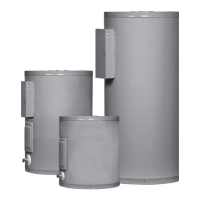
COMMERCIAL LIGHT DUTY ELECTRIC WATER HEATERS
Compact 6/10/15/20 Models
Lowboy 30/40/50 Models
Tall 30/40/52 Models
INSTALLATION - OPERATION - SERVICE - MAINTENANCE
LOW LEAD
CONTENT
Thank you for buying this energy efficient water heater. We
appreciate your condence in our products.
Read and understand this instruction
manual and the safety messages
herein before installing, operating or
servicing this water heater.
Failure to follow these instructions and
safety messages could result in death
or serious injury.
This manual must remain with the
water heater.
If the water heater becomes immersed
in water up to or above the level of the
bottom of the element doors, the
heater should be examined by a
qualified service agency before it is
placed in operation.
Electrical Shock Hazard
Printed on 7/25/2022 7:17 AM CT
Question and Answer IconNeed help?

Do you have a question about the American Water Heater Compact 6 and is the answer not in the manual?

Summary

Safe Installation, Use, and Service

Important Definitions

Defines terms like 'Qualified Installer or Service Agency' as per ANSI standards.

Approvals

Shows UL, CSA, and AHRI certifications for the product.

General Safety Information

Precautions

Highlights warnings about water damage, external fire, and operating without water.

Grounding Instructions

Details requirements for grounding the water heater per electrical codes.

Limiting the Risk of Scalding

Advises on preventing scalding by managing water temperature and using mixing valves.

Hydrogen Gas (Flammable)

Warns about the risk of hydrogen gas accumulation and flammability.

Hazard Messages Explanation

Explains the meaning of DANGER, WARNING, and CAUTION safety alert symbols.

Specific Hazard Warnings

Covers specific safety warnings for burn, explosion, electrical shock, and property damage hazards.

Introduction

Preparing for the Installation

Outlines essential pre-installation steps, including reading manuals and safety warnings.

Features and Components

Model and Rating Interpretation

Explains how to interpret the model and rating plate for product information.

Installation Considerations

Locating the Water Heater

Provides guidance on selecting a suitable location for the water heater, considering clearances and drainage.

Clearances for Servicing

Details minimum clearances required around the water heater for servicing and access.

Installation

Required Ability for Installation

Specifies the required skills, equivalent to a qualified tradesman or agency, for installation.

General Installation Requirements

Outlines general installation compliance with codes, instructions, and power company requirements.

Mixing Valve Usage and Safety

Discusses the importance and use of mixing valves for safe water temperatures and scald prevention.

Contaminated Water and Chemicals

States the water heater cannot be connected to non-potable water or heating systems.

Circulating Pump Recommendations

Recommends bronze construction for field-installed circulating pumps.

Insulation Blanket Guidelines

Provides instructions and warnings regarding the use of external insulation blankets.

Temperature-Pressure Relief Valve Importance

Details requirements and importance of the temperature-pressure relief valve for safety.

Closed Water Systems

Explains what constitutes a closed water system and its implications.

Thermal Expansion Effects

Describes thermal expansion, its effects, and the need for an expansion tank.

Electrical Safety and Connections

Covers essential electrical safety and connection requirements for the water heater.

Branch Circuit Requirements

Details branch circuit wire sizing based on NFPA-70 and heater amperage.

Calculating Amperage and Over-Current Protection

Explains how to calculate amperage and select over-current protection for the circuit.

Start Up

Initial Start Up Procedures

Provides a checklist for initial checks and operations after installation.

Scald Prevention During Start Up

Reiteration of scald prevention measures, recommending mixing valves.

Filling the Water Heater

Instructs on the proper procedure for filling the water heater tank before operation.

Draining the Water Heater

Details the procedure for draining the water heater tank for maintenance or shutdown.

Temperature Regulation

Temperature Adjustment Guidelines

Explains how to adjust the thermostat for desired water temperature settings.

Maintenance

Tank Drain and Flush

Details the periodic draining and flushing of the tank to reduce sediment.

Lime Scale Removal Methods

Explains the causes of lime scale and its effects, recommending removal.

Chemical Lime Scale Removal

Recommends UN-LIME® Professional Delimer for stubborn lime scale deposits.

Anode Maintenance

Temperature-Pressure Relief Valve Test

Troubleshooting

General Troubleshooting Checklist

Provides a checklist of common issues to verify before calling for service.

Abnormal Sounds Diagnosis

Explains common noises like sizzling or hissing and their causes.

Water Leakage Suspects

Guides on checking for water leaks, including common causes like pressure or faulty valves.

Unresolved Malfunctions

Instructs users to contact a qualified service agency if problems persist.

Replacement Parts Information

Advises on how to obtain replacement parts and what information to provide.

Checking for Leaks

Provides a guide and illustration for checking various potential leak points on the water heater.

Wiring Diagrams

Overview

This document is an installation, operation, service, and maintenance manual for Commercial Light Duty Electric Water Heaters, specifically covering Compact 6/10/15/20 Models, Lowboy 30/40/50 Models, and Tall 30/40/52 Models. The water heaters are AHRI Certified® and comply with Low Lead Content standards, as indicated by the UL and SA certifications.

Function Description

These electric water heaters are designed to produce hot water for various commercial applications, including space heating, clothes washing, dishwashing, cleaning, and other sanitizing needs. They are equipped with adjustable thermostats to control water temperature and are designed for energy-efficient operation. The manual emphasizes the importance of proper installation, use, and maintenance to ensure safe and trouble-free service.

Important Technical Specifications

The manual includes a "Table 1. Recovery Capacities" which details the U.S. Gallons/Hr (GPH) and Liters/Hr (LPH) at various temperature rises for different element wattages (Input kW) in both non-simultaneous and simultaneous operation. For example, a 1.5 kW element in non-simultaneous operation can produce 17 GPH at a 36°F rise, while a 6 kW element in simultaneous operation can produce 135 GPH at a 36°F rise. The table also provides temperature rise values in both Fahrenheit and Celsius.

"Table 2. Rough-In Dimensions" provides detailed measurements (Inches and mm) for various models, including Compact-6, Compact-10, Compact-15, Compact-20, Lowboy-30, Lowboy-40, Lowboy-50, Tall-30, Tall-40, and Tall-52. These dimensions include A, B, C, and D measurements, along with approximate shipping weights in Lbs. and kg.

The water heaters are designed for specific electrical configurations. The manual describes two main circuits:

  • C-2 Circuit for Single Element Heaters: Equipped with a high limit control, single-phase power input.
  • A-8 Circuit for Dual Element Heaters: Equipped with two high limit controls, single-phase or three-phase power input.
    • Dual element heaters are factory wired for non-simultaneous operation but can be field-converted to simultaneous operation by moving a specific red wire on the "J" terminal to L1.
    • They can also be field-converted to single-phase operation by moving the wire on L3 of the terminal block to L2 (L3 is not used in this configuration).
    • A critical note warns that the A-8 circuit must NOT be converted to simultaneous operation if the total current draw exceeds 48 AMPS.

The manual also references "Table 3. Example Calculation" for amperage, showing how to calculate current draw for both non-simultaneous and simultaneous units. It also includes "Portion of Table 310-16 (NFPA-70)" and "Portion of Table 310-18 (NFPA-70)" for allowable ampacities of insulated copper and aluminum/copper-clad aluminum conductors, respectively, based on conductor temperature ratings and ambient temperatures.

Thermostats are adjustable: A-8 circuit thermostats range from approximately 120°F (49°C) to 181°F (83°C), while C-2 circuit thermostats range from approximately 110°F (43°C) to 170°F (77°C). Factory pre-set temperature is 140°F (60°C). Each thermostat includes an over-temperature device (ECO high limit) with a manual reset.

Usage Features

  • Temperature Regulation: The water heater is equipped with an adjustable thermostat. Users are advised to set the temperature to the lowest possible setting that satisfies their hot water needs to avoid scalding and ensure energy efficiency. "Table 4. Burn Time at Various Temperatures" provides critical information on how quickly burns can occur at different water temperatures, emphasizing the risk of severe burns at temperatures above 125°F (52°C).
  • Scald Prevention: To reduce the risk of scalding, especially for children, the elderly, and the physically or mentally disabled, the manual strongly recommends installing thermostatic mixing valves at each point of use. These valves allow for a higher tank temperature setting (beneficial for appliances like dishwashers) while ensuring safe water temperatures at fixtures.
  • Hydrogen Gas Warning: The manual warns about the potential presence of flammable hydrogen gas in hot water systems that have not been used for two weeks or more. Users are advised to open hot water faucets for several minutes at the kitchen sink before using any electrical appliance connected to the hot water system, and to avoid smoking or open flames near the faucet during this time.
  • Closed Water Systems: In closed water systems (due to devices like pressure reducing valves or backflow preventers), thermal expansion can cause excessive pressure and premature tank failure. The installation of a properly sized thermal expansion tank is recommended to mitigate these effects.
  • Contaminated Water: The water heater should not be connected to non-potable water systems or systems using toxic chemicals for boiler treatment.
  • Circulating Pump: Field-installed circulating pumps should be of all bronze construction.

Maintenance Features

  • Drain and Flush: The manual recommends draining and flushing the water heater storage tank every 6 months to reduce sediment buildup. This involves turning off the electrical supply, opening a hot water faucet until the water is cool, closing the supply water inlet valve, attaching a hose to the drain valve, and allowing the water to run until clean.
  • Lime Scale Removal: Dissolved minerals in water can precipitate as lime scale, reducing heating efficiency and potentially shortening the water heater's lifespan. Regular deliming is recommended. For stubborn deposits, UN-LIME® Professional Delimer (a food-grade acid) is suggested, with instructions to contact technical support for ordering. Hydrochloric-based acids should not be used.
  • Anode Maintenance: The water heater is equipped with an anode rod to protect the tank from corrosion. The anode rod sacrifices itself and should be inspected annually. Signs of a depleted anode rod include a diameter less than 3/8" or significant sections of the support wire being visible. Replacement of a depleted anode rod is crucial to extend the water heater's life. Softened water can accelerate anode deterioration.
  • Temperature-Pressure Relief Valve (T&P Valve) Test: The T&P valve should be checked every 6 months to ensure it is in operating condition. This involves lifting the lever several times to ensure it seats properly and operates freely. If the valve fails to reset or continuously releases water, it must be replaced with a properly rated/sized new one. The discharge pipe from the T&P valve must terminate at an adequate drain, be of appropriate material and size, and not be plugged or blocked.
  • Clearances: A minimum clearance of 4 inches is required for access to replaceable parts like thermostats, drain valves, and relief valves. Adequate clearance for servicing, such as changing anodes, should be considered during installation.
  • Electrical System Check: Before any servicing or removing access panels, the electrical supply to the water heater must be turned OFF to prevent electrical shock. Full power is present whenever the cabinet door is opened, even if the pilot switch is off.
  • Leak Detection: The manual provides an illustration and checklist for identifying potential leak sources, including fittings, pipe connections, anode rod fitting, T&P valve, element terminals, and drain valve. It advises against replacing the water heater until all potential leak points have been inspected and corrected.

American Water Heater Compact 6 Specifications

General IconGeneral
BrandAmerican Water Heater
ModelCompact 6
CategoryWater Heater
LanguageEnglish

Related product manuals