
 Need help?
Do you have a question about the AMH ULTRAMIG 200 and is the answer not in the manual?
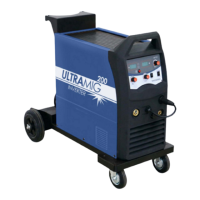
The ULTRAMIG 200 Inverter is a MIG welder designed for various welding applications, offering a blend of safety, reliability, durability, and efficient maintenance. This manual provides comprehensive information for safe installation, operation, and maintenance of the product.
The ULTRAMIG 200 Inverter is a multi-function welding machine capable of performing MMA (Manual Metal Arc) and MIG (Metal Inert Gas) welding. It is designed to be used with an integrated trolley, a spool gun, and supports FCAW (Flux-Cored Arc Welding).
The ULTRAMIG 200 Inverter operates on a single-phase AC220V-240V, 50/60Hz input power supply, with a rated input capacity of 8.8 kVA. Its rated output current is 200 A, and the rated output voltage is 24 V. The rated duty cycle is 35%, and the no-load voltage is 52 V. For MMA welding, the output current range is 10–200 A, while for MIG welding, it is 30–200 A. The output voltage range in MIG is 11–27 V. The machine supports electrode diameters of 0.6/0.8/0.9/1.0 mm and can accommodate a wire spool of 15 kg. The wire feed speed range is 1.5–16 m/min. It has an insulation class of F and employs air-cooling. The protection class is IP21S, and the power factor is 0.7, with an efficiency of 85%. The physical dimensions of the machine are 900x450x755 mm, and it weighs 46 kg. It is designed for use in a working environment with temperatures between -10°C and 40°C and relative humidity of 90% or less.
The ULTRAMIG 200 Inverter incorporates advanced IGBT inverter technology, which significantly reduces the welder's size and weight. This technology also leads to great reductions in copper and iron loss, enhancing welding efficiency and saving energy. The switching frequency is beyond audio frequency, which almost eliminates noise pollution. The machine offers leading control mode, allowing it to be welded with various electrodes with a diameter of 0.6mm–1.2mm, and it can be used in acid and basic electrode welding. It ensures easy arc starting, less spatter, stable current, and good shaping. The metal enclosure is designed to withstand strong shock and drop, guaranteeing high work efficiency even in harsh working environments. It features excellent insulating properties and is waterproof, antistatic, and anticorrosion.
Installation and Operation: For MMA welding, the primary power line should be connected to the appropriate voltage class. The earth clamp cable is inserted into the front panel's "-" output terminal, and the quick plug into the "+" output terminal. For gas shielded welding, the welding torch is inserted into the "Euro connector for torch" output socket and tightened. The wire spool is installed, and the welding wire is pulled through the torch body. A cylinder with a gas regulator is connected to the gas inlet on the back panel. The earth clamp and quick plug are connected to the respective terminals. The wire spool is installed, ensuring the groove size matches the contact tip and wire size. The pressure arm of the wire feeder is adjusted to prevent wire sliding or distortion. The inching wire feeding button is used to thread the wire. For gasless self-shielded metal arc welding, the installation is similar to gas shielded welding, but without the gas cylinder connection. The operation method is the same as gas shielded welding, except for polarity connection.
Welding Process: The manual details various aspects of MMA welding, including connecting output terminals, setting current, and handling electrode and workpiece connections. It also covers basic operation of MMA, such as welding joint cleaning, posture in operating, arc igniting, tack weld, electrode manipulation, and arc extinguishing. For GMAW (Gas Metal Arc Welding), the manual describes the classification and application of GMAW, welding tools (welding source, wire feed system, welding torch), and basic operation. This includes preweld cleaning, equipment checks, labor protection, welding parameter selection (current, speed, stick-out, angle, position), and welding process (including positioning, weld bead initiating, electrode manipulation, weld bead connection, and weld bead ending).
The ULTRAMIG 200 Inverter requires professional knowledge for maintenance. Operators should be licensed and certified. Regular checks:
Troubleshooting: The manual provides a comprehensive troubleshooting guide for common malfunction phenomena, their causes, and solutions.
This product is under continuous improvements; therefore, there might be differences in some respects except for functions and operation. Your understanding is much appreciated.
 General
| Brand | AMH |
|---|---|
| Model | ULTRAMIG 200 |
| Category | Welding System |
| Language | English |

 To Next Page