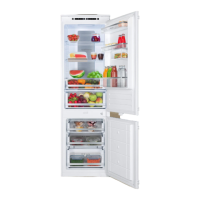
This document is an instruction manual for an Amica refrigerator-freezer, covering models BK296.3FA, BK296.3, BK316.3FA, and BK316.3. It provides comprehensive guidelines for safe use, installation, operation, maintenance, and troubleshooting.
Function Description
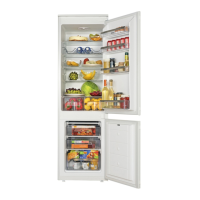
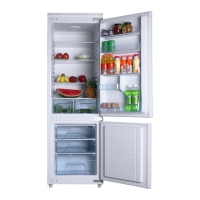
The Amica refrigerator-freezer is designed for household use, primarily for storing food. It features both a refrigerator compartment and a freezer compartment, with some models offering a "no-frost" system in the freezer. The appliance is intended for use as a built-in unit.
Refrigerator Compartment:
This section is for storing fresh food items such as eggs, cooked food, packaged food, fruits, vegetables, dairy products, cakes, and drinks. The recommended temperature range for the fridge is +2°C to +8°C. Some models may include a "Chill" compartment (2°C to +3°C) for fresh/frozen pork, beef, chicken, and freshwater aquatic products, or a "0-star compartment" (-6°C to 0°C) for fresh pork, beef, fish, chicken, and some packaged processed foods. The coldest area in the refrigerator is typically above the vegetable drawers, suitable for delicate and highly perishable foods like fish, meat, poultry, ready meals, and fresh dough. The warmest area is in the top section of the door, ideal for butter and cheese.
Freezer Compartment:
The freezer is designed for storing frozen food and, in some models, for freezing fresh food. Depending on the star rating, the freezer can maintain temperatures suitable for different storage durations:
- * (One-star): At least -6°C, suitable for storing frozen food for about a week.
- ** (Two-star): -12°C or below, suitable for 1-2 weeks without losing taste. Not suitable for freezing fresh food.
- *** (Three-star): -18°C or below, suitable for storing foods and freezing up to 1 kilogram of fresh food.
- **** (Four-star): -18°C or below, suitable for storing foods and freezing larger quantities of fresh foods.
Foods suitable for freezing include seafood (fish, shrimp, shellfish), freshwater aquatic products, and meat products, with recommended storage times ranging from 1 to 3 months depending on the specific food and freezer rating. Most food products, except raw vegetables like lettuce, can be frozen.
Important Technical Specifications
- Power Supply: AC 220-240V 50Hz, requiring a properly fitted socket with an earthing conduit and a 10A fuse.
- Refrigerant: The appliance uses a flammable refrigerant (isobutane/R600a). The room size for a product containing R600a must be at least 4m³ to avoid damage to the cooling system.
- Climate Range: The optimal operating temperature depends on the climate class:
- SN (Extended Temperate): 10°C to 32°C
- N (Temperate): 16°C to 32°C
- ST (Subtropical): 16°C to 38°C
- T (Tropical): 16°C to 43°C
- Lighting: Some units are equipped with incandescent lightbulbs, while selected appliances feature LED lighting with E14 thread (220-240V, max dimensions: 26 mm diameter, 55 mm length).
- Spare Parts Availability: Pursuant to Commission Regulation (EU) 2019/2019, the minimum availability period for spare parts is 7 or 10 years, depending on the type and purpose of the spare part.
Usage Features
- Temperature Control: The appliance features a temperature control dial (1) to adjust the internal temperature. Settings range from 1 (highest temperature/warmer) to 7 (lowest temperature/cooler), with an OFF/0 position to turn the appliance off. The middle setting is generally optimal.
- Food Storage Guidelines:
- Food should be placed on plates, in containers, or packed in food wrap, distributed evenly.
- Avoid placing hot food directly into the fridge.
- Strong-smelling foods like fish or smoked meat should be tightly sealed.
- Vegetables should be dried before storage to prevent excessive moisture.
- For freezing, food should be of high quality, divided into small portions, and packed in odourless, air/moisture-resistant materials (plastic bags, polyethylene, aluminum sheets). Glass containers should not be used.
- Do not refreeze partly thawed products.
- Avoid storing carbonated beverages in the freezer chamber, as cans and bottles may explode.
- Do not consume frozen products directly from the freezer to prevent frostbite.
- Energy Efficiency Tips:
- Avoid placing the appliance near heat sources or in direct sunlight.
- Ensure air vents are not covered and clean them regularly.
- Select appropriate temperatures (6-8°C for fridge, -18°C for freezer).
- Open doors only when necessary and return food quickly.
- Keep door seals clean and replace broken ones.
- For increased freezer capacity, drawers can be removed to place food directly on shelves.
Maintenance Features
- Cleaning:
- Never use solvents or strong, abrasive detergents on the casing or plastic parts. Use mild liquid detergents and soft cloths.
- Disconnect the appliance from the mains before cleaning.
- Clean the interior surfaces of both fridge and freezer chambers at least once a year with water and a mild detergent, then wipe dry.
- Clean the door gasket with water and wipe dry.
- For models with a water dispenser, clean water tanks if unused for 48 hours and flush the system if water hasn't been drawn for 5 days.
- Defrosting:
- Automatic Fridge Defrosting: The fridge chamber automatically defrosts. Condensate drains down the rear wall; if clogged, unclog the opening with the cleaning plug.
- Manual Freezer Defrosting: Recommended at least once or twice a year, or more frequently if ice builds up.
- Switch off the appliance and unplug it.
- Remove food from the freezer and store it in a cool place, wrapped in paper/blankets.
- Pull out the drainage tube (if present) and place a vessel underneath.
- Leave the door open; placing a pot of hot (not boiling) water inside can speed up defrosting.
- Wash and dry the freezer interior.
- Switch the appliance back on.
- Automatic Freezer Defrosting (No-Frost models): Food is frozen by circulating air, and moisture is discharged outside, preventing ice and frost buildup.
- Light Bulb Replacement: For models with incandescent bulbs, set the knob to "OFF," unplug, remove the bulb cover, replace with an identical E14 thread bulb (220-240V, max 26x55mm), and replace the cover. For LED lighting, if Figure 18 is not shown, the light source can only be replaced by a qualified service technician.
- Door Opening Direction Change: The manual provides detailed instructions (Fig. 20) for reversing the door opening direction, involving removing and reattaching hinges and caps. This process requires unplugging the appliance and removing all food.
- Troubleshooting: The manual includes a comprehensive troubleshooting section to address common issues such as the appliance not working, lighting failure, continuous operation, water collection, and unusual noise, along with possible causes and remedies.
- Warranty and Service: Repairs should be carried out by Factory Service Technicians or Authorized Service Points. The warranty is void if unauthorized adaptations, alterations, tampering with safety devices, or interference contrary to operating instructions occur.

 Need help?
 General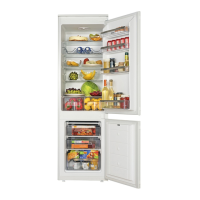

 To Next Page