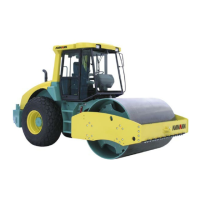
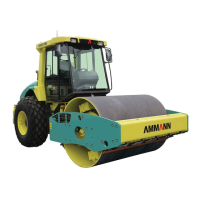
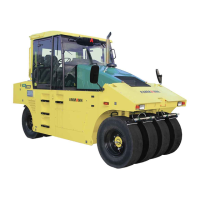
13ASC 70 / 90 / 100 / 110 / 130 / 150 / 200 / 250
WORKSHOP MANUAL
MAINTENANCE
Generalities
Carefully read the Operation and Maintenance Instruction Man-
ual before starting, operating, maintaining, fuelling or servicing
the machine in any manner.
Read all safety plates mounted on the machine and observe
instructions they contain before starting, operating, repairing,
fuelling or servicing the machine. Do not allow unauthorised
personnel to repair or service the machine.
Follow all recommended maintenance and service procedures.
Do not wear rings, wrist watches, jewellery, loose or hanging
garments, such as ties, torn clothing, scarves, unbuttoned or
unzipped jackets that can get caught in moving parts. Wear cer-
tied safety clothes such as: hard hat, no-slip footwear, heavy
gloves, ear protection, safety glasses, reector vests, respirators
when required. Ask your employer about safety regulations in
force and protective equipment.
Do not use controls or hoses as hand holds. Hoses and controls
are movable parts and do not provide solid support. Besides,
controls may be inadvertently moved and cause unexpected
movement of the machine or its attachments.
Do not jump on or o the machine. Always keep both hands and
one foot, or both feet and one hand in contact with steps and/
or grab rails.
Never service the machine with someone sitting in the driver’s
seat, unless this person is an authorised operator assisting in the
maintenance being carried out.
Keep the operator’s compartment, step plates, grab rails and
handles clear of foreign objects, oil, grease, mud or snow to
minimise the danger of slipping or stumbling.
Clean mud or grease from your shoes before climbing on the
machine or driving it.
Never attempt to operate the machine or its attachments from
any position other than sitting in the operator’s seat.
Keep the driver’s seat free from foreign objects, especially if
these are not secured.
Should it be necessary to move the attachment for maintenance
purposes, do not raise or lower the attachment from any other
position than sitting in the operator’s seat. Before starting the
machine or moving its attachment, sound the horn and require
that nobody remains near the machine.
Raise the attachment slowly.
Always lock all moving components or parts of the machine that
must be lifted for maintenance purposes using adequate exter-
nal means as required by local and national regulations. Do not
allow anyone to pass or stay near or below a raised attachment.
If you are not absolutely sure about your safety, do not stay or
walk under a raised attachment.
Do not place head, body, limbs, hands, feet or ngers near artic-
ulated cutting edges deprived of the necessary guards, unless
they are suitably and safely locked.
Never lubricate, repair or adjust the machine with the engine
running, except when this is specically required by the Opera-
tion and Maintenance Instruction Manual.
Do not wear loose clothing, jewellery near rotating parts.
When service or maintenance require access to areas that can-
not be reached from the ground, use a ladder or step platform
conforming to local or national regulations to reach the working
area. If such means are not available, use machine grab rails and
steps. Always perform all service or maintenance work with the
greatest care and attention.
Shop and/or eld service platforms or ladders should be manu-
factured and maintained in accordance with local or national
safety regulations in force.
Disconnect batteries and label all controls to warn that service
work is in progress, according to local and national safety regu-
lation requirements.
Block the machine and all attachments to be raised according to
local and national safety regulation requirements.
Do not check or ll fuel tanks or install batteries near burning
or smoking materials and open ames due to the presence of
ammable vapours.
The fuel ller pipe nozzle must be constantly kept in contact
with the ller neck and this even before fuel starts owing in.
Keep this contact from the beginning to the end of the fuelling
operation to avoid possible generation of sparks due to static
electricity.
Use a trailer to haul a failed machine. Should it be necessary to
tow it, provide for suitable danger signals as required by the lo-
cal norms and regulations and observe recommendations given
in the Operation and Maintenance Instruction Manual. Load/un-
load the machine on rm level ground providing safe support.
Use strong access ramps, with adequate height and angle. Keep
the trailer atbed free of mud, oil or slippery materials. Tie the
machine securely to the trailer.
Never align holes or slots using your ngers; always use appro-
priate aligning tools.
Remove all sharp edges and burrs from re-worked parts.
Use only approved and eectively grounded auxiliary power
sources for heaters, battery chargers, pumps and similar equip-
ment to reduce electrical shock hazard.
Lift and handle heavy components using hoisting devices of ap-
propriate capacity. Ensure the parts are supported by appropri-
ate straps and hooks.
Use lifting eyes provided to this aim.
Pay attention to bystanders near the lifting area.
Never pour gasoline or diesel fuel into open containers. Never
use gasoline, solvents or other ammable uids to clean parts.
Use proprietary certied non-ammable, non-toxic solvents
only.
When using compressed air to clean parts, wear safety glasses
with side shields. Limit pressure to max. 2 bars, in accordance
with local and national safety regulations in force.
Do not run the engine of this machine in closed buildings with-
out proper forced ventilation capable to remove toxic exhaust
gases concentrating in the air. Do not smoke, nor allow open
ames or sparks nearby while refuelling the unit or handling
highly ammable materials.
Do not use open ames as light sources to look for leaks or in-
spect anywhere on the machine.
Make sure that all mechanical tools provided are in good condi-
tion at all times. Never use tools with mushroomed or damaged
heads. Always wear eye protections with side shields.
Move with extreme care when working under, on or near the
machine or its attachments.
In case of attachment tests during which the engine should be
kept running, a qualied operator must sit in the driver’s seat at
all times while the mechanic is at work.
Keep hands and clothes far OFF moving parts.
MANUALEQUIPOSPESADOS.COM manualequipospesados@gmail.com


 To Next Page
 Loading...