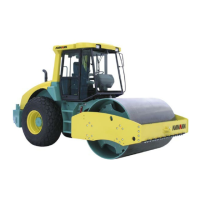
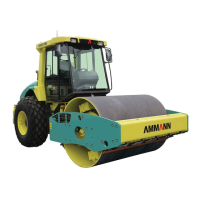
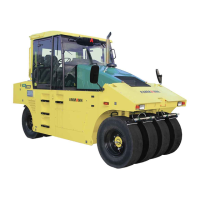
15ASC 70 / 90 / 100 / 110 / 130 / 150 / 200 / 250
WORKSHOP MANUAL
able, fabricate one using blocks. The ramp should be suciently
strong to support machine weight. Always load and unload on
level surface.
Tow the machine following the instructions contained in the
Operation and Maintenance Instruction Manual.
Engine
Do not run the engine in closed buildings without proper venti-
lation capable to remove harmful exhaust fumes. Do not place
head, body, limbs, feet, hands or ngers near rotating fans or
belts. Be especially careful near blower fans.
Loosen the radiator cap very slowly to relieve system pressure
before removing it. Always top-up coolant level with the engine
o or idling if hot. See the Operation and Maintenance Instruc-
tion Manual.
Keep the exhaust manifold and tube free from combustible
matters. Fit the machine with shields and guards when working
in the presence of combustible matter free in the air.
Do not refuel with the engine running, especially if hot, as this
increases re hazard in case of fuel spillage. Never attempt to
check or adjust fan belt tensions when the engine is running.
Do not adjust the fuel injection pump when the machine is op-
erating.
Do not lubricate the machine with the engine running. Do not
run the engine with the air intakes open and not protected. If
this cannot be avoided for service reasons, place protection
meshes on all intakes before servicing the engine.
Electrical system
Pay attention to connect connecting cables to correct poles (+
to +) and (- to -) at both ends. Do not short-circuit
terminals. Thoroughly follow instructions given in Operation
and Maintenance Instruction Manual.
Always move the key-start switch in the lock position before
servicing or repairing the machine.
Batteries contain SULPHURIC ACID. Protect the eyes when work-
ing near the batteries against possible sprays of the acid solu-
tion. Should acid contact skin, eyes, or clothes, RINSE IMMEDI-
ATELY IN WATER FOR AT LEAST 15 MINUTES. Immediately seek
medical attention.
Battery released gas is highly ammable. Leave the battery
compartment cover open during recharging to improve ventila-
tion. Never check battery charge by placing metal objects across
the posts. Keep sparks or open ames away from batteries. Do
not smoke near the battery to prevent explosion hazard.
Before any maintenance or repair, make sure that there are no
fuel or electrolyte leaks from the batteries. If any, correct prior
to proceeding with further work. Do not recharge batteries in
conned spaces. Ensure proper ventilation is provided to avoid
accidental explosions due to build-up of explosive gas released
during charging.
Disconnect batteries before working on the electrical system or
carrying out any other type of work.
Hydraulic system
Pressure uid escaping from a very small hole can be almost in-
visible and still have sucient force to penetrate the skin. Always
check any suspected pressure leaks using a piece of cardboard
or wood. Do not use hands. If injured by escaping uid, obtain
medical attention immediately or serious infection or reaction
may develop.
Stop the engine and ensure pressure is relieved from all systems
before removing side panels, housings, guards and covers. See
the Operation and Maintenance Instruction Manual.
Always use gauges of adequate capacity for pressure testing.
Refer to the Operation and Maintenance Instruction Manual or
Repair Manual.
Tools
Always keep head, body, limbs, feet, hands, and ngers away
from the bucket and attachments, when in the raised position.
Prior to any maintenance or repair work, install all supports nec-
essary to this aim according to local and national safety regula-
tions.
In case the attachment is to be operated for maintenance or re-
pair purposes, do so exclusively while sitting in the driver’s seat.
Sound the horn before starting the machine or moving the at-
tachment. Require that nobody remain near the machine. Raise
the attachment slowly.
Do not use the machine to transport loose objects, unless prop-
er securing devices are provided.
Tyres and wheels
Make sure that the ination pressure of the tyres is according
to the specications issued by the Manufacturer and check it
periodically.
Should the pressure be changed, stand on the side of the tyre
at a safe distance.
Pressure check operations must be performed with unloaded
machine and cold tyres.
Never use reconditioned tyre rims, since eventual weldings,
heat-treatments or repairs not performed correctly can weaken
the wheel, thus causing subsequent damages or dangers.
Do not perform torch cutting or welding operations on rims
with tyres installed.
Spare tyres must be inated only as far it is necessary to keep the
rim components assembled; remember that when not installed
on the disc, a tyre inated to maximum pressure can explode.
Before operating on tyres, block all wheels, front and rear. After
lifting the machine with the cylinders, block it with stands ac-
cording to current safety rules and regulations.
Deate the tyres before removing them.
Before removing objects from the tyre tread, deate it.
Do not inate tyres with ammable gas: they may cause explo-
sions and serious personal injuries.
After each shift check for loose screws and/or rim mounting
brackets. If necessary, tight them according to the instructions
herein contained.
MANUALEQUIPOSPESADOS.COM manualequipospesados@gmail.com


 To Next Page
 Loading...