23www.ampmaker.com
Initial AC and DC voltage tests
• Use your DMM to measure the AC voltage between points A and B in the this diagram. You should
get approximately 430V. Record this gure and the rest in the rest of the gures in the voltage chart.
• Now check the AC voltage between points C and D. You should get a reading of about 6.5-7V.
• Select the high DC voltage range on your DMM and check the voltage between points E and F. The
expected reading is 290V or so.
• Turn the Power level control all the way up. Check the DC voltage between E and G for a reading of
about 285-290V.
• Now dial the Power control down to about midway. The E-G reading should be about 180V. It may
take a few seconds to get there.
• Dial the Power control to minimum and the E-G reading should fall to around 25V
• Stop the project and contact Amp Maker if you get any odd readings.
TIP: Almost all DMMs have switchable ranges to help you get accurate measurements. When measuring
smaller voltages, switch to one of the lower voltage ranges. For example, if you measure the heater
supply using a 500V range, you will most likely see a gure of '7', but if you switch to the 20V range you
would see '6.85', for instance.
Switch o checks
Keep your DMM to hand and switch the amplier o and disconnect the mains lead from your mains
supply. This is a VERY important step - it's easy to forget that when the amplier is switched o, there's
still a potentially lethal voltage at the IEC socket and On/O switch. As
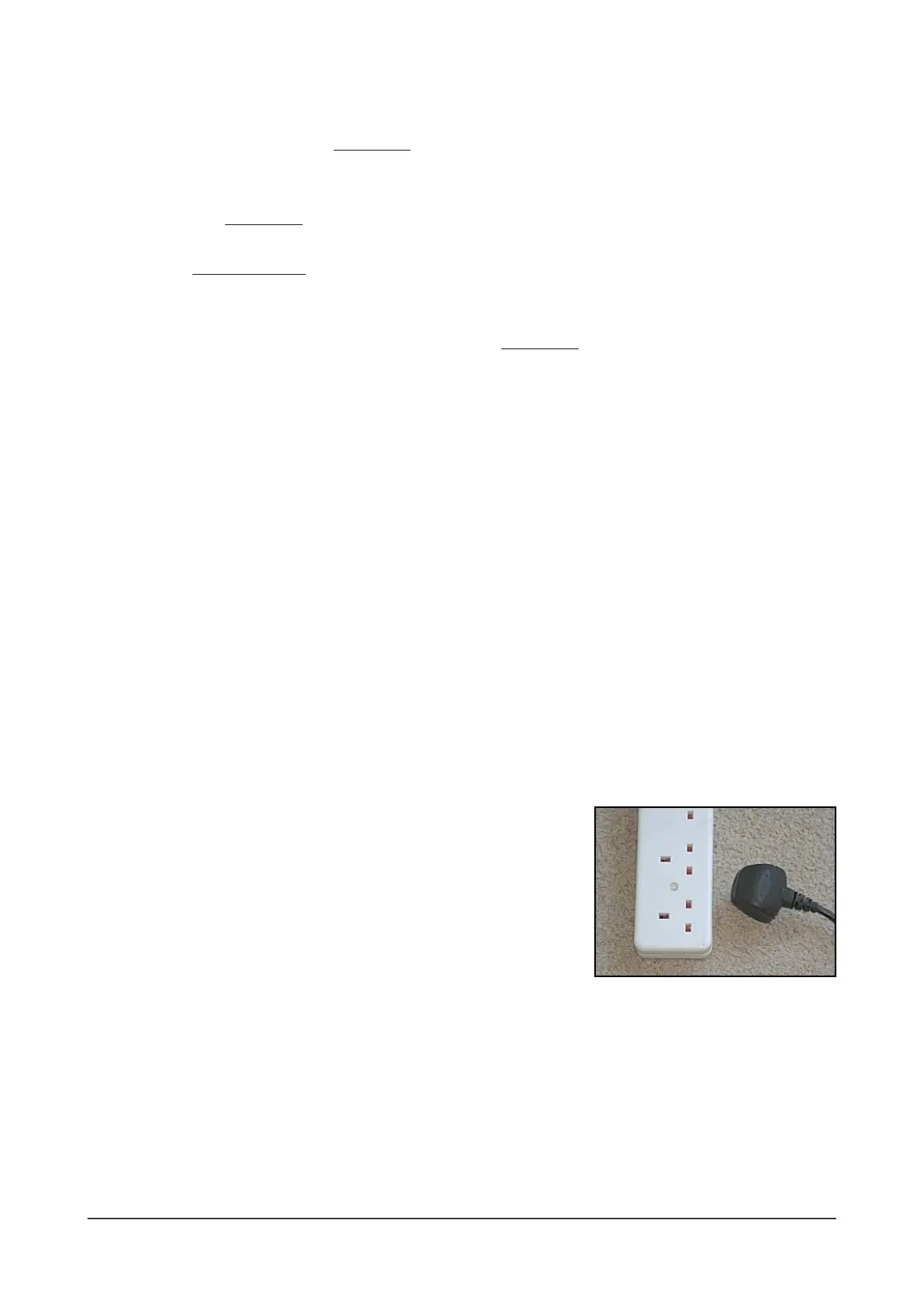
a quick visual check, I pull the amplier cable from the mains socket to
be sure that this voltage is disconnected.
Now recheck all of the DC voltages that you just measured. They
should all fall towards zero. Keep checking until they read less than
10V. If it takes longer than 60 seconds, there's a problem - contact Amp Maker.
NOTE: This step is important because it reminds you that the large blue-black capacitors, known as lter
caps or sometimes reservoir caps, store a large amount of electrical energy, even after an amp is
switched o. The N5X has two bleed resistors - R22 and R26 - that allow this charge to drain away
safely and quickly.


 To Next Page
 Loading...