EasyManua.ls Logo

Ampex 351 - Page 30

Default Icon
103 pages
Print Icon
To Next Page IconTo Next Page
To Previous Page IconTo Previous Page
Loading...
BASIC
CONCEPTS
OF
MAGNETIC
TAPE
RECORDING
FOREWORD
,A"i
i
GENERAL
1
Let
it
be
understood
to
start
with
that
you
are
not
going
to
be
bored
by
the
long,
drawn
out.
discussion
of
the
history
of
magnetic
recording
which
is
the
seemingly
inevitable
preface
to
any
attempts
to
ex
plain
the
basic
theory
of
this
process.
But
it
seems
pertinent
to
point
out
that
the
first
patent
on
a
mag
netic
recording
device
was
issued
some
60
years
ago.
and
it
was
originally
anticipated
that
its
main
use
would
be
in
the
telephone
and
telegraph
industries.
So
magnetic
sound
is
not
a
recent
innovation.
It
is
also
interesting
to
note
that
probably
the
first
magnetic
recorder
to
use
tape
(steel
tape,
that
is)
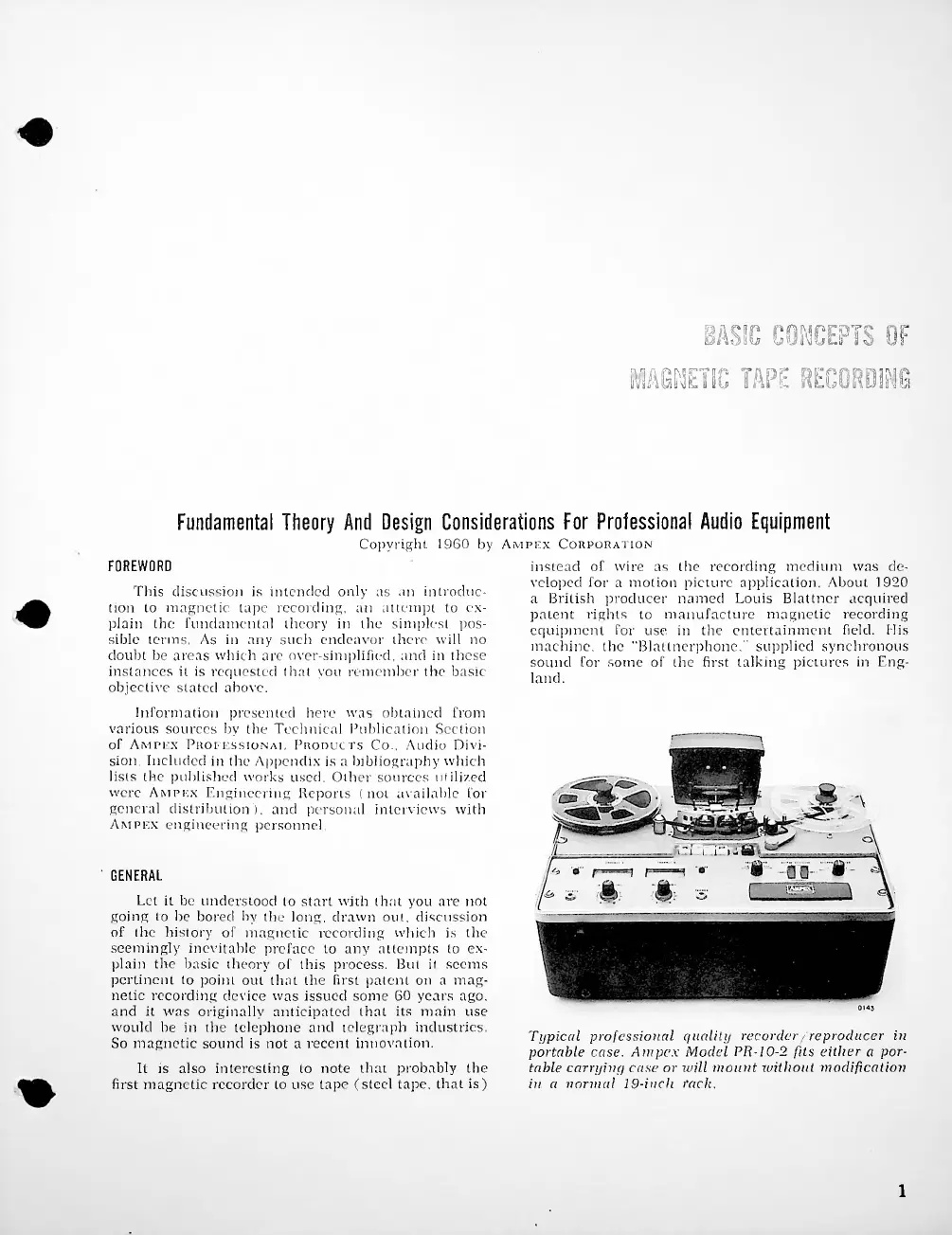
Typical
professional
quality
recorder/reproducer
in
portable
case.
Ampex
Model
PR-10-2
fits
either
a
por
table
carrying
case
or
will
mount
without
modification
in
a
normal
19-inch
rack.
Fundamental
Theory
And
Design
Considerations
For
Professional
Audio
Equipment
Copyright
1960
by
A
mpex
C
orporation
instead
of
wire
as
the
recording
medium
was
de
veloped
for
a
motion
picture
application.
About
1920
a
British
producer
named
Louis
Blattner
acquired
patent
rights
to
manufacture
magnetic
recording
equipment
for
use
in
the
entertainment
field.
His
machine,
the
Blattnerphone,
supplied
synchronous
sound
for
some
of
the
first
talking
pictures
in
Eng
land.
This
discussion
is
intended
only
as
an
introduc
tion
to
magnetic
tape
recording,
an
attempt
to
ex
plain
the
fundamental
theory
in
the
simplest
pos
sible
terms.
As
in
any
such
endeavor
there
will
no
doubt
be
areas
which
are
over-simplified,
and
in
these
instances
it
is
requested
that
you
remember
the
basic
objective
stated
above.
Information
presented
here
was
obtained
from
various
sources
by
the
Technical
Publication
Section
of
A
mpex
P
rofessional
P
roducts
C
o
..
Audio
Divi
sion.
Included
in
the
Appendix
is
a
bibliography
which
lists
the
published
works
used.
Other
sources
utilized
were
A
mpex
Engineering
Reports
(not
available
for
general
distribution),
and
personal
interviews
with
A
mpex
engineering
personnel.

Related product manuals