EasyManua.ls Logo

Ampex 351 - Page 31

Default Icon
103 pages
Print Icon
To Next Page IconTo Next Page
To Previous Page IconTo Previous Page
Loading...
BASIC
COMPONENTS
OF
A
MAGNETIC
TAPE
RECORDER
OB
Odb
B
IOOOO
2
A
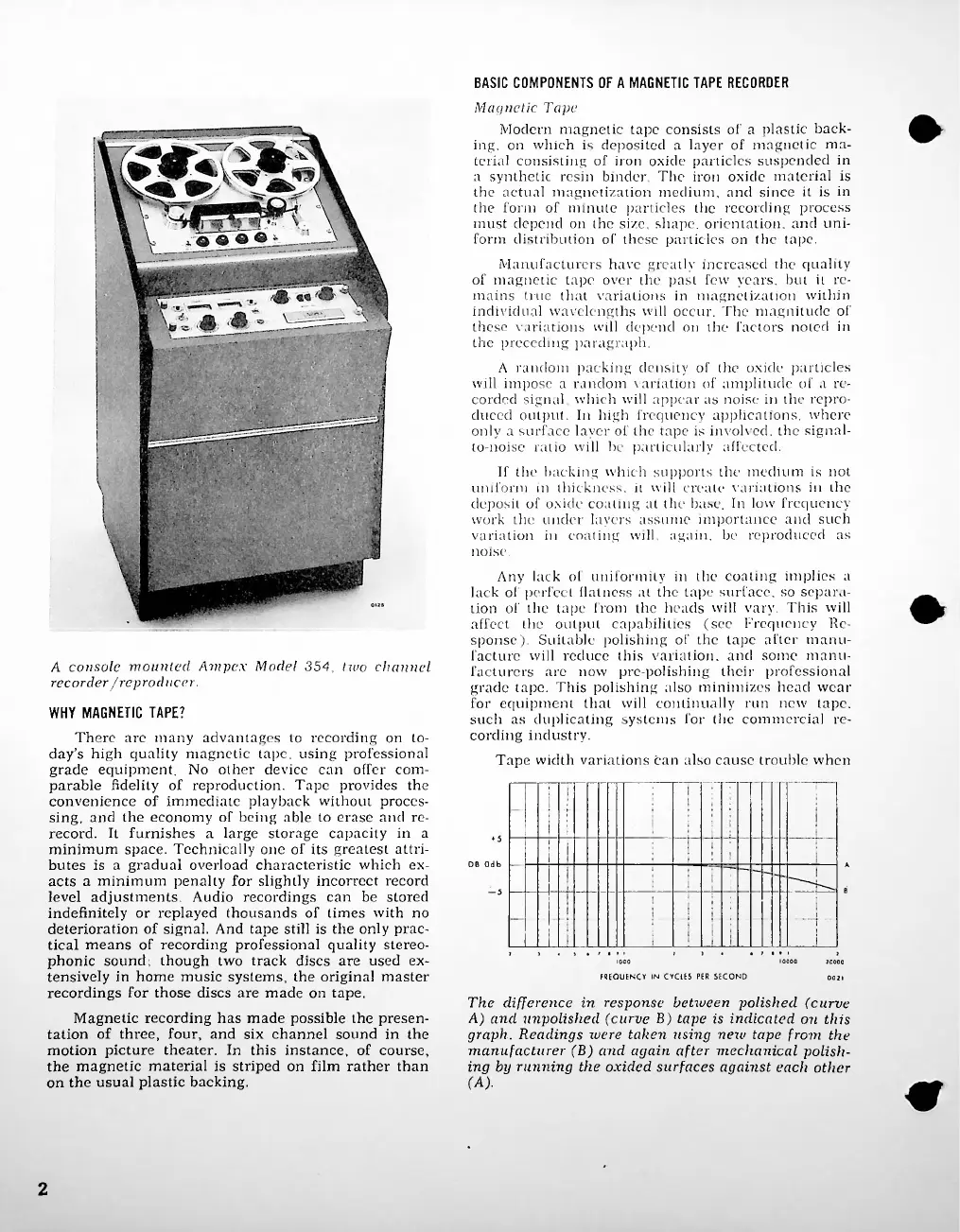
console
mounted
Ampex
Model
354,
two
channel
recorder/reproducer.
2CCOO
0021
FREQUENCY
IN
CYCLES
PER
SECOND
The
difference
in
response
between
polished
(curve
A)
and
unpolished
(curve
B)
tape
is
indicated
on
this
graph.
Readings
were
taken
using
new
tape
from
the
manufacturer
(B)
and
again
after
mechanical
polish
ing
by
running
the
oxided
surfaces
against
each
other
(A).
Ki
WHY
MAGNETIC
TAPE?
There
are
many
advantages
to
recording
on
to
day
s
high
quality
magnetic
tape,
using
professional
grade
equipment.
No
other
device
can
offer
com
parable
fidelity
of
reproduction.
Tape
provides
the
convenience
of
immediate
playback
without
proces
sing,
and
the
economy
of
being
able
to
erase
and
re
record.
It
furnishes
a
large
storage
capacity
in
a
minimum
space.
Technically
one
of
its
greatest
attri
butes
is
a
gradual
overload
characteristic
which
ex
acts
a
minimum
penalty
for
slightly
incorrect
record
level
adjustments.
Audio
recordings
can
be
stored
indefinitely
or
replayed
thousands
of
times
with
no
deterioration
of
signal.
And
tape
still
is
the
only
prac
tical
means
of
recording
professional
quality
stereo
phonic
sound;
though
two
track
discs
are
used
ex
tensively
in
home
music
systems,
the
original
master
recordings
for
those
discs
are
made
on
tape.
Magnetic
recording
has
made
possible
the
presen
tation
of
three,
four,
and
six
channel
sound
in
the
motion
picture
theater.
In
this
instance,
of
course,
the
magnetic
material
is
striped
on
film
rather
than
on
the
usual
plastic
backing.
Any
lack
of
uniformity
in
the
coating
implies
a
lack
of
perfect
flatness
at
the
tape
.surface,
so
separa
tion
of
the
tape
from
the
heads
will
vary.
This
will
affect
the
output
capabilities
(sec
Frequency
Re
sponse).
Suitable
polishing
of
the
tape
after
manu
facture
will
reduce
this
variation,
and
some
manu
facturers
are
now
pre-polishing
their
professional
grade
tape.
This
polishing
also
minimizes
head
wear
for
equipment
that
will
continually
run
new
tape,
such
as
duplicating
systems
for
the
commercial
re
cording
industry.
Tape
width
variations
can
also
cause
trouble
when
Magnetic
Tape
Modern
magnetic
tape
consists
of
a
plastic
back
ing.
on
which
is
deposited
a
layer
of
magnetic
ma
terial
consisting
of
iron
oxide
particles
suspended
in
a
synthetic
resin
binder.
The
iron
oxide
material
is
the
actual
magnetization
medium,
and
since
it
is
in
the
form
of
minute
particles
the
recording
process
must
depend
on
the
size,
shape,
orientation,
and
uni
form
distribution
of
these
particles
on
the
tape.
Manufacturers
have
greatly
increased
the
quality
of
magnetic
tape
over
the
past
few
years,
but
it
re
mains
true
that
variations
in
magnetization
within
individual
wavelengths
will
occur.
The
magnitude
of
these
variations
will
depend
on
the
factors
noted
in
the
preceding
paragraph.
A
random
packing
density
of
the
oxide
particles
will
impose
a
random
variation
of
amplitude
of
a
re
corded
signal
which
will
appear
as
noise
in
the
repro
duced
output.
In
high
frequency
applications,
where
only
a
surface
layer
of
the
tape
is
involved,
the
signal-
to-noise
ratio
will
be
particularly
affected.
If
the
backing
which
supports
the
medium
is
not
uniform
in
thickness,
it
will
create
variations
in
the
deposit
of
oxide
coaling
at
the
base.
In
low
frequency
work
the
under
layers
assume
importance
and
such
variation
in
coating
will,
again,
be
reproduced
as
noise.

Related product manuals