EasyManua.ls Logo

Ampex 351 - Page 32

Default Icon
103 pages
Print Icon
To Next Page IconTo Next Page
To Previous Page IconTo Previous Page
Loading...
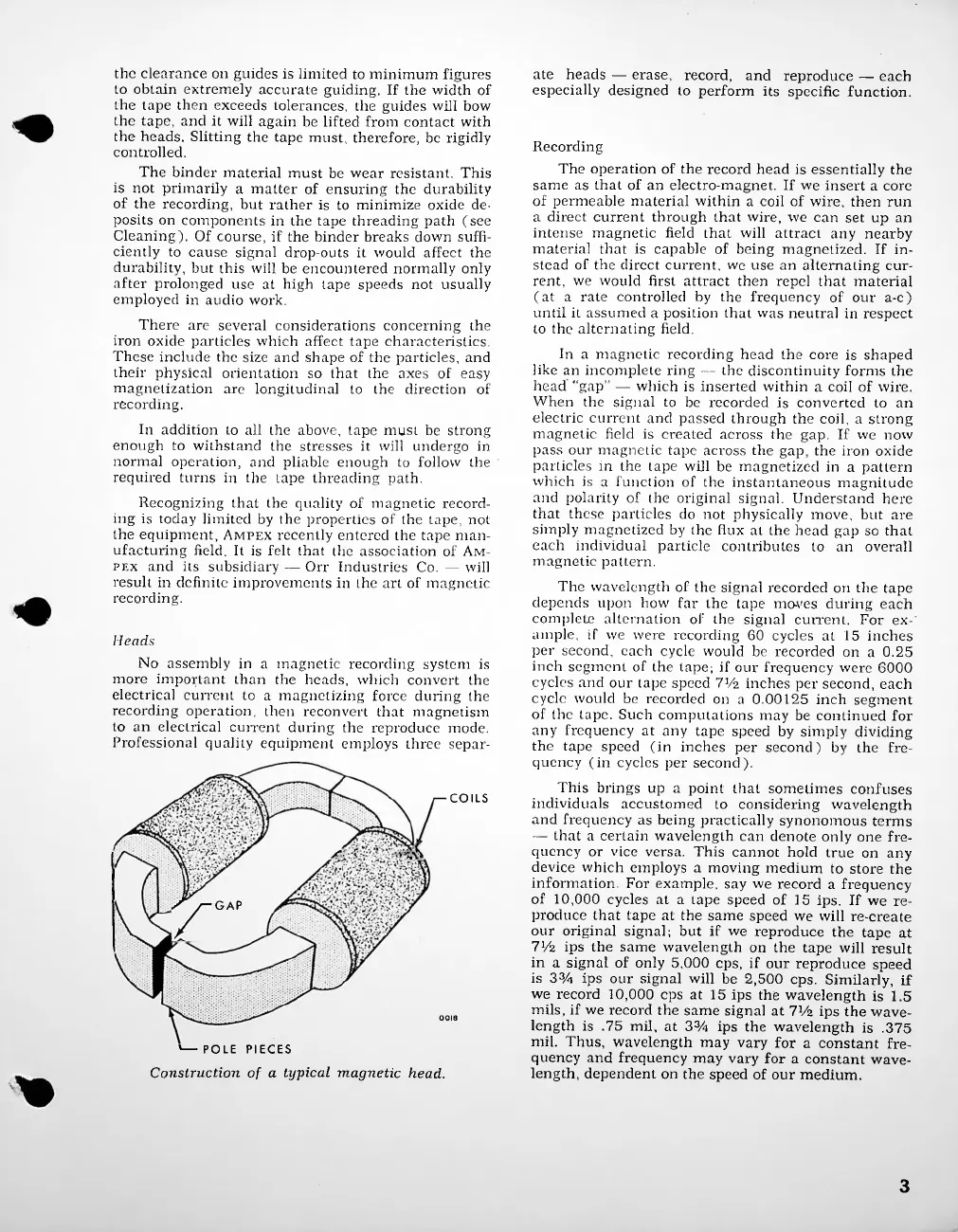
COILS
GAP
0016
3
'
POLE
PIECES
Construction
of
a
typical
magnetic
head.
ate
heads
erase,
record,
and
reproduce
each
especially
designed
to
perform
its
specific
function.
Heads
No
assembly
in
a
magnetic
recording
system
is
more
important
than
the
heads,
which
convert
the
electrical
cun-ent
to
a
magnetizing
force
during
the
recording
operation,
then
reconvert
that
magnetism
to
an
electrical
cun-ent
during
the
reproduce
mode.
Professional
quality
equipment
employs
three
separ-
the
clearance
on
guides
is
limited
to
minimum
figures
to
obtain
extremely
accurate
guiding.
If
the
width
of
the
tape
then
exceeds
tolerances,
the
guides
will
bow
the
tape,
and
it
will
again
be
lifted
from
contact
with
the
heads.
Slitting
the
tape
must,
therefore,
be
rigidly
controlled.
The
binder
material
must
be
wear
resistant.
This
is
not
primarily
a
matter
of
ensuring
the
durability
of
the
recording,
but
rather
is
to
minimize
oxide
de
posits
on
components
in
the
tape
threading
path
(see
Cleaning).
Of
course,
if
the
binder
breaks
down
suffi
ciently
to
cause
signal
drop-outs
it
would
affect
the
durability,
but
this
will
be
encountered
normally
only
after
prolonged
use
at
high
tape
speeds
not
usually
employed
in
audio
work.
There
are
several
considerations
concerning
the
iron
oxide
particles
which
affect
tape
characteristics.
These
include
the
size
and
shape
of
the
particles,
and
their
physical
orientation
so
that
the
axes
of
easy
magnetization
are
longitudinal
to
the
direction
of
recording.
In
addition
to
all
the
above,
tape
must
be
strong
enough
to
withstand
the
stresses
it
will
undergo
in
normal
operation,
and
pliable
enough
to
follow
the
required
turns
in
the
tape
threading
path.
Recognizing
that
the
quality
of
magnetic
record
ing
is
today
limited
by
the
properties
of
the
tape,
not
the
equipment,
A
mpex
recently
entered
the
tape
man
ufacturing
field.
It
is
felt
that
the
association
of
A
m
pex
and
its
subsidiary
Orr
Industries
Co.
will
result
in
definite
improvements
in
the
art
of
magnetic
recording.
AT
J
-'
vS
Recording
The
operation
of
the
record
head
is
essentially
the
same
as
that
of
an
electro-magnet.
If
we
insert
a
core
of
permeable
material
within
a
coil
of
wire,
then
run
a
direct
current
through
that
wire,
we
can
set
up
an
intense
magnetic
field
that
will
attract
any
nearby
material
that
is
capable
of
being
magnetized.
If
in
stead
of
the
direct
cun-ent,
we
use
an
alternating
cur
rent,
we
would
first
attract
then
repel
that
material
(at
a
rate
controlled
by
the
frequency
of
our
a-c)
until
it
assumed
a
position
that
was
neutral
in
respect
to
the
alternating
field.
In
a
magnetic
recording
head
the
core
is
shaped
like
an
incomplete
ring
the
discontinuity
forms
the
head
gap
which
is
inserted
within
a
coil
of
wire.
When
the
signal
to
be
recorded
is
converted
to
an
electric
current
and
passed
through
the
coil,
a
strong
magnetic
field
is
created
across
the
gap.
If
we
now
pass
our
magnetic
tape
across
the
gap,
the
iron
oxide
particles
in
the
tape
will
be
magnetized
in
a
pattern
which
is
a
function
of
the
instantaneous
magnitude
and
polarity
of
the
original
signal.
Understand
here
that
these
particles
do
not
physically
move,
but
are
simply
magnetized
by
the
flux
at
the
head
gap
so
that
each
individual
particle
contributes
to
an
overall
magnetic
pattern.
The
wavelength
of
the
signal
recorded
on
the
tape
depends
upon
how
far
the
tape
moves
during
each
complete
alternation
of
the
signal
cun-ent.
For
ex
ample,
if
we
were
recording
60
cycles
at
15
inches
per
second,
each
cycle
would
be
recorded
on
a
0.25
inch
segment
of
the
tape;
if
our
frequency
were
6000
cycles
and
our
tape
speed
7
/2
inches
per
second,
each
cycle
would
be
recorded
on
a
0.00125
inch
segment
of
the
tape.
Such
computations
may
be
continued
for
any
frequency
at
any
tape
speed
by
simply
dividing
the
tape
speed
(in
inches
per
second)
by
the
fre
quency
(in
cycles
per
second).
This
brings
up
a
point
that
sometimes
confuses
individuals
accustomed
to
considering
wavelength
and
frequency
as
being
practically
synonomous
terms
that
a
certain
wavelength
can
denote
only
one
fre
quency
or
vice
versa.
This
cannot
hold
true
on
any
device
which
employs
a
moving
medium
to
store
the
information.
For
example,
say
we
record
a
frequency
of
10,000
cycles
at
a
tape
speed
of
15
ips.
If
we
re
produce
that
tape
at
the
same
speed
we
will
re-create
our
original
signal;
but
if
we
reproduce
the
tape
at
71/2
ips
the
same
wavelength
on
the
tape
will
result
in
a
signal
of
only
5,000
cps,
if
our
reproduce
speed
is
3%
ips
our
signal
will
be
2,500
cps.
Similarly,
if
we
record
10,000
cps
at
15
ips
the
wavelength
is
1.5
mils,
if
we
record
the
same
signal
at
7
/2
ips
the
wave
length
is
.75
mil,
at
3%
ips
the
wavelength
is
.375
mil.
Thus,
wavelength
may
vary
for
a
constant
fre
quency
and
frequency
may
vary
for
a
constant
wave
length,
dependent
on
the
speed
of
our
medium.

Related product manuals