EasyManua.ls Logo

Ampex 351 - Page 34

Default Icon
103 pages
Print Icon
To Next Page IconTo Next Page
To Previous Page IconTo Previous Page
Loading...
SUPPLY
TURNTABLE
TAKEUP
TURNTABLE
loss
in
frequency
re
Tape
Transport
Detailed
Discussion*
5
Supply
and
Takeup
Systems
Usually,
the
tape
supply
and
tape
takeup
systems
can
be
considered
as
identical
assemblies,
with
the
only
probably
differences
being
in
the
brake
configur
ation
and
the
connection
to
the
power
source.
Torque
motors
(or
their
equivalent)
arc
used
to
drive
the
turntables
directly.
These
motors
are
connected
to
rotate
in
opposite
directions
when
power
is
applied
the
supply
motor
opposing
and
the
takeup
motor
supporting
the
normal
direction
of
tape
motion.
the
head
gap.
This
means
that
the
gap
must
always
intercept
less
than
one
complete
wavelength
of
the
signal
recorded
on
the
tape
(see
High
Frequency
Re
sponse).
However,
if
the
gap
is
too
small
the
flux
will
not
be
forced
through
the
core
to
the
coil,
and
signal
level
will
be
reduced.
An
optimum
design,
tailored
to
specific
requirements
of
frequency
response
and
level
is
thus
necessary.
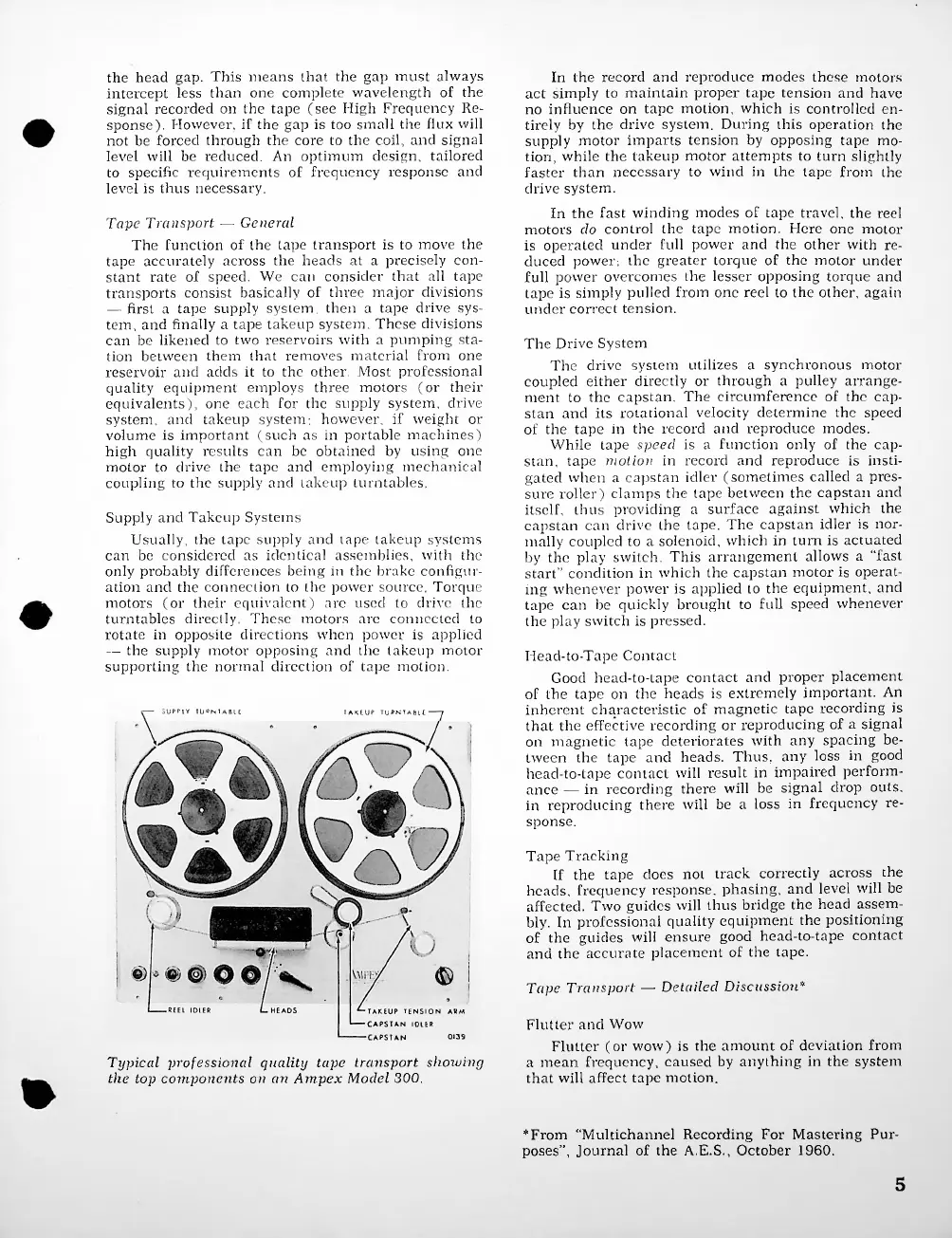
Typical
professional
quality
tape
transport
showing
the
top
components
on
an
Ampex
Model
300.
*From
Multichannel
Recording
For
Mastering
Pur
poses
,
Journal
of
the
A.E.S.,
October
1960.
©
!
The
Drive
System
The
drive
system
utilizes
a
synchronous
motor
coupled
either
directly
or
through
a
pulley
arrange
ment
to
the
capstan.
The
circumference
of
the
cap
stan
and
its
rotational
velocity
determine
the
speed
of
the
tape
in
the
record
and
reproduce
modes.
While
tape
speed
is
a
function
only
of
the
cap
stan.
tape
motion
in
record
and
reproduce
is
insti
gated
when
a
capstan
idler
(sometimes
called
a
pres
sure
roller)
clamps
the
tape
between
the
capstan
and
itself,
thus
providing
a
surface
against
which
the
capstan
can
drive
the
tape.
The
capstan
idler
is
nor
mally
coupled
to
a
solenoid,
which
in
turn
is
actuated
by
the
play
switch.
This
arrangement
allows
a
fast
start
condition
in
which
the
capstan
motor
is
operat
ing
whenever
power
is
applied
to
the
equipment,
and
tape
can
be
quickly
brought
to
full
speed
whenever
the
play
switch
is
pressed.
Tape
Transport
General
The
function
of
the
tape
transport
is
to
move
the
tape
accurately
across
the
heads
at
a
precisely
con
stant
rate
of
speed.
We
can
consider
that
all
tape
transports
consist
basically
of
three
major
divisions
first
a
tape
supply
system,
then
a
tape
drive
sys
tem,
and
finally
a
tape
takeup
system.
These
divisions
can
be
likened
to
two
reservoirs
with
a
pumping
sta
tion
between
them
that
removes
material
from
one
reservoir
and
adds
it
to
the
other.
Most
professional
quality
equipment
employs
three
motors
(or
their
equivalents),
one
each
for
the
supply
system,
drive
system,
and
takeup
system;
however,
if
weight
or
volume
is
important
(such
as
in
portable
machines)
high
quality
results
can
be
obtained
by
using
one
motor
to
drive
the
tape
and
employing
mechanical
coupling
to
the
supply
and
takeup
turntables.
In
the
record
and
reproduce
modes
these
motors
act
simply
to
maintain
proper
tape
tension
and
have
no
influence
on
tape
motion,
which
is
controlled
en
tirely
by
the
drive
system.
During
this
operation
the
supply
motor
imparts
tension
by
opposing
tape
mo
tion,
while
the
takeup
motor
attempts
to
turn
slightly
faster
than
necessary
to
wind
in
the
tape
from
the
drive
system.
In
the
fast
winding
modes
of
tape
travel,
the
reel
motors
do
control
the
tape
motion.
Here
one
motor
is
operated
under
full
power
and
the
other
with
re
duced
power;
the
greater
torque
of
the
motor
under
full
power
overcomes
the
lesser
opposing
torque
and
tape
is
simply
pulled
from
one
reel
to
the
other,
again
under
correct
tension.
Head-to-Tape
Contact
Good
head-to-tape
contact
and
proper
placement
of
the
tape
on
the
heads
is
extremely
important.
An
inherent
characteristic
of
magnetic
tape
recording
is
that
the
effective
recording
or
reproducing
of
a
signal
on
magnetic
tape
deteriorates
with
any
spacing
be-
Flutter
and
Wow
Flutter
(or
wow)
is
the
amount
of
deviation
from
a
mean
frequency,
caused
by
anything
in
the
system
that
will
affect
tape
motion.
tween
the
tape
and
heads.
Thus,
any
loss
in
good
head-to-tape
contact
will
result
in
impaired
perform
ance
in
recording
there
will
be
signal
drop
outs,
in
reproducing
there
will
be
a
'
sponse.
Tape
Tracking
If
the
tape
does
not
track
correctly
across
the
heads,
frequency
response,
phasing,
and
level
will
be
affected.
Two
guides
will
thus
bridge
the
head
assem
bly.
In
professional
quality
equipment
the
positioning
of
the
guides
will
ensure
good
head-to-tape
contact
and
the
accurate
placement
of
the
tape.
TENSION
ARM
CAPSTAN
IDLER
CAPSTAN
0139

Related product manuals