EasyManua.ls Logo

Ampex 351 - Page 35

Default Icon
103 pages
Print Icon
To Next Page IconTo Next Page
To Previous Page IconTo Previous Page
Loading...
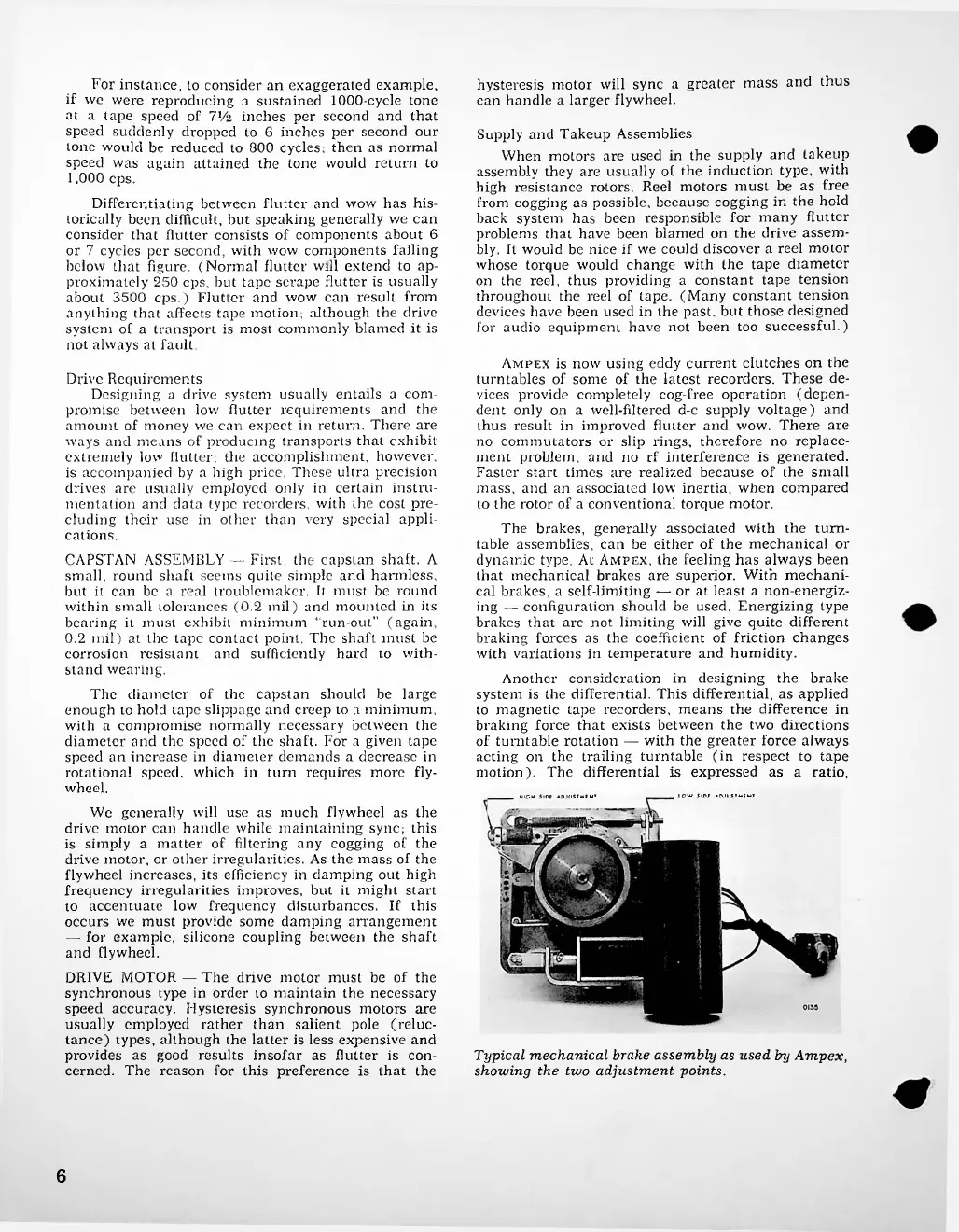
tow
Slot
ADJUSTMENT
HIGH
SIDE
ADJUSTMENT
6
Typical
mechanical
brake
assembly
as
used
by
Ampex,
showing
the
two
adjustment
points.
Supply
and
Takeup
Assemblies
When
motors
are
used
in
the
supply
and
takeup
assembly
they
are
usually
of
the
induction
type,
with
high
resistance
rotors.
Reel
motors
must
be
as
free
from
cogging
as
possible,
because
cogging
in
the
hold
back
system
has
been
responsible
for
many
flutter
problems
that
have
been
blamed
on
the
drive
assem
bly.
It
would
be
nice
if
we
could
discover
a
reel
motor
whose
torque
would
change
with
the
tape
diameter
on
the
reel,
thus
providing
a
constant
tape
tension
throughout
the
reel
of
tape.
(Many
constant
tension
devices
have
been
used
in
the
past,
but
those
designed
for
audio
equipment
have
not
been
too
successful.)
A
mpex
is
now
using
eddy
current
clutches
on
the
turntables
of
some
of
the
latest
recorders.
These
de
vices
provide
completely
cog-free
operation
(depen
dent
only
on
a
well-filtered
d-c
supply
voltage)
and
thus
result
in
improved
flutter
and
wow.
There
are
no
commutators
or
slip
rings,
therefore
no
replace
ment
problem,
and
no
rf
interference
is
generated.
Faster
start
times
are
realized
because
of
the
small
mass,
and
an
associated
low
inertia,
when
compared
to
the
rotor
of
a
conventional
torque
motor.
The
brakes,
generally
associated
with
the
turn
table
assemblies,
can
be
either
of
the
mechanical
or
dynamic
type.
At
A
mpex
,
the
feeling
has
always
been
that
mechanical
brakes
are
superior.
With
mechani
cal
brakes,
a
self-limiting
or
at
least
a
non-energiz
ing
configuration
should
be
used.
Energizing
type
brakes
that
are
not
limiting
will
give
quite
different
braking
forces
as
the
coefficient
of
friction
changes
with
variations
in
temperature
and
humidity.
Another
consideration
in
designing
the
brake
system
is
the
differential.
This
differential,
as
applied
to
magnetic
tape
recorders,
means
the
difference
in
braking
force
that
exists
between
the
two
directions
of
turntable
rotation
with
the
greater
force
always
acting
on
the
trailing
turntable
(in
respect
to
tape
motion).
The
differential
is
expressed
as
a
ratio.
hysteresis
motor
will
sync
a
greater
mass
and
thus
can
handle
a
larger
flywheel.
Drive
Requirements
Designing
a
drive
system
usually
entails
a
com
promise
between
low
flutter
requirements
and
the
amount
of
money
we
can
expect
in
return.
There
are
ways
and
means
of
producing
transports
that
exhibit
extremely
low
flutter,
the
accomplishment,
however,
is
accompanied
by
a
high
price.
These
ultra
precision
drives
are
usually
employed
only
in
certain
instru
mentation
and
data
type
recorders,
with
the
cost
pre
cluding
their
use
in
other
than
very
special
appli
cations.
CAPSTAN
ASSEMBLY
First,
the
capstan
shaft.
A
small,
round
shaft
seems
quite
simple
and
harmless,
but
it
can
be
a
real
troublemaker.
It
must
be
round
within
small
tolerances
(0.2
mil)
and
mounted
in
its
bearing
it
must
exhibit
minimum
run-out"
(again,
0.2
mil)
at
the
tape
contact
point.
The
shaft
must
be
corrosion
resistant,
and
sufficiently
hard
to
with
stand
wearing.
The
diameter
of
the
capstan
should
be
large
enough
to
hold
tape
slippage
and
creep
to
a
minimum,
with
a
compromise
normally
necessary
between
the
diameter
and
the
speed
of
the
shaft.
For
a
given
tape
speed
an
increase
in
diameter
demands
a
decrease
in
rotational
speed,
which
in
turn
requires
more
fly
wheel.
We
generally
will
use
as
much
flywheel
as
the
drive
motor
can
handle
while
maintaining
sync;
this
is
simply
a
matter
of
filtering
any
cogging
of
the
drive
motor,
or
other
irregularities.
As
the
mass
of
the
flywheel
increases,
its
efficiency
in
damping
out
high
frequency
irregularities
improves,
but
it
might
start
to
accentuate
low
frequency
disturbances.
If
this
occurs
we
must
provide
some
damping
arrangement
for
example,
silicone
coupling
between
the
shaft
and
flywheel.
DRIVE
MOTOR
The
drive
motor
must
be
of
the
synchronous
type
in
order
to
maintain
the
necessary
speed
accuracy.
Hysteresis
synchronous
motors
are
usually
employed
rather
than
salient
pole
(reluc
tance)
types,
although
the
latter
is
less
expensive
and
provides
as
good
results
insofar
as
flutter
is
con
cerned.
The
reason
for
this
preference
is
that
the
For
instance,
to
consider
an
exaggerated
example,
if
we
were
reproducing
a
sustained
1000-cycle
tone
at
a
tape
speed
of
7
/2
inches
per
second
and
that
speed
suddenly
dropped
to
6
inches
per
second
our
tone
would
be
reduced
to
800
cycles;
then
as
normal
speed
was
again
attained
the
tone
would
return
to
1,000
cps.
Differentiating
between
flutter
and
wow
has
his
torically
been
difficult,
but
speaking
generally
we
can
consider
that
flutter
consists
of
components
about
6
or
7
cycles
per
second,
with
wow
components
falling
below
that
figure.
(Normal
flutter
will
extend
to
ap
proximately
250
cps,
but
tape
scrape
flutter
is
usually
about
3500
cps.)
Flutter
and
wow
can
result
from
anything
that
affects
tape
motion,
although
the
drive
system
of
a
transport
is
most
commonly
blamed
it
is
not
always
at
fault

Related product manuals