EasyManua.ls Logo

Ampex 351 - Page 37

Default Icon
103 pages
Print Icon
To Next Page IconTo Next Page
To Previous Page IconTo Previous Page
Loading...
equipment,
disregarding
the
human
r
8
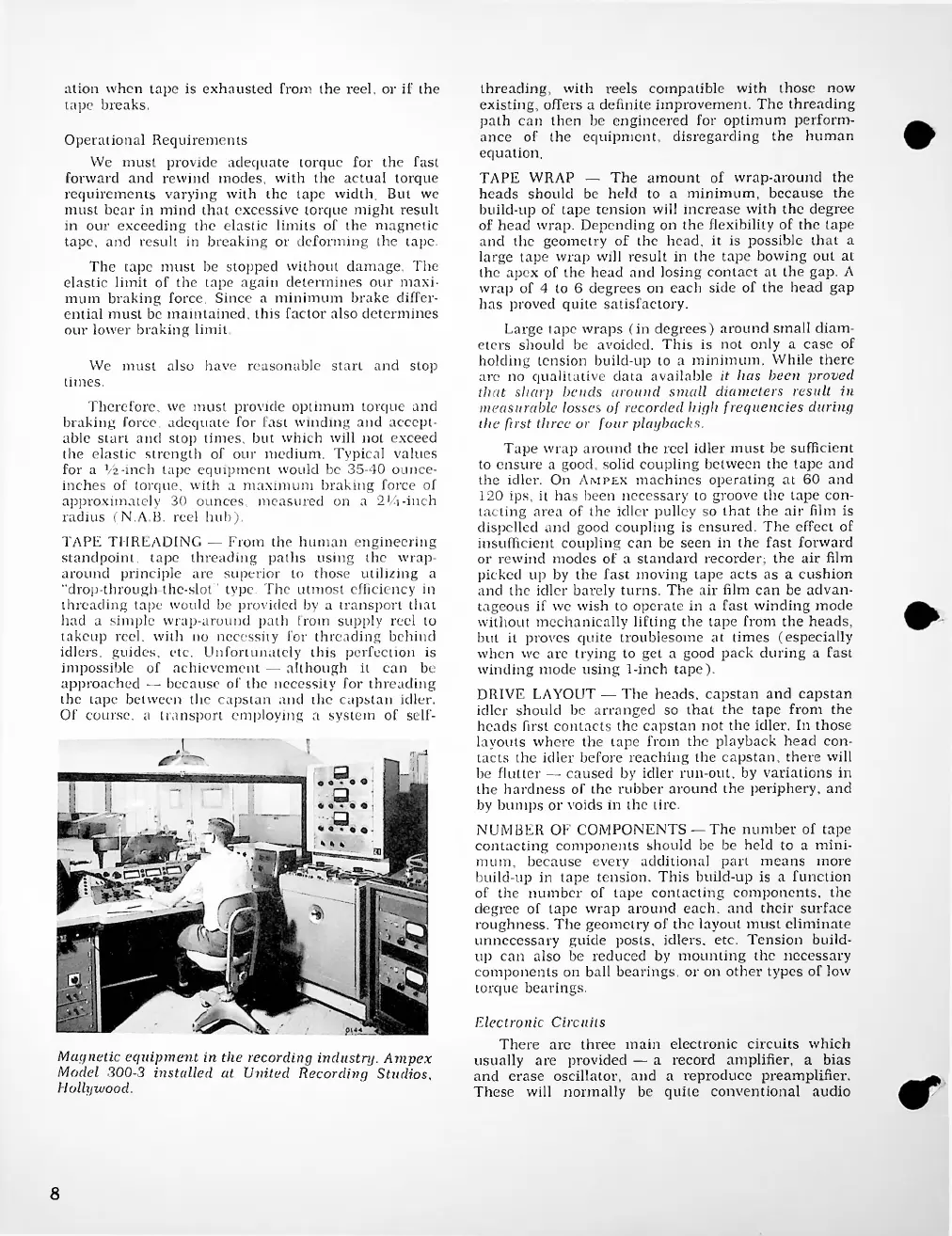
Magnetic
equipment
in
the
recording
industry.
Ampex
Model
300-3
installed
at
United
Recording
Studios,
Hollywood.
ation
when
tape
is
exhausted
from
the
reel,
or
if
the
tape
breaks.
J
Electronic
Circuits
There
arc
three
main
electronic
circuits
which
usually
are
provided
a
record
amplifier,
a
bias
and
erase
oscillator,
and
a
reproduce
preamplifier.
These
will
normally
be
quite
conventional
audio
Operational
Requirements
We
must
provide
adequate
torque
for
the
fast
forward
and
rewind
modes,
with
the
actual
torque
requirements
varying
with
the
tape
width.
But
we
must
bear
in
mind
that
excessive
torque
might
result
in
our
exceeding
the
elastic
limits
of
the
magnetic
tape,
and
result
in
breaking
or
deforming
the
tape.
The
tape
must
be
stopped
without
damage.
The
elastic
limit
of
the
tape
again
determines
our
maxi
mum
braking
force.
Since
a
minimum
brake
differ
ential
must
be
maintained,
this
factor
also
determines
our
lower
braking
limit
We
must
also
have
reasonable
start
and
stop
times.
The
amount
of
wrap-around
the
be
held
to
a
minimum,
because
the
build-up
of
tape
tension
will
increase
with
the
degree
of
head
wrap.
Depending
on
the
flexibility
of
the
tape
and
the
geometry
of
the
head,
it
is
possible
that
a
large
tape
wrap
will
result
in
the
tape
bowing
out
at
the
apex
of
the
head
and
losing
contact
at
the
gap.
A
wrap
of
4
to
6
degrees
on
each
side
of
the
head
gap
has
proved
quite
satisfactory.
Large
tape
wraps
(in
degrees)
around
small
diam
eters
should
be
avoided.
This
is
not
only
a
case
of
holding
tension
build-up
to
a
minimum.
While
there
are
no
qualitative
data
available
it
has
been
proved
that
sharp
bends
around
small
diameters
result
in
measurable
losses
of
recorded
high
frequencies
during
the
first
three
or
four
playbacks.
Tape
wrap
around
the
reel
idler
must
be
sufficient
to
ensure
a
good,
solid
coupling
between
the
tape
and
the
idler.
On
A
mpex
machines
operating
at
60
and
120
ips,
it
has
been
necessary
to
groove
the
tape
con
tacting
area
of
the
idler
pulley
so
that
the
air
film
is
dispelled
and
good
coupling
is
ensured.
The
effect
of
insufficient
coupling
can
be
seen
in
the
fast
forward
or
rewind
modes
of
a
standard
recorder;
the
air
film
picked
up
by
the
fast
moving
tape
acts
as
a
cushion
and
the
idler
barely
turns.
The
air
film
can
be
advan
tageous
if
we
wish
to
operate
in
a
fast
winding
mode
without
mechanically
lifting
the
tape
from
the
heads,
but
it
proves
quite
troublesome
at
times
(especially
when
we
are
trying
to
get
a
good
pack
during
a
fast
winding
mode
using
1-inch
tape).
DRIVE
LAYOUT
The
heads,
capstan
and
capstan
idler
should
be
arranged
so
that
the
tape
from
the
heads
first
contacts
the
capstan
not
the
idler.
In
those
layouts
where
the
tape
from
the
playback
head
con
tacts
the
idler
before
reaching
the
capstan,
there
will
be
flutter
caused
by
idler
run-out,
by
variations
in
the
hardness
of
the
rubber
around
the
periphery,
and
by
bumps
or
voids
in
the
tire.
NUMBER
OF
COMPONENTS
The
number
of
tape
contacting
components
should
be
be
held
to
a
mini
mum,
because
every
additional
part
means
more
build-up
in
tape
tension.
This
build-up
is
a
function
of
the
number
of
tape
contacting
components,
the
degree
of
tape
wrap
around
each,
and
their
surface
roughness.
The
geometry
of
the
layout
must
eliminate
unnecessary
guide
posts,
idlers,
etc.
Tension
build
up
can
also
be
reduced
by
mounting
the
necessary
components
on
ball
bearings,
or
on
other
types
of
low
torque
bearings.
threading,
with
reels
compatible
with
those
now
existing,
offers
a
definite
improvement.
The
threading
path
can
then
be
engineered
for
optimum
perform
ance
of
the
equation.
TAPE
WRAP
heads
should
Therefore,
we
must
provide
optimum
torque
and
braking
force,
adequate
for
fast
winding
and
accept
able
start
and
stop
times,
but
which
will
not
exceed
the
elastic
strength
of
our
medium.
Typical
values
for
a
/a-inch
tape
equipment
would
be
35-40
ounce
inches
of
torque,
with
a
maximum
braking
force
of
approximately
30
ounces,
measured
on
a
2
J
Zi-inch
radius
(N.A.B.
reel
hub).
TAPE
THREADING
From
the
human
engineering
standpoint,
tape
threading
paths
using
the
wrap
around
principle
are
superior
to
those
utilizing
a
"drop-through
the-slot
type.
The
utmost
efficiency
in
threading
tape
would
be
provided
by
a
transport
that
had
a
simple
wrap-around
path
from
supply
reel
to
takeup
reel,
with
no
necessity
for
threading
behind
idlers,
guides,
etc.
Unfortunately
this
perfection
is
impossible
of
achievement
although
it
can
be
approached
because
of
the
necessity
for
threading
the
tape
between
the
capstan
and
the
capstan
idler.
Of
course,
a
transport
employing
a
system
of
self-

Related product manuals