EasyManua.ls Logo

Ampex 351 - Page 38

Default Icon
103 pages
Print Icon
To Next Page IconTo Next Page
To Previous Page IconTo Previous Page
Loading...
a
the
moving
arc
H
>
500
80
275
60
150
J
0
40
|A|
20
0
80
60
-
'*
2000
40
20
0
100
200 300
400
h
9
500
0019
Typical
two
channel
electronic
assembly.
Ampex
Model
PR-10-2
professional
recorder/reproducer.
circuits,
except
for
certain
minor
modifications
made
necessary
by
the
special
application.
(Note
here
that
such
necessary
items
as
line
amplifiers,
power
am
plifiers.
loudspeakers,
microphones,
mixers,
etc.,
not
considered
part
of
the
magnetic
recorder.)
Record
Amplifier
The
function
of
the
record
amplifier
is
to
pre
sent
to
the
record
head
a
signal
current
of
proper
amplitude
for
the
recording
process.
The
record
head
is
essentially
an
inductance
whose
impedance
will
vary
directly
with
frequency.
The
magnetizing
force
is
directly
related
to
the
amount
of
current
which
flows
in
the
head
coil,
so
high
frequencies
would
suf
fer
if
the
rising
impedance
of
the
head
coil
at
the
higher
freguency
were
allowed
to
decrease
the
current
flow
appreciably.
Therefore,
the
output
circuit
of
the
amplifier
will
present
a
relatively
high
resistance
in
respect
to
the
head
coil,
which
will
now
have
a
minor
effect
on
the
complete
circuit,
a
virtually
constant
current
condition
is
thus
maintained
regardless
of
the
frequency
involved.
In
order
to
further
ensure
proper
recording
of
high
frequencies,
the
record
amplifier
also
contains
a
pre-emphasis
circuit
which
essentially
provides
more
amplification
as
frequency
rises.
Because
the
repro
duce
curve
has
been
standardized,
the
pre-emphasis
circuit
is
adjustable
to
reproduce
a
flat
overall
re
sponse
when
the
reproduce
amplifier
is
set
on
the
standard
curve.
several
times
that
of
the
highest
signal
frequency
(in
A
mpex
audio
equipment
the
bias
frequency
is
nor
mally
100
kc).
Fundamentally,
biasing
with
an
a-c
field
is
similar
to
a
long-known
method
of
achieving
an
"ideal"
(or
anhysteretic
)
magnetization.
In
this
method,
an
alternating
field
of
high
amplitude
is
superimposed
on
an
unidirectional
field,
then
the
amplitude
of
the
alternating
field
is
gradually
reduced
to
zero.
The
result
is
a
remnant
magnetization
that
is
a
linear
function
of
the
unidirectional
field.
The
maximum
amplitude
of
the
alternating
field
is
unimportant
as
long
as
it
exceeds
a
certain
level,
and
the
final
state
of
magnetization
will
depend
only
on
the
value
of
the
unidirectional
field
when
the
alternating
field
strength
falls
below
a
certain
level.
If
we
assume
that
while
a
point
on
A-C
Bias
The
normal
magnetization
curve
of
any
ferro
magnetic
material
is
extremely
non-linear,
with
the
slope
near
the
point
of
origin
practically
zero.
Theo
retically
we
should
be
able
to
record
in
this
region
with
no
correction
(it
is
sufficiently
linear)
by
main
taining
signal
amplitude
at
a
sufficiently
low
level.
However,
such
a
recorded
signal
would
be
so
small
that
the
signal-to-noise
ratio
would
be
unacceptable.
By
using
carefully
chosen
values
of
d-c
bias
we
can
utilize
the
approximately
linear
portion
of
the
curve
in
recording
a
limited
range
of
alternating
signal
amplitudes.
But
lower
basic
noise
and
more
linear
results
over
a
greater
range
of
signal
levels
can
be
accomplished
by
using
an
a-c
bias
voltage.
The
fre
quency
of
this
a-c
bias
is
not
critical,
but
it
should
be
'
f
-
CSji
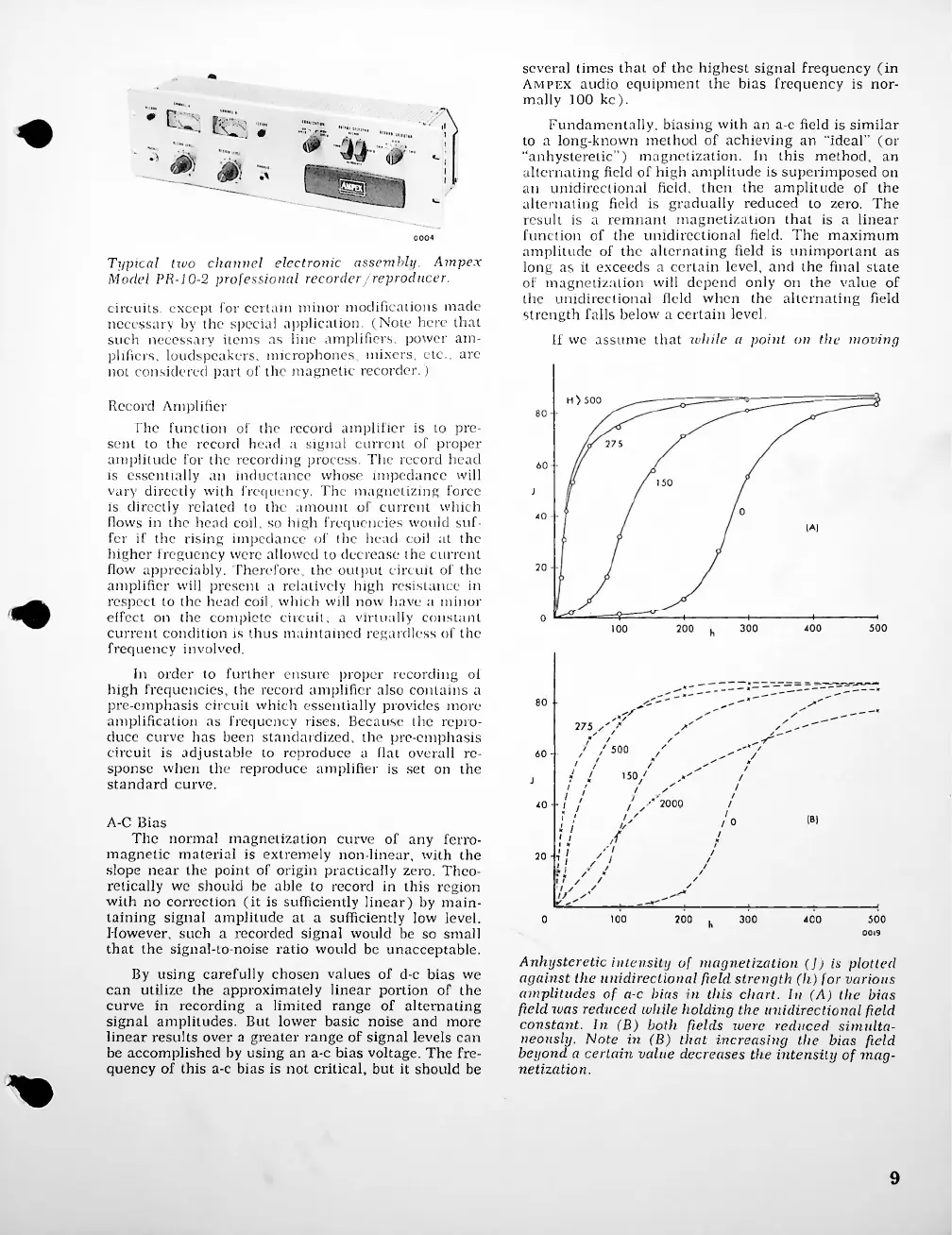
Anhysteretic
intensity
of
magnetization
(J)
is
plotted
against
the
unidirectional
field
strength
(h)
for
various
amplitudes
of
a-c
bias
in
this
chart.
In
(A)
the
bias
field
was
reduced
while
holding
the
unidirectional
field
constant.
In.
(B)
both
fields
were
reduced
simulta
neously.
Note
in
(B)
that
increasing
the
bias
field
beyond
a
certain
value
decreases
the
intensity
of
mag
netization.
/
500
/
/
I

Related product manuals