EasyManua.ls Logo

Ampex 351 - Page 40

Default Icon
103 pages
Print Icon
To Next Page IconTo Next Page
To Previous Page IconTo Previous Page
Loading...
Our
major
limiting
factor
today
is
the
magnetic
Track
Width
11
Signal-To-Noise
Ratio
Many
factors
complicate
the
signal-to-noise
prob
lem,
some
of
them
entirely
beyond
any
control
of
the
manufacturer
of
magnetic
tape
recorders.
First
is
the
tendency
of
both
studios
and
"hi-fi
fans
to
reproduce
music
al
a
greater
volume
than
that
of
the
original
source.
This,
of
course,
also
increases
the
audible
noise
level.
Such
a
standard
implies
that
the
professional
user
will
have
equipment
to
adjust
his
recorder
to
meet
these
distortion
specifications.
It
is
rare
that
wave
analyzers
or
distortion
meters
are
available,
therefore
the
calibration
is
usually
made
by
using
a
standard
tape
(see
Basic
Adjustments).
Distortion
Distortion
in
magnetic
recording
is
a
function
of
both
the
bias
adjustment
and
the
recording
level.
We
have
already
seen
the
effect
of
the
bias
voltage
near
the
point
of
zero
magnetization
on
the
tape
(see
Electronic
Circuits)
so
in
this
we
will
cover
only
the
effect
of
the
recording
level.
of
the
middle
frequencies,
and
the
audible
noise
level
is
increased.
The
noise
coming
from
a
small
area
is
also
more
noticeable
than
if
it
emanated
from
a
large
source.
4
To
achieve
a
maximum
signal-to-noise
ratio,
we
wish
to
record
at
the
highest
possible
signal
level.
But
as
we
increase
our
recording
level
we
will
even
tually
reach
the
point
where
any
further
increase
has
little
effect
in
magnetizing
the
tape.
We
have
saturated
the
medium,
and
any
additional
current
in
the
record
head
will
simply
give
distortion
Where
the
maximum
signal-to-noise
ratio
is
nec
essary,
wide
tracks
are
desirable,
but
there
are
certain
limitations.
Economically,
the
amount
of
tape
used,
and
therefore
the
cost,
increases
roughly
in
propor-
In
distortion
caused
by
over-recording,
the
odd
harmonics
will
stand
out,
with
the
third
harmonic
predominating.
Our
prevailing
standards
define
the
normal
recording
level
as
the
point
where
there
is
a
1%
third
harmonic
content
of
the
signal,
and
the
maximum
recording
level
as
the
point
where
there
is
a
3%
third
harmonic
content.
the
discussion
of
the
tape
transport,
so
we
will
treat
the
first
three
in
this
portion
and
then
follow
with
additional
factors
encountered
in
stereophonic
re
cording.
tape.
Our
system
noise
(which
includes
the
tape)
is
from
8
to
10
db
higher
than
our
equipment
noise
.
A
theoretical
study
has
shown
that
an
improvement
in
the
noise
characteristic
of
the
tape
should
be
possible
by
decreasing
the
size
of
the
oxide
particles,
and
tape
manufacturers
are
experimenting
with
this
theory.
Assuming
a
given
tape
noise,
we
are
mainly
con
cerned
with
track
width,
track
spacing
(in
multi
channel
equipment),
tape
speed,
and
equalization.
Then
there
is
the
fact
that
the
average
loud
speaker
is
deficient
in
response,
and
directional
at
high
frequencies.
The
deficient
response
sometimes
results
in
the
user
increasing
the
high
frequency
energy
electrically
(with
an
equalizing
circuit)
during
the
recording
process.
This
extra
high
fre
quency
energy
increases
the
problems
that
exist
in
high
frequency
overloading.
The
directional
pattern
at
high
frequencies
means
that,
if
the
average
high
frequency
energy
throughout
the
room
is
to
equal
the
energy
al
lower
frequencies,
the
high
frequency
energy
on
the
axis
of
the
speaker
is
higher
than
that
But
probably
the
major
complication
is
that
the
human
ear
is
most
sensitive
to
noise
in
the
1
to
6
kc
area,
and
the
noise
below
100
cps
must
be
very
great
before
it
is
objectionable.
The
usual
meter
indication
consists
largely
of
the
low
frequency
component
of
noise,
which
is
inaudible;
it
is
for
this
reason
that
a
recorder
which
tests
quieter
than
another
on
our
normal
measuring
devices
sometimes
sounds
noiser
when
we
actually
listen
to
it.
(Significant
noise
meas
urements,
therefore,
can
be
achieved
only
by
using
a
weighting
network
with
an
inverse
response
to
that
of
the
human
ear.
)
But
these
are
things
we
cannot
control.
What
can
we
do
to
get
the
best
signal-to-noise
ratio?
esw
>>x.>
0066
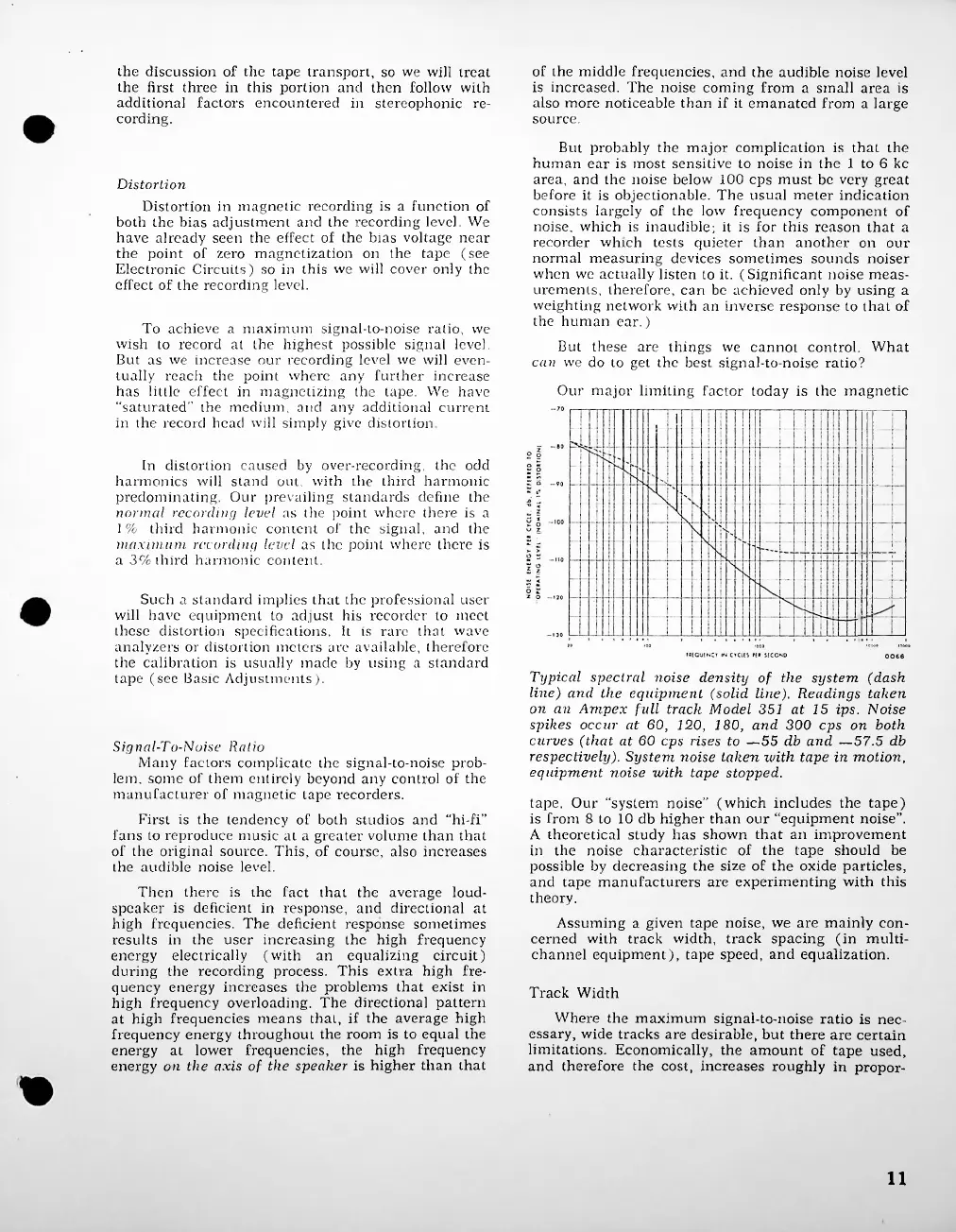
Typical
spectral
noise
density
of
the
system
(dash
line)
and
the
equipment
(solid
line).
Readings
taken
on
an
Ampex
full
track
Model
351
at
15
ips.
Noise
spikes
occur
at
60,
120,
180,
and
300
cps
on
both
curves
(that
at
60
cps
rises
to
55
db
and
57.5
db
respectively).
System
noise
taken
with
tape
in
motion,
equipment
noise
with
tape
stopped.

Related product manuals