EasyManua.ls Logo

Ampex 351 - Page 41

Default Icon
103 pages
Print Icon
To Next Page IconTo Next Page
To Previous Page IconTo Previous Page
Loading...
HIOUCNCV
IN
C
CllJ
H>
SECOND
»20
<10
OB
Odb
10
10000
12
4
TRACK
MASTER,
HALF
TRACK
FREQUENCY
IN
CYCLES
PER
SECOND
0067
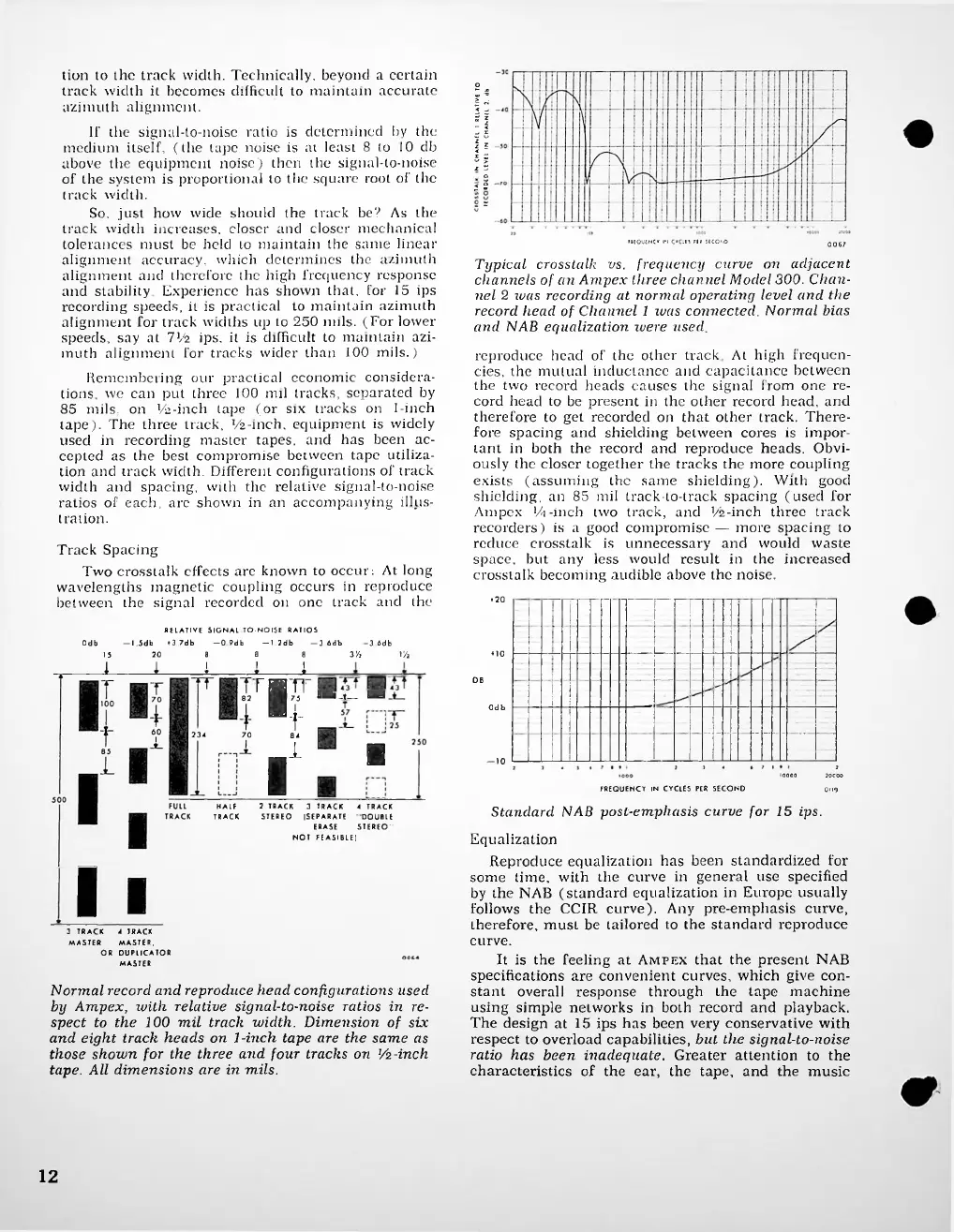
Typical
crosstalk
vs.
frequency
curve
on
adjacent
channels
of
an
Ampex
three
channel
Model
300.
Chan
nel
2
was
recording
at
normal
operating
level
and
the
record
head
of
Channel
1
was
cotinected.
Normal
bias
and
NAB
equalization
were
used.
0
E
20000
0H9
Standard
NAB
post-emphasis
curve
for
15
ips.
lion
to
the
track
width.
Technically,
beyond
a
certain
track
width
it
becomes
difficult
to
maintain
accurate
azimuth
alignment.
If
the
signal-to-noise
ratio
is
determined
by
the
medium
itself,
(the
tape
noise
is
at
least
8
to
10
db
above
the
equipment
noise)
then
the
signal-to-noise
of
the
system
is
proportional
to
the
square
root
of
the
track
width.
So.
just
how
wide
should
the
track
be?
As
the
track
width
increases,
closer
and
closer
mechanical
tolerances
must
be
held
to
maintain
the
same
linear
alignment
accuracy,
which
determines
the
azimuth
alignment
and
therefore
the
high
frequency
response
and
stability.
Experience
has
shown
that,
for
15
ips
recording
speeds,
it
is
practical
to
maintain
azimuth
alignment
for
track
widths
up
to
250
mils.
(For
lower
speeds,
say
at
7
/2
ips.
it
is
difficult
to
maintain
azi
muth
alignment
for
tracks
wider
than
100
mils.)
Remembering
our
practical
economic
considera
tions,
we
can
put
three
100
mil
tracks,
separated
by
85
mils,
on
'/a-inch
tape
(or
six
tracks
on
1-inch
tape).
The
three
track,
'/a-inch.
equipment
is
widely
used
in
recording
master
tapes,
and
has
been
ac
cepted
as
the
best
compromise
between
tape
utiliza
tion
and
track
width.
Different
configurations
of
track
width
and
spacing,
with
the
relative
signal-to-noise
ratios
of
each,
are
shown
in
an
accompanying
illus
tration.
Odb
15
L
I
3
TRACK
MASTER
OR
DUPLICATOR
MASTER
h
H
tl
h
si
Equalization
Reproduce
equalization
has
been
standardized
for
some
time,
with
the
curve
in
general
use
specified
by
the
NAB
(standard
equalization
in
Europe
usually
follows
the
CCIR
curve).
Any
pre-emphasis
curve,
therefore,
must
be
tailored
to
the
standard
reproduce
curve.
It
is
the
feeling
at
A
mpex
that
the
present
NAB
specifications
are
convenient
curves,
which
give
con
stant
overall
response
through
the
tape
machine
using
simple
networks
in
both
record
and
playback.
The
design
at
15
ips
has
been
very
conservative
with
respect
to
overload
capabilities,
but
the
signal-to-noise
ratio
has
been
inadequate.
Greater
attention
to
the
characteristics
of
the
ear,
the
tape,
and
the
music
reproduce
head
of
the
other
track
At
high
frequen
cies,
the
mutual
inductance
and
capacitance
between
the
two
record
heads
causes
the
signal
from
one
re
cord
head
to
be
present
in
the
other
record
head,
and
therefore
to
get
recorded
on
that
other
track.
There
fore
spacing
and
shielding
between
cores
is
impor
tant
in
both
the
record
and
reproduce
heads.
Obvi
ously
the
closer
together
the
tracks
the
more
coupling
exists
(assuming
the
same
shielding).
With
good
shielding,
an
85
mil
track-to-track
spacing
(used
for
Ampex
/i-inch
two
track,
and
Va-inch
three
track
recorders)
is
a
good
compromise
more
spacing
to
reduce
crosstalk
is
unnecessary
and
would
waste
space,
but
any
less
would
result
in
the
increased
crosstalk
becoming
audible
above
the
noise.
Track
Spacing
Two
crosstalk
effects
are
known
to
occur:
At
long
wavelengths
magnetic
coupling
occurs
in
reproduce
between
the
signal
recorded
on
one
track
and
the
Normal
record
and
reproduce
head
configurations
used
by
Ampex,
with
relative
signal-to-noise
ratios
in
re
spect
to
the
100
mil
track
width.
Dimension
of
six
and
eight
track
heads
on
1-inch
tape
are
the
same
as
those
shown
for
the
three
and
four
tracks
on
'/z-inch
tape.
All
dimensions
are
in
mils.
3
TRACK
4
TRACK
(SEPARATE
•DOUBLE
ERASE
STEREO'
NOT
FEASIBLE)
RELATIVE
SIGNAL
TO-NOISE
RATIOS
1.5db
+
3
7db
-0.9db
I2db
-3
6db
20
8
8
0
1
i
1
1
r
l|
84
X
2
TRACK
STEREO
-3.6db
3J6
V/
2
75
L&J-t
LkJ

Related product manuals