EasyManua.ls Logo

Ampex 351 - Page 42

Default Icon
103 pages
Print Icon
To Next Page IconTo Next Page
To Previous Page IconTo Previous Page
Loading...
<10
Odb
DB
-20
FREQUENCY
RESPONSE
E
[
*
to
I
lAICt
FOIITCH
V«(Ut
01
.01
13
Head-To-Tape
Contact
A
knowledge
of
the
effects
of
losing
good
head-to-
tape
contact
will
help
us
realize
the
importance
of
would
provide
a
system
with
a
greater
signal-to-noise
ratio.
Two
methods
may
be
employed
to
counteract
this
gap"
effect
either
the
gap
can
be
made
smaller
or
the
record-reproduce
tape
speed
can
be
increased.
We
can
reduce
the
dimension
of
the
gap
only
so
far
and
retain
adequate
signal
levels
and
realistic
manufacturing
tolerances;
as
this
point
is
reached
any
further
extension
of
high
frequency
re
sponse
must
be
accompanied
by
a
corresponding
in
crease
in
tape
speed.
maintaining
good
contact.
The
predicted
loss
in
sepa
rating
the
reproduce
head
from
the
surface
of
the
medium
is
54.6
db
per
wavelength
separation.
Thus
at
short
wavelengths,
say
'/z
mil
(15,000
cps
at
7
¥2
ips),
it
takes
very
little
space
to
result
in
a
5
db
loss
in
signal
strength.
When
we
remember
that
commen
surate
losses
also
could
occur
in
the
record
mode,
it
becomes
evident
why
good
contact
is
a
major
con
sideration
in
achieving
top
performance
in
a
magnetic
tape
recorder.
5
4
7
8
9
1
0
0123
This
curve
indicates
the
result
of
poor
head-to-tape
contact
as
a
function
of
the
amount
of
separation
and
the
signal
wavelength.
07
01
04
05
.1
2
ratio
or
stfAOAtiON
io
wavuingth
In
this
illustration
sinusoidal
waveforms
are
used
to
denote
the
average
state
of
tape
magnetization
and
to
indicate
how
the
reproduce
head
gap
derives
a
large
output
from
a
medium
wavelength
signal
(A),
a
small
output
from
a
long
wavelength
signal
(B
),
or
no
output
when
the
wavelength
equals
the
gap
length
(C).
High
Frequency
Response
In
audio
applications,
and
at
tape
speeds
normally
used
in
professional
work,
the
high
frequency
re
sponse
is
almost
entirely
limited
by
the
tape
and
mag
netic
heads,
in
what
arc
referred
to
as
wavelength
losses".
Despite
numerous
tomes
attempting
to
ex
plain
these
losses
they
are
as
yet
not
fully
understood,
and
we
would
be
presumptuous
if
we
attempted
any
explanation
on
this
plane
As
our
high
frequency
requirement
rises
in
video
or
instrumentation
applications
or
as
our
tape
speed
is
lowered,
we
enter
a
region
where
the
dimensions
of
the
reproduce
head
gap.
and
the
reso
nant
frequency
of
the
heads
become
important
factors.
Gap
Effect
As
shown
on
the
accompanying
diagram,
when
the
recorded
frequency
rises
to
a
degree
where
the
reproduce
head
gap
intercepts
a
complete
wave
length
of
the
signal
on
the
tape,
there
can
be
no
difference
in
flux
magnitude
across
the
gap,
and
the
head
output
will
be
reduced
to
zero.
Practically,
this
will
occur
at
the
'effective
gap
length,
which
is
slightly
longer
than
the
physical
length.
For
all
prac
ticable
purposes
this
effect
causes
the
head
output
at
this
frequency
and
above
to
be
useless.
A
mpex
engineers
therefore
devised
a
15
ips
equal
ization
known
as
A
mpex
Master
Equalization
(AME)
wherein
a
post-emphasis
is
designed
to
minimize
audible
noise,
and
then
the
pre-emphasis
is
employed
to
make
the
overall
system
flat.
AME
admittedly
trades
overload
margin
for
a
lower
noise
level,
and
must
be
properly
used
to
obtain
the
intended
results
without
distortion.
It
is
intended
for
professional
use,
such
as
the
recording
industry,
and
is
not
to
be
considered
as
supplanting
the
NAB
standard
for
pub
licly
released
tapes.
FREQUENCY
IN
CYCIES
PEP
SECOND
0018
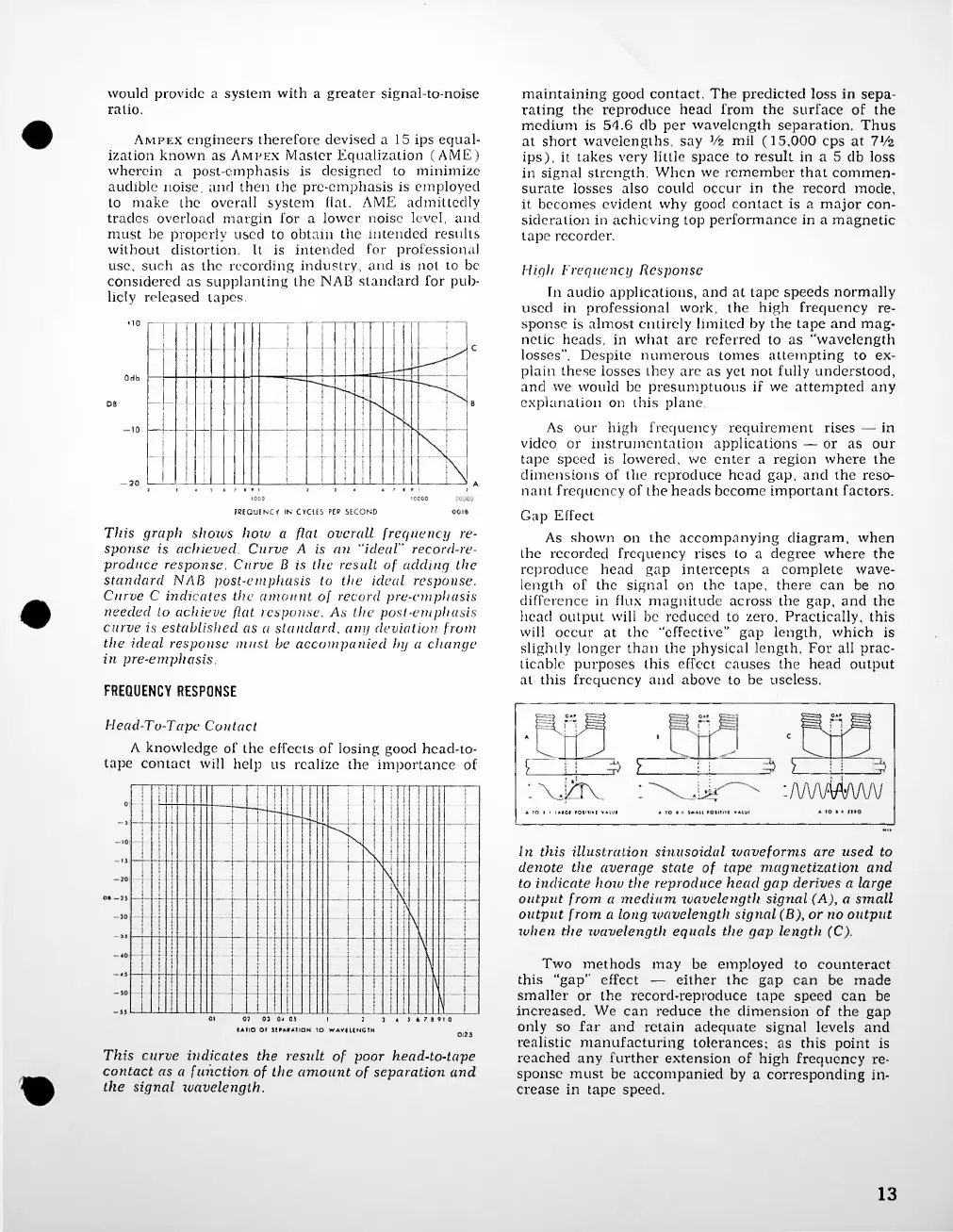
This
graph
shows
how
a
flat
overall
frequency
re
sponse
is
achieved
Curve
A
is
an
"ideal"
record-re
produce
response.
Curve
B
is
the
result
of
adding
the
standard
NAB
post-emphasis
to
the
ideal
response.
Curve
C
indicates
the
amount
of
record
pre-emphasis
needed
to
achieve
flat
response.
As
the
post-emphasis
curve
is
established
as
a
standard,
any
deviation
from
the
ideal
response
must
be
accompanied
by
a
change
in
pre-emphasis.
i/vvwww

Related product manuals