EasyManua.ls Logo

Ampex 351 - Page 43

Default Icon
103 pages
Print Icon
To Next Page IconTo Next Page
To Previous Page IconTo Previous Page
Loading...
0
-20
14
OB
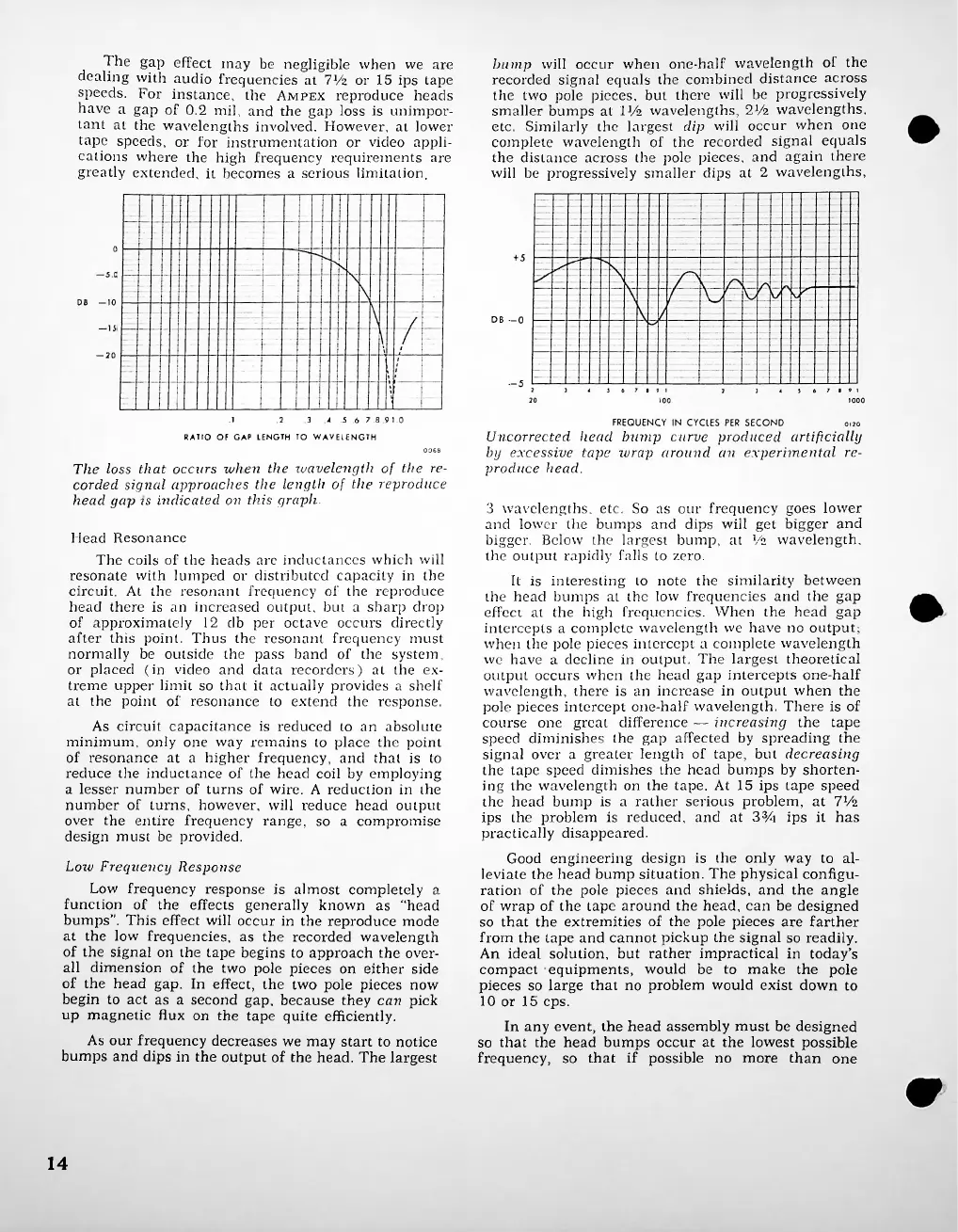
bump
will
occur
when
one-half
wavelength
of
the
recorded
signal
equals
the
combined
distance
across
the
two
pole
pieces,
but
there
will
be
progressively
smaller
bumps
at
IVz
wavelengths,
21/2
wavelengths,
etc.
Similarly
the
largest
dip
will
occur
when
one
complete
wavelength
of
the
recorded
signal
equals
the
distance
across
the
pole
pieces,
and
again
there
will
be
progressively
smaller
dips
at
2
wavelengths,
0068
The
loss
that
occurs
when
the
wavelength
of
the
re
corded
signal
approaches
the
length
of
the
reproduce
head
gap
is
indicated
on
this
graph.
Low
Frequency
Response
Low
frequency
response
is
almost
completely
a
function
of
the
effects
generally
known
as
head
bumps".
This
effect
will
occur
in
the
reproduce
mode
at
the
low
frequencies,
as
the
recorded
wavelength
of
the
signal
on
the
tape
begins
to
approach
the
over
all
dimension
of
the
two
pole
pieces
on
either
side
of
the
head
gap.
In
effect,
the
two
pole
pieces
now
begin
to
act
as
a
second
gap,
because
they
can
pick
up
magnetic
flux
on
the
tape
quite
efficiently.
As
our
frequency
decreases
we
may
start
to
notice
bumps
and
dips
in
the
output
of
the
head.
The
largest
Head
Resonance
The
coils
of
the
heads
are
inductances
which
will
resonate
with
lumped
or
distributed
capacity
in
the
circuit.
At
the
resonant
frequency
of
the
reproduce
head
there
is
an
increased
output,
but
a
sharp
drop
of
approximately
12
db
per
octave
occurs
directly
after
this
point.
Thus
the
resonant
frequency
must
normally
be
outside
the
pass
band
of
the
system,
or
placed
(in
video
and
data
recorders)
at
the
ex
treme
upper
limit
so
that
it
actually
provides
a
shelf
at
the
point
of
resonance
to
extend
the
response.
As
circuit
capacitance
is
reduced
to
an
absolute
minimum,
only
one
way
remains
to
place
the
point
of
resonance
at
a
higher
frequency,
and
that
is
to
reduce
the
inductance
of
the
head
coil
by
employing
a
lesser
number
of
turns
of
wire.
A
reduction
in
the
number
of
turns,
however,
will
reduce
head
output
over
the
entire
frequency
range,
so
a
compromise
design
must
be
provided.
3
wavelengths,
etc.
So
as
our
frequency
goes
lower
and
lower
the
bumps
and
dips
will
get
bigger
and
bigger.
Below
the
largest
bump,
at
I/2
wavelength,
the
output
rapidly
falls
to
zero.
It
is
interesting
to
note
the
similarity
between
the
head
bumps
at
the
low
frequencies
and
the
gap
effect
at
the
high
frequencies.
When
the
head
gap
intercepts
a
complete
wavelength
we
have
no
output;
when
the
pole
pieces
intercept
a
complete
wavelength
we
have
a
decline
in
output.
The
largest
theoretical
output
occurs
when
the
head
gap
intercepts
one-half
wavelength,
there
is
an
increase
in
output
when
the
pole
pieces
intercept
one-half
wavelength.
There
is
of
course
one
great
difference
increasing
the
tape
speed
diminishes
the
gap
affected
by
spreading
the
signal
over
a
greater
length
of
tape,
but
decreasing
the
tape
speed
dimishes
the
head
bumps
by
shorten
ing
the
wavelength
on
the
tape.
At
15
ips
tape
speed
the
head
bump
is
a
rather
serious
problem,
at
7¥2
ips
the
problem
is
reduced,
and
at
3%
ips
it
has
practically
disappeared.
Good
engineering
design
is
the
only
way
to
al
leviate
the
head
bump
situation.
The
physical
configu
ration
of
the
pole
pieces
and
shields,
and
the
angle
of
wrap
of
the
tape
around
the
head,
can
be
designed
so
that
the
extremities
of
the
pole
pieces
are
farther
from
the
tape
and
cannot
pickup
the
signal
so
readily.
An
ideal
solution,
but
rather
impractical
in
today
s
compact
equipments,
would
be
to
make
the
pole
pieces
so
large
that
no
problem
would
exist
down
to
10
or
15
cps.
In
any
event,
the
head
assembly
must
be
designed
so
that
the
head
bumps
occur
at
the
lowest
possible
frequency,
so
that
if
possible
no
more
than
one
.1
,2
3
4
,5
.6
7.8.91.0
RATIO
OF
GAP
LENGTH
TO
WAVELENGTH
Uncorrected
head
bump
curve
produced
artificially
by
excessive
tape
wrap
around
an
experimental
re
produce
head.
DB
10
The
gap
effect
may
be
negligible
when
we
are
dealing
with
audio
frequencies
at
71/2
or
15
ips
tape
speeds.
For
instance,
the
A
mpex
reproduce
heads
have
a
gap
of
0.2
mil,
and
the
gap
loss
is
unimpor
tant
at
the
wavelengths
involved.
However,
at
lower
tape
speeds,
or
for
instrumentation
or
video
appli
cations
where
the
high
frequency
requirements
are
greatly
extended,
it
becomes
a
serious
limitation.

Related product manuals