EasyManua.ls Logo

Ampex 351 - Page 84

Default Icon
103 pages
Print Icon
To Next Page IconTo Next Page
To Previous Page IconTo Previous Page
Loading...
Example
:
-5
19-
■15
24
20
-IQ-
29
-15-
•25
30
■35
Step
4:
40
-30-
.44.
-49-
45
35-
54
50
-40-
Step
7:
65
■69
-55-
Step
8:
■70
-60-
Step
9:
Step
10:
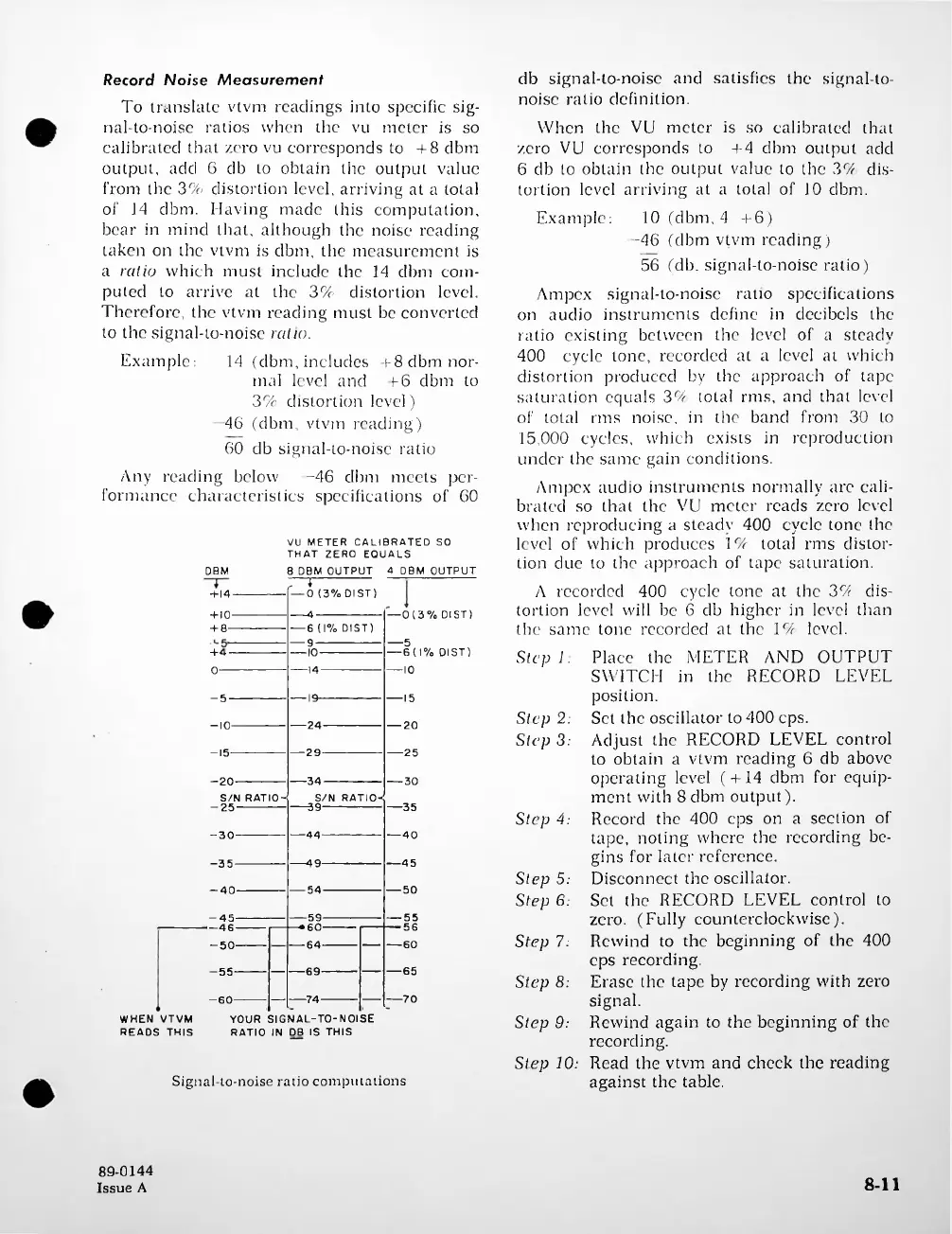
Signal-to-noise
ratio
computations
8-11
Step
5:
Step
6:
WHEN
VTVM
READS
THIS
-74
---------------
YOUR
SIGNAL-TO-NOISE
RATIO
IN
DB
IS
THIS
-5
6(1%
DIST)
■10
55
56
60
Step
2:
Step
3:
89-0144
Issue
A
-45
---------
>-46
--------
-50
--------
-20
----------------
S/N
RATIO-
-25
----------------
----
59-
•60-
64-
34
---------------
S/N
RATIO-
-39
----------------
DBM
4-14
-HO-
4-8-
+
4~
0
VU
METER
CALIBRATED
SO
THAT
ZERO
EQUALS
8
DBM
OUTPUT
7
I
0
(3%
DI
ST)
----
4
-----------------
6(1%
DI
ST)
9
-----------------
----10----------------
----14----------------
4
DBM
OUTPUT
0(3%
DI
ST)
Place
the
METER
AND
OUTPUT
SWITCH
in
the
RECORD
LEVEL
position.
Set
the
oscillator
to
400
cps.
Adjust
the
RECORD
LEVEL
control
to
obtain
a
vtvm
reading
6
db
above
operating
level
(
+
14
dbm
for
equip
ment
with
8
dbm
output).
Record
the
400
cps
on
a
section
of
tape,
noting
where
the
recording
be
gins
for
later
reference.
Disconnect
the
oscillator.
Set
the
RECORD
LEVEL
control
to
zero.
(Fully
counterclockwise).
Rewind
to
the
beginning
of
the
400
cps
recording.
Erase
the
tape
by
recording
with
zero
signal.
Rewind
again
to
the
beginning
of
the
recording.
Read
the
vtvm
and
check
the
reading
against
the
table.
db
signal-to-noise
and
satisfies
the
signal-to-
noise
ratio
definition.
When
the
VU
meter
is
so
calibrated
that
zero
VU
corresponds
to
+4
dbm
output
add
6
db
to
obtain
the
output
value
to
the
3%
dis
tortion
level
arriving
at
a
total
of
10
dbm.
Example:
10
(dbm,
4
+6)
-46
(dbm
vtvm
reading)
56
(db.
signal-to-noise
ratio)
Ampcx
signal-to-noise
ratio
specifications
on
audio
instruments
define
in
decibels
the
ratio
existing
between
the
level
of
a
steady
400
cycle
tone,
recorded
at
a
level
at
which
distortion
produced
by
the
approach
of
tape
saturation
equals
3%
total
rms,
and
that
level
of
total
rms
noise,
in
the
band
from
30
to
15,000
cycles,
which
exists
in
reproduction
under
the
same
gain
conditions.
Ampcx
audio
instruments
normally
arc
cali
brated
so
that
the
VU
meter
reads
zero
level
when
reproducing
a
steady
400
cycle
tone
the
level
of
which
produces
1%
total
rms
distor
tion
due
to
the
approach
of
tape
saturation.
A
recorded
400
cycle
tone
at
the
3
r
/r
dis
tortion
level
will
be
6
db
higher
in
level
than
the
same
tone
recorded
at
the
1%
level.
Step
1.
Record
Noise
Measurement
To
translate
vtvm
readings
into
specific
sig-
nal-to-noise
ratios
when
the
vu
meter
is
so
calibrated
that
zero
vu
corresponds
to
+8
dbm
output,
add
6
db
to
obtain
the
output
value
from
the
3%
distortion
level,
arriving
at
a
total
of
14
dbm.
Having
made
this
computation,
bear
in
mind
that,
although
the
noise
reading
taken
on
the
vtvm
is
dbm,
the
measurement
is
a
ratio
which
must
include
the
14
dbm
com
puted
to
arrive
at
the
3%
distortion
level.
Therefore,
the
vtvm
reading
must
be
converted
to
the
signal-to-noise
ratio.
14
(dbm,
includes
+8
dbm
nor
mal
level
and
+6
dbm
to
3%
distortion
level)
46
(dbm,
vtvm
reading)
60
db
signal-to-noise
ratio
Any
reading
below
-46
dbm
meets
per
formance
characteristics
specifications
of
60

Related product manuals