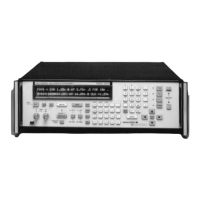
High Performance
Analogic Polynomial Waveform Synthesizers produce
analog signal emulation with more accuracy than other
arbitrary signal generators. A waveform is synthesized
from thousands of data points that are precisely calculated
from a polynomial equation. This includes sums and prod-
ucts of trigonometric LOGs and exponential functions.
All fundamental operations are readily accessible from the
front keypad.
Although the 2020 has a standard 512k-point output
memory, two innovative techniques – Dynamic Looping
and Constant Compression – are used to ensure that mem-
ory space is not exhausted when generating long wave-
forms. Dynamic Looping allows production of periodic
waveforms using real-time looping through portions of
output memory. Because of Constant Compression, DC
values of any required duration use only a few words of
output memory. These methods enable the unit to gener-
ate a close approximation of the complex NTSC-7 com-
posite video test signal, using just a few thousand words
of memory.
To provide the full benefit of 800 MS/s synthesis, both the
2040 and 2045 provide a 1V output with a typical 1 GHz
bandwidth and 500 ps rise time, and 7 ns settling time to
within 1% of final value. The 2040 has a second output,
opposite in phase, for differential applications. The Model
2045 has a 5V output with a 200 MHz bandwidth, a pro-
grammable filter, an attenuator, and a DC offset source.
All outputs retain full 8-bit resolution over the specified
range of amplitude.
High-Speed, High-Quality Signals
These synthesizers guarantee high resolution and linearity
for signal amplitudes from millivolts to full scale by auto-
matically driving the output DAC over its full range and
attenuating the output to the required level. The resulting
wide dynamic range is not affected by even a large DC
offset, as the instrument adds this to the output from a sep-
arate 12-bit DAC. An output amplitude as large as 10V
p–p into 50Ω is available with absolute accuracy better
than 1%. The output doubles with a high-impedance load.
Arbitrary Waveform Generation Made Easy
Complex waveforms required for thorough, effective sim-
ulation and testing can be generated quickly and easily
using Math Equation Entry. With this method, hundreds
of waveform equations can be stored in a non-volatile
waveform equation library and quickly regenerated when
needed.
One instrument can replace a full rack of expensive signal
sources and conditioning gear, and can meet changing test
requirements with new easily defined waveforms.
Family of Polynomial Waveform Synthesizers
2020-25 2020-100 2040 2045
Max. Output Rate
25 MS/s 100 MS/s 800 MS/s 800 MS/s
Optional 1000 MS/s
*
Optional 1000 MS/s
*
Analog Outputs
10V (2V p-p with Diff. Output Opt.) 1V True 5V
(Vp-p into 50Ω)
1V Complement 1V
Vertical Resolution
12 bits 8 bits 8 bits
Output Memory (#points)
64k up to 512k 128k or 512k 512k 512k
2048k (2040B) 2048k (2045B)
Equation Memory
30k or 78k 30k or 78k 78k 78k
Math Co-Processor
Optional Standard
Systems Interface
IEEE-488, with High-Speed DMA IEEE-488 with High-Speed DMA
or RS-232 (all optional) and RS-232 (standard)
* Contact factory for 1000 MS/s option


 To Next Page
 Loading...