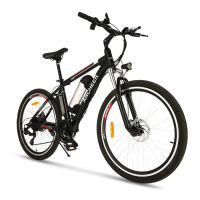
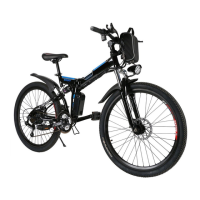
This document is a user manual for an ANCHEER E-bike, providing comprehensive instructions for assembly, operation, and maintenance to ensure safe and effective use. The E-bike is designed to offer a versatile transportation solution, catering to various needs, from daily commuting to outdoor sports and exploration.
Function Description:
The ANCHEER E-bike is an electric bicycle that combines traditional cycling with electric assistance. It is equipped with a motor and a battery, allowing riders to choose between pure electric mode, pedal-assist mode, or traditional pedaling. The electric assistance helps riders cover longer distances with less effort, tackle inclines more easily, and enjoy a more relaxed riding experience. The E-bike is designed for both urban environments and outdoor adventures, offering a balance of performance, comfort, and convenience. Its core function is to provide an efficient and enjoyable mode of transport that reduces physical strain compared to conventional bicycles.
Usage Features:
The ANCHEER E-bike is designed with user-friendliness in mind, featuring several operational modes and controls.
- Assembly: The manual provides detailed, step-by-step instructions for assembling the E-bike. This includes attaching the handlebar, installing the front fender, assembling the front wheel, installing the headlamp, attaching the pedals, and installing the saddle. These steps are crucial for ensuring the bike is set up correctly and safely before its first use.
- Handlebar and Controls Adjustment: After initial assembly, riders are instructed to adjust the angle of the brake rod, meter, gearshift rod, throttle, and horn on the handlebar to suit their ergonomic preferences, ensuring comfortable and safe access to all controls during operation.
- Rear Carrier Assembly: The E-bike also features a rear carrier, which needs to be assembled and securely fastened to the frame. This carrier enhances the bike's utility by providing space for carrying items, making it suitable for shopping or commuting with bags.
- Battery Installation and Operation: A key feature of the E-bike is its battery system. The manual guides users through installing the battery into the rack and locking it securely with a key. It emphasizes the importance of turning on the battery switch before operating the meter.
- Meter Operation: The E-bike is equipped with a meter that serves as the central control interface.
- Power On/Off: To switch the E-bike system on or off, users need to hold the "M" key for 2 seconds.
- Assistance Levels: The meter displays three assistance levels: Low, Mid, and High. These levels correspond to the amount of electric assistance provided by the motor.
- Pedal Assist Mode: Riders can increase the pedal assist level by pressing the "+" button. Pressing it once moves from "Low" to "Mid," and pressing it again moves to "High," which provides the maximum power assistance.
- Full Electric Mode (Pure Electric Mode): To engage the full electric mode, riders need to press the "-" button until all three indicators ("Low," "Mid," "High") are off. In this mode, the E-bike operates solely on electric power without requiring pedaling.
- Battery Indicator: The meter also includes a battery indicator, allowing riders to monitor the remaining charge.
- Charging: The E-bike's battery can be charged both on and off the bike. The charging process is indicated by a RED light, which turns GREEN when fully charged. Users are advised to unplug the charger from the wall once charging is complete, with a typical full charge taking about 6 hours for a completely drained battery. A critical safety instruction is to avoid mixing the charging port with the key port to prevent short circuits or explosions. Users must plug the charger into the battery first, then connect it to the power supply.
- Safety Precautions: The manual highlights several safety cautions, including avoiding collisions, not modifying system parameters to prevent disorder, and ensuring the charging pot is kept dry.
Maintenance Features:
Proper maintenance is essential for the longevity and safe operation of the ANCHEER E-bike. The manual provides specific guidelines for battery care and general bike checks.
- Pre-Ride Checks: Before each ride, especially for long distances, riders are advised to perform several checks:
- Tires: Inspect tires for proper inflation and cracks. Maintaining correct tire pressure helps prevent flats and damage.
- Cables and Housings: Check all cables and cable housings for fraying, breaks, rust, or corrosion, and replace them if necessary.
- Brakes: Ensure both brakes are working properly and inspect brake pads for wear, replacing them as needed.
- Nuts and Bolts: Verify that all nuts and bolts are tight and properly fastened to prevent injury and unnecessary wear.
- Battery Information and Maintenance: The battery is a critical component, and its proper care is emphasized:
- Storage: When storing the battery for extended periods (e.g., during winter), it should be fully charged and placed on a flat, dry surface.
- Recharging During Storage: If the battery is not used for 2-3 months, it should be recharged to maintain its health.
- Safety Warnings: Users are warned to keep the battery out of reach of children and never attempt to dismantle it. In case of damage (e.g., from a fall or accident) leading to electrolyte leakage, immediately stop using the battery due to the risk of chemical burns. Avoid touching the battery with wet hands and ensure no acid contacts the eyes.
- Temperature Control: Do not store the battery in extreme temperatures (above 75°F or below -10°F).
- Charging Habits: Do not allow the battery to run down completely before charging. Charge the battery before storing the product to prevent it from losing the ability to take a charge. For new batteries, charge them for at least 6 hours before the first use. Avoid overcharging or undercharging, as this can shorten battery life and decrease run time.
- Battery Disposal: The manual stresses the importance of environmentally sound disposal or recycling of the battery. It explicitly prohibits disposing of the battery in fire (due to explosion/leakage risk) or regular household trash.
- Charger Care: The battery charger and charging plug must always be kept dry. The charger should only be cleaned with a dry cloth, never with a wet cloth, oil, or any other liquid. Charging time should not exceed 10 hours, and the charger should be kept away from high-temperature environments.
The ANCHEER E-bike is designed to be a reliable and enjoyable mode of transport, and adherence to these instructions will ensure its optimal performance and longevity. For further technical support, including service, maintenance, and repair information, customers are directed to contact their purchasing store's customer service with the order ID or reach out via email. Additional installation and repair instructions can be found by searching "ANCHEER SPORT" on YouTube.

 Need help?
 General

 To Next Page